
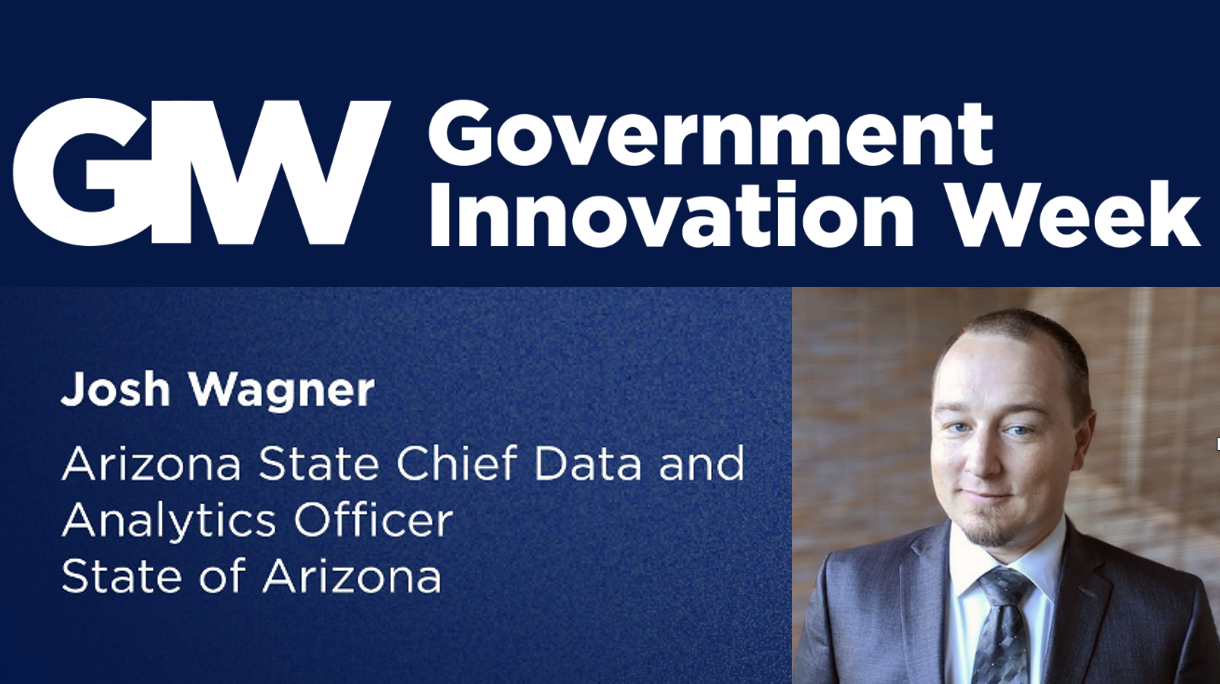
Government leaders are under pressure to move faster. Residents expect simpler services, agencies are being asked to do more with limited resources, and technologies like AI are creating new possibilities almost every month.
But Josh Wagner, Arizona’s State Chief Data and Analytics Officer, brings a clear message to this moment: speed without structure is not real progress.
“Public sector innovation cannot follow the tech industry playbook of moving fast and breaking things. When we break things in government, real people lose access to services they depend on.”
As Wagner prepares to speak at both Public Sector Network’s Government Innovation Showcase New South Wales (Australia) and Government Innovation Arizona (United States), his perspective offers a useful bridge between 2 public sector markets facing the same core challenge: how to innovate quickly while protecting trust, security and service reliability.
Innovation cannot copy the private sector playbook
In the technology sector, innovation is often linked to the idea of “move fast and break things.” Wagner argues that this mindset does not fit government.
When government systems break, the impact is not abstract. People may lose access to housing support, healthcare, identity services, permits, benefits or other essential services. For the public sector, the goal is not simply to launch faster. The goal is to deliver better outcomes without increasing risk for the people who depend on government most.
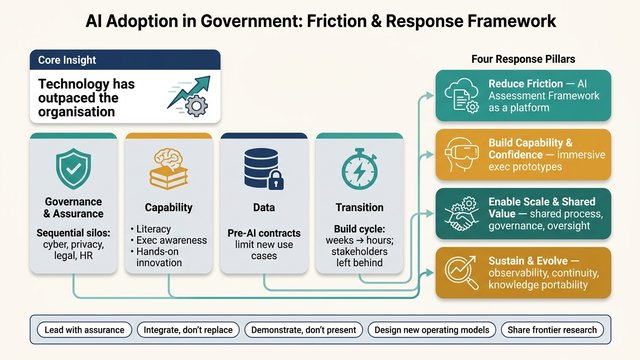
That warning is consistent with what PSN is seeing across the market. In NSW, the Office for AI has identified 4 common friction points slowing safe adoption: governance and assurance, capability, data and transition.
The challenge is not ambition. It is absorption. In NSW, AI can compress a 2 to 3 week service design cycle into a 24-hour prototype, but that speed creates a new problem: stakeholders may not have been brought along quickly enough to trust or evaluate the result.
That is why Wagner’s work focuses on the foundations that make innovation safe to scale: strong data discipline, clear governance, practical security and shared direction across agencies.
Governance is not the brake. It is the operating system.
One of Wagner’s strongest themes is the need to rethink governance.
Too often, governance is treated as a compliance layer added at the end of a project. In that model, it can feel slow, reactive and disconnected from delivery. Wagner’s view is different. Good governance should be designed into the work from the start.
“Real transformation requires building strong governance from the start. Governance is not a bureaucratic hurdle; it is the foundation that gives teams the confidence to experiment safely and move quickly.”
That means agencies need clear rules, clear decision rights and clear boundaries before teams begin experimenting. Done well, governance gives teams more confidence to move, not less. It helps people understand what is safe, what needs approval, where risk sits and how new tools can be used responsibly.
This matters even more as governments adopt AI. AI does not succeed because an agency buys a tool. It succeeds when the data is reliable, the use case is clear, the risks are understood and the people using it know what good looks like.
Data discipline comes before AI ambition
Wagner’s work in Arizona points to a simple but often overlooked truth: AI readiness starts with data readiness.
Arizona has been building stronger data foundations through efforts such as a statewide data catalog, shared language across agencies and policies that encourage responsible data sharing. PSN’s source material describes Arizona’s statewide data catalog as helping build a common language across more than 200 agencies, supporting interoperability and more joined-up service delivery.
The aim is not data management for its own sake. The aim is better service delivery.
When agencies can understand, trust and share data, they can work together on complex problems that do not sit neatly inside one department. Issues like homelessness, public safety, workforce planning and service access require a broader view than any one system can provide.
This is where Wagner’s message becomes relevant beyond Arizona. New South Wales, like many governments, is also navigating how to connect digital services, improve citizen experience and use AI in ways that are useful rather than performative. The lesson is clear: better technology depends on better operating discipline.
Culture is the hard part
Wagner also makes an important point that every public sector leader will recognise: the biggest barrier is rarely the technology itself.
The harder work is cultural. Agencies need trust before they share data. Teams need confidence before they adopt new tools. Leaders need to reward collaboration, not just local control. Frontline staff need to see how innovation helps them do their jobs, rather than feeling like another reform being done to them.
That means data leaders must also be translators. They need to connect technical work to human outcomes. A dashboard is not the win. A new platform is not the win. The win is time saved, duplication reduced, families connected to services, staff freed from manual work and residents receiving support faster.
“Success should be measured by practical impacts like time saved for residents and reduced duplication, not just by launching a new piece of software.”
Why his message matters in both NSW and Arizona
Wagner speaking at both the NSW and Arizona events creates a valuable cross-market conversation.
For Australian public sector leaders, his Arizona experience offers a practical example of how statewide data leadership, governance and AI guardrails can support delivery without losing public trust.
For US leaders, his NSW appearance reinforces that these challenges are not local. Governments around the world are trying to solve the same tension: faster delivery, safer systems and better outcomes.
The common thread is that innovation must be built on discipline. Not bureaucracy for its own sake, but the kind of structure that lets agencies move with confidence.
The takeaway
Josh Wagner’s message is simple and timely: government can move faster, but only if it builds the right foundations first.
Data quality, governance, security and culture are not side issues. They are the conditions that make modern public service possible.
As Wagner joins Public Sector Network audiences in both New South Wales and Arizona, his contribution will help leaders move past the false choice between speed and control. The real opportunity is to design public sector innovation so that speed, trust and accountability work together.
Register here: Sydney, NSW (28-30 Jul) | Phoenix, AZ (01 Oct)














Help your peers
Share what you've learned with fellow public servants