
When Daniel Roelink, Director of the NSW Office for AI, briefed the Public Sector Network industry community recently, one point came through clearly:
AI adoption in government is not really a technology problem.
That may sound odd, given how much of the public conversation is about models, tools and features. But the more we speak with government leaders, the more obvious it becomes. The technology is moving faster than most organisations can absorb. The harder work is organisational: governance, capability, data, operating models and trust.
That is where the real friction sits.
For government, the challenge is not simply “how do we use AI?” It is “how do we adopt AI safely, consistently and in a way that improves public services?”
For industry, the lesson is just as important. Agencies do not need louder AI pitches. They need partners who understand the environment government is operating in, and who can help reduce risk while creating practical value.
The technology has moved faster than the organisation
Frontier AI models are developing at a pace that no large organisation, public or private, can easily keep up with. In government, that gap is even harder to manage because the consequences of getting it wrong are higher.
Public sector organisations need to evaluate opportunity, risk, legality, ethics, privacy, security, procurement, workforce impact and public trust. That is not a small checklist. It is the operating reality of government.
Daniel made the point plainly: the technology has already exceeded many organisations’ ability to absorb it.
This is familiar territory for anyone who has worked in digital transformation. Adoption problems are rarely just about the technology. They are usually about the system around the technology.
AI makes that more obvious because the technology is changing so quickly. There is a temptation to focus on the newest release, the newest demo, the newest model. But government does not need to chase every release. It needs to build the foundations that allow safe adoption at scale.
That means becoming more adaptable, not more distracted.
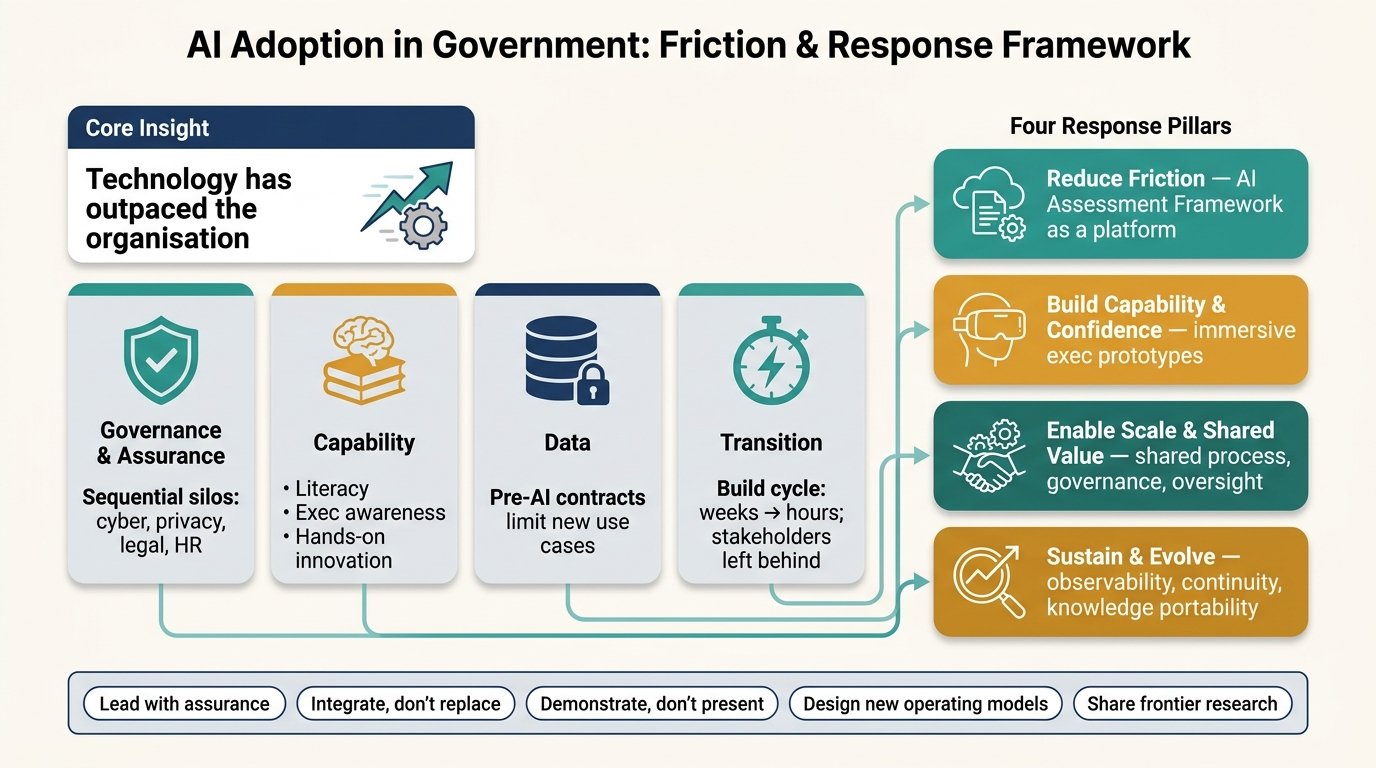
Four friction patterns slowing AI adoption
Across NSW government, Daniel and the Office for AI are seeing four common friction patterns. None of them are about computing power or model quality.
1. Governance and assurance
Government has strong capability in cybersecurity, privacy, architecture, legal, HR and ethics. The issue is that these functions often operate in separate lanes.
When an agency wants to assess an AI use case, the work can move through each area one after another. The same information may be requested multiple times. The process can become slow, repetitive and hard for teams to navigate.
The answer is not to reduce rigour. Government cannot and should not cut corners on assurance.
The better answer is to make the process clearer and more joined up, so the right checks happen without unnecessary duplication. Safe adoption needs good governance, but good governance should help people move, not trap them in process.
2. Capability
AI capability is not one thing. Daniel described three layers that matter.
First, public servants need basic AI literacy. People need to understand what AI is, what it is not, where it can help, and where it can create risk.
Second, senior executives need enough awareness to make decisions in their own business context. They do not need to become technologists. They do need to understand the opportunity, the risk and the organisational implications.
Third, and often missed, is innovation capability. People need safe access to tools so they can test ideas against real work. That is where learning becomes practical.
You cannot build genuine AI capability through slide decks alone. People need to see it, use it, question it and apply it to the problems they actually face.
3. Data
Data is the foundation for serious AI adoption, but government data is not just an asset sitting on a shelf. It is governed by laws, agreements, public expectations, contracts and trust.
Government has traditionally been disciplined about using data only for the purpose it was collected for. That discipline matters. But many agreements were written before AI use cases were realistic.
This creates a practical problem. AI may offer better ways to deliver services, but the data needed to do that may sit behind contracts or consent models that never contemplated AI.
That does not mean government should push ahead without care. It means agencies, suppliers and communities need more honest conversations about how data may be used to improve services, what safeguards are needed, and how those expectations are built in from the start.
Retrofitting trust later is much harder.
4. Transition
This is the friction point that deserves more attention.
AI can compress work that used to take weeks into hours. A traditional service design process might involve workshops, stakeholder engagement, scenario testing and prototyping over several weeks. With AI agents, a team can move from problem statement to working prototype in a day.
That speed is useful, but it creates a new problem. Stakeholders may not have been on the journey.
If the process that normally builds shared understanding gets skipped, leaders can be shown a working prototype without enough context to assess it properly. The output may be impressive, but the organisation may not be ready to interpret it, trust it or govern it.
This is a real change management issue. As AI accelerates delivery, government will need new ways to bring people along without slowing everything back down to the old pace.
Speed is helpful only if the organisation can absorb what has been created.
What NSW is doing about it
The NSW Office for AI is taking a practical approach built around four areas.
Reduce friction. The AI Assessment Framework is being rebuilt from an Excel-based process into a platform. The goal is not just compliance. It is to make the process useful enough that public servants want to use it. A good platform can show legal and ethical requirements, connect teams to similar use cases, and help agencies see what others are doing at different stages.
Build capability and confidence. Literacy programs matter, but immersive executive experiences seem to be especially powerful. When leaders see a working prototype in a context they understand, the conversation changes. It becomes less abstract and more useful.
Enable scale and shared value. Not everything can be shared easily across agencies, especially at the technology level. Different agencies have different systems and architectures. But business process, governance approaches and oversight models are more transferable. That is where shared value may be easier to build.
Sustain and evolve. Once AI is deployed, agencies need observability, feedback, incident response and continuity planning. This matters because AI systems may depend on models that change or disappear within 12 to 18 months. If a system starts to automate important work, government needs to know what happens if that system is no longer available.
That last point is worth underlining. AI adoption is not just about getting a tool live. It is about being able to operate safely once the tool becomes part of the business.
What this means for industry partners
For vendors and partners working with government, the message is simple: lead with the problem government actually has.
That problem is rarely “we need more AI features.” It is more likely to be:
- Can this be assured?
- Can it work with our current environment?
- Can we explain it?
- Can we govern it?
- Can we stop using it if we need to?
- Can it improve a service without creating unacceptable risk?
That changes how industry should engage.
Lead with assurance, not features. Agencies need to see how an AI product or service is ethical, lawful, transparent and manageable. Do not wait for government to ask. Make assurance visible from the start.
Show integration, not replacement. Government has invested heavily in existing systems. A pitch that requires wholesale replacement will be hard to land unless the case is very strong. Better to show how the offer complements what already exists and how the business logic can be carried forward if needed.
Demonstrate, don’t just present. A good prototype in the agency’s context is often more useful than another slide deck. The point is not theatre. It is understanding. Demonstrations help leaders see what is possible and what questions they need to ask.
Think about operating model impact. AI will change roles, processes and decision pathways. Partners who can help agencies think through those implications will be more useful than those who only sell the tool.
Use the right channels. The Office for AI is focused on system-level issues, not advocating for individual products. Established procurement channels and agency relationships still matter. Forums like PSN help government and industry understand each other’s direction, but they do not replace proper procurement.
The bigger lesson
The most useful part of Daniel’s briefing was not that NSW has all the answers. It was the clarity about where the real work sits.
Government AI adoption will not be solved by better demos alone. It will be solved by reducing organisational friction, building confidence, improving data readiness, strengthening assurance and helping people move through change at a pace they can absorb.
That is good news, in a practical sense.
It means this is not a mystery. The work is hard, but it is visible. Government can name the barriers. Industry can respond to them. Communities can be brought into the conversation about trust, data and service improvement.
The question is no longer whether AI will affect public services. It already is.
The real question is whether we build the foundations to use it well.
That is where PSN has a role to play: creating the space for government leaders and industry partners to speak honestly about what is working, what is risky, and what needs to change next.
The practical takeaway is simple: if we want safe AI adoption in government, we need to spend less time admiring the technology and more time fixing the conditions around it.
This article is based on a briefing delivered by Daniel Roelink, Director of the NSW Office for AI, to the Public Sector Network community in May 2026.







Help your peers
Share what you've learned with fellow public servants