
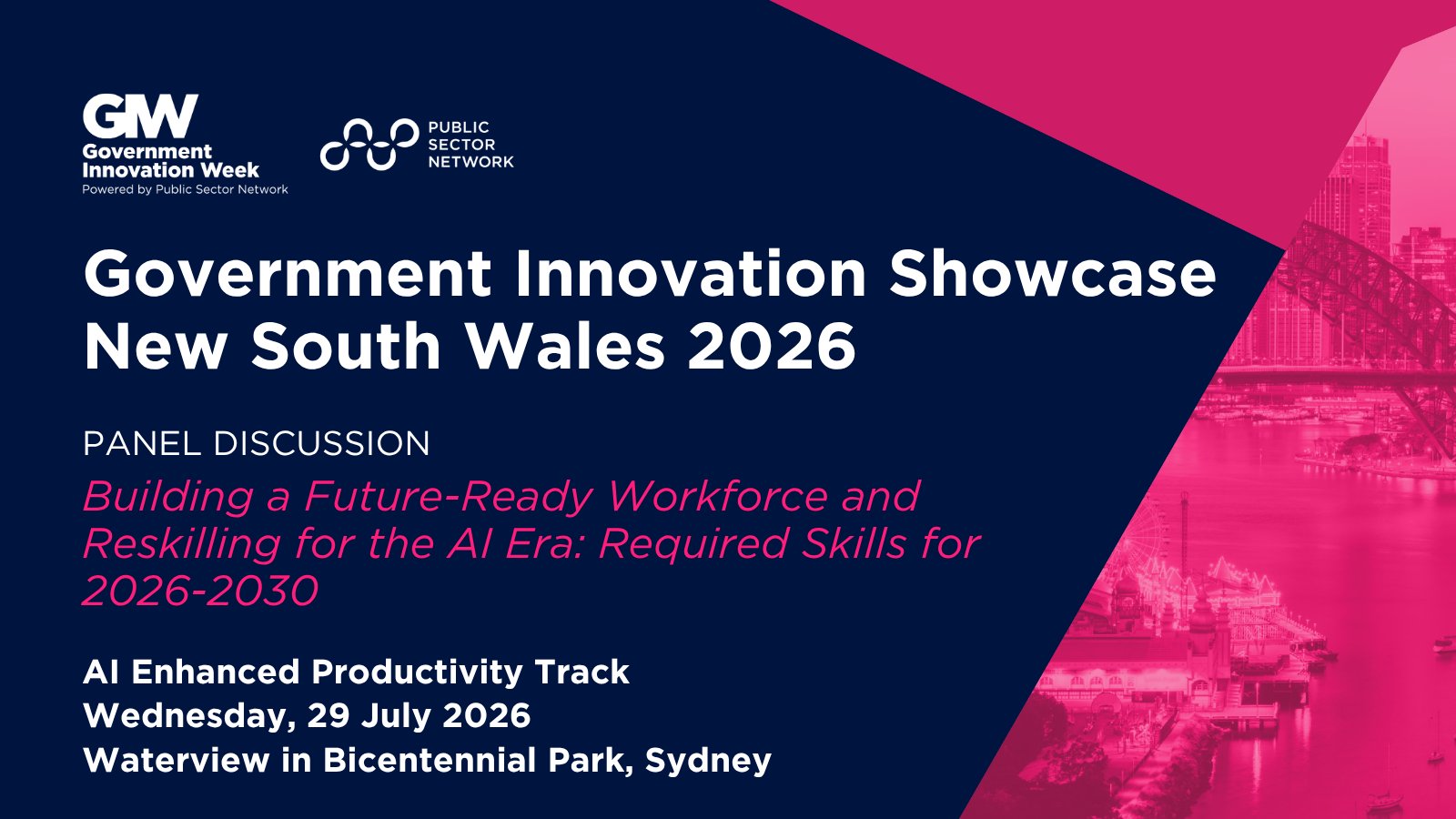
The next phase of public sector transformation will not be defined by artificial intelligence alone—but by how effectively people and AI systems work together in practice.
That is the central premise of the session Building a Future-Ready Workforce and Reskilling for the AI Era: Required Skills for 2026–2030, part of the Government Innovation Showcase New South Wales Sydney 2026. The discussion reflects a growing shift across government: AI is no longer an emerging concept to be explored, but an operational force already reshaping how work is done.
The session brings together senior leaders including Julie Tickle, Jane Lin, and Andrew Spiegelman—each representing a critical lens on workforce, data, and service delivery transformation.
From automation anxiety to augmentation reality
A persistent misconception in workforce conversations is that AI will primarily replace jobs. In practice, the direction of change across government is more nuanced: AI is increasingly being used to augment frontline roles rather than eliminate them.
This distinction matters. In agencies such as Service NSW, AI-enabled tools are already improving productivity by supporting staff with information retrieval, triage, and administrative processing—freeing human workers to focus on judgement, empathy, and complex problem-solving.
The session explores this shift from automation to augmentation, and what it means for workforce design over the next five years.
The emerging “People + AI” operating model
Rather than treating AI as a standalone capability, the discussion reframes it as part of a combined operating model: People + AI.
In this model:
- AI handles pattern recognition, data processing, and repetitive tasks
- Humans focus on interpretation, escalation, decision-making, and service quality
- Productivity gains come from collaboration, not replacement
This approach is becoming increasingly relevant across NSW government agencies, particularly in high-volume service environments where speed, accuracy, and consistency matter—but so does human judgement.
The key question is no longer whether AI will be used, but how seamlessly it is embedded into everyday workflows.
Workforce readiness: skills gaps are becoming structural
One of the most pressing themes in the session is workforce readiness. As AI adoption accelerates, the gap is no longer just technical—it is behavioural and organisational.
Across government, three capability gaps are emerging:
- Digital confidence gap – not all employees are equally comfortable using AI-enabled tools
- Data literacy gap – limited understanding of how to interpret and question AI outputs
- Workflow redesign gap – difficulty rethinking processes around AI-assisted work
The discussion highlights that successful adoption depends less on technology deployment and more on how people are supported to use it confidently and responsibly.
Upskilling without overwhelming the workforce
A critical challenge for public sector leaders is scaling capability without creating resistance. AI adoption often fails not because of poor tools, but because of low trust, unclear use cases, or insufficient training.
The session focuses on practical approaches to addressing this, including:
- Targeted capability building rather than broad, generic training
- Embedding AI skills into existing roles instead of creating separate “AI teams”
- Encouraging experimentation in controlled environments
- Reducing fear by clarifying what AI is—and is not—being used for
This reflects a broader shift in workforce strategy: from training as an event to capability as an ongoing system.
Why this matters now
The 2026–2030 horizon is a critical transition period for government workforces. AI is moving from pilot programs into mainstream operations, while workforce expectations are simultaneously shifting.
Three forces are converging:
- Rising service demand and complexity
- Tight labour markets and capability shortages
- Rapid acceleration of AI-enabled tools in everyday workflows
Together, these forces are reshaping what “readiness” means. It is no longer just about digital skills—it is about adaptability, data confidence, and the ability to work effectively alongside intelligent systems.
Linking strategy to action: why training matters
The themes in this session are directly reinforced by upcoming capability development opportunities such as the AI for NSW Public Sector Leaders: Strategy, Governance & Practical Application Training program.
That training focuses on translating AI strategy into practical governance and operational action—helping leaders move from conceptual understanding to implementation readiness. It complements the workforce discussion by addressing a critical gap: how to actually govern, deploy, and manage AI responsibly in public sector environments.
Final insight
The future public sector workforce will not be defined by how much technology is adopted, but by how effectively people and AI systems are integrated into everyday work.
The organisations that succeed will be those that:
- Treat AI as a workforce partner, not just a tool
- Invest in continuous capability building, not one-off training
- Redesign work around augmentation, not automation
- Build trust, clarity, and confidence across all levels of staff
In this context, workforce transformation is no longer a support function—it is becoming a core driver of public sector performance.
Next step towards workforce readiness starts here:
Free for government to attend the Innovation Showcase on 29 Jul 2026 at Waterview in Bicentennial Park, Sydney. Register now: https://publicsectornetwork.com/psnplatform/accounts/event_register/government-innovation-showcase-nsw-2026
Save at least $200 with Early Bird discount(s) until 24 July when you register to our in-person course AI for NSW Public Sector Leaders: Strategy, Governance & Practical Application, facilitated by AI Governance expert Waqas Khan, happening on 30 September 2026.





Help your peers
Share what you've learned with fellow public servants