
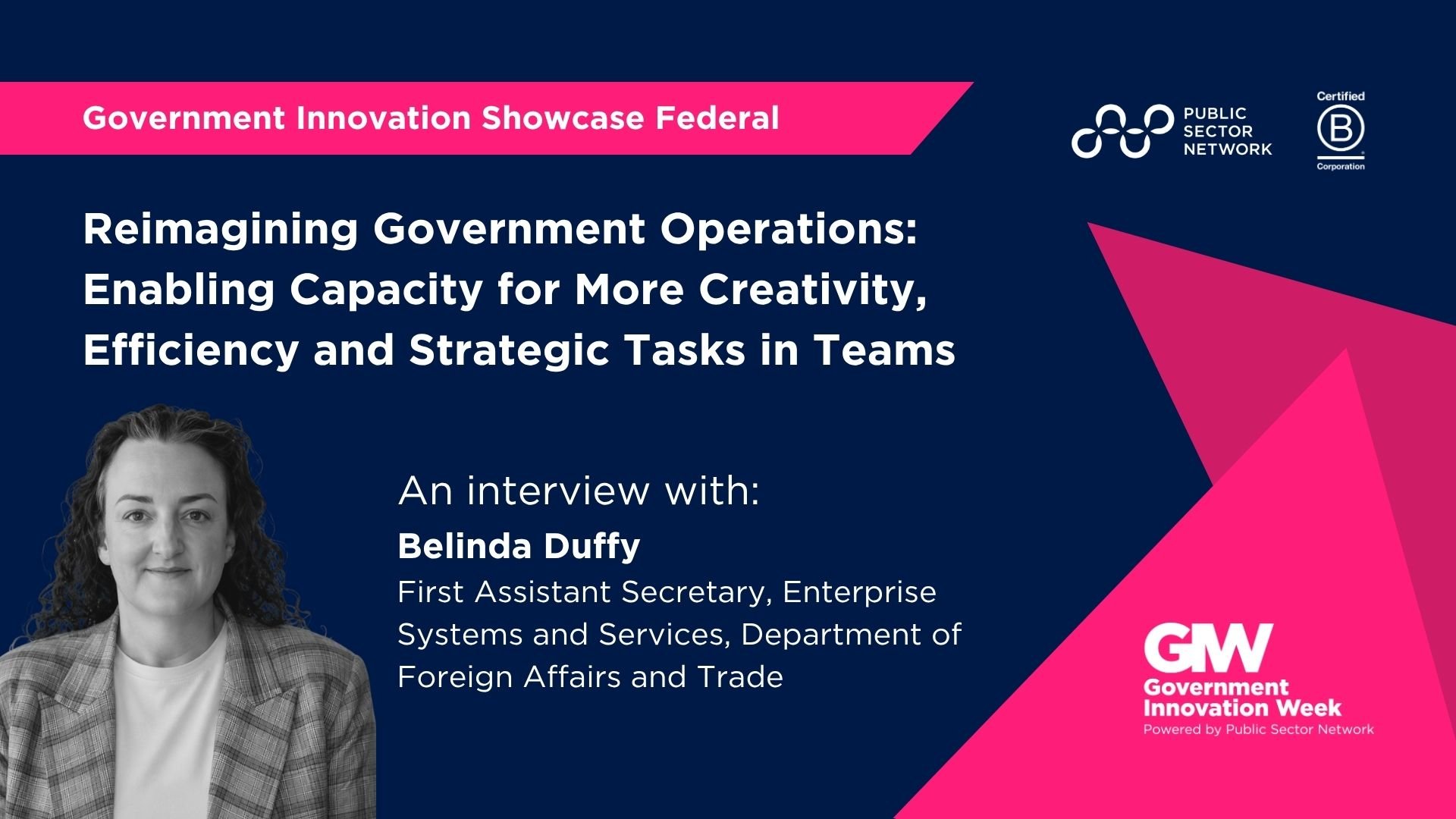
As AI adoption matures across government, the conversation is moving beyond individual tools and isolated pilots.
For Belinda Duffy, First Assistant Secretary, Enterprise Systems and Services, Department of Foreign Affairs and Trade, the more important question is how AI changes the way work itself is designed.
Ahead of Government Innovation Showcase Federal 2026, Public Sector Network spoke with Belinda about operating models, existing capabilities government may be overlooking, the move from pilots to scalable delivery, and how agencies can balance automation with accountability.
Belinda will continue this discussion at the Showcase in the AI Enhanced Productivity fireside chat “Reimagining Government Operations: Enabling Capacity for More Creativity, Efficiency and Strategic Tasks in Teams.”
She will be joined by Nicky Bell, General Manager, Data Sourcing, Australian Bureau of Statistics, for a conversation on workforce capacity, intelligent automation and deciding which tasks should remain with people and which can be supported by AI. The session takes place from 11:40 AM to 12:00 PM on Thursday, 22 October.
Q&A with Belinda Duffy
Public Sector Network: Our agenda stream explores AI, emerging technologies and new models of public service delivery. What is the most significant shift you are seeing in government innovation?
Belinda Duffy:
The shift I’m observing is from treating AI as a project to treating it as an operating model decision.
Early conversations were about the tools: chatbots, automation of single processes. The real shift now is agencies asking a more structural question: which tasks are inherently deterministic, rules-based, auditable and appropriate to automate, and which are genuinely probabilistic and judgement-based, where a human needs to own the accountability?
This reframing changes procurement, workforce design and governance all at once, rather than bolting AI onto existing processes.
Public Sector Network: Where do you believe government is still underutilising existing tools, technologies or capabilities?
Belinda Duffy:
There are a few areas that stand out to me.
The first is data government already has. We chase new AI capability while sitting on enterprise data that is poorly modelled or siloed. The governance and architecture groundwork is less exciting than AI pilots, but often the precondition for most of the productivity gains at scale.
The second is existing governance machinery. We already have mechanisms for accountable authorities’ obligations, including the PGPA Act and PSPF, that provide a framework for risk-based decision-making.
We sometimes build entirely new governance structures from scratch instead of extending what already exists. This can slow adoption and create duplication.
We also underutilise existing technologies that have the potential to deliver greater automation and outcomes if designed appropriately.
For example, leveraging workflow, business rule and integration capabilities together has the potential to solve a common problem where systems become overly rigid or difficult to change as a consequence of an over-configured or over-specified business process.
Keeping components simple and applying business rules or specifics through encapsulated linked capabilities can offer greater flexibility.
Public Sector Network: How can agencies move from promising pilot initiatives to practical, scalable delivery?
Belinda Duffy:
Pilots sometimes fail because they’re centred around technology rather than an accountable business owner, are assessed on technical success rather than business productivity, risk and outcomes, or don’t have an identifiable pathway beyond seed funding.
These types of initiatives need to be appropriately framed from the beginning rather than trying to “productionise” a system by stealth or run a proof of technology that then looks for a business problem to solve.
The business case needs to be solid and able to survive contact with the budget process.
Public Sector Network: What does effective governance look like when teams are seeking to innovate quickly while maintaining appropriate oversight and accountability?
Belinda Duffy:
Effective governance should draw a clear line at the point of consequence.
Automate confidently up to the point where a citizen-facing service, an individual’s entitlement, or an agency’s accountability are reached.
That means:
- business functions and tasks should be classified by risk, not the technology
- in the case of AI and automated decision-making, there needs to be clarity on who the accountable officer is if an AI-assisted decision is wrong
- assurance should scale with risk, rather than applying a single heavy oversight process to everything
- governance forums should actually make decisions, rather than becoming communication-only forums disguised as governance
Public Sector Network: What is one idea you hope attendees take away from your session?
Belinda Duffy:
The service delivery and workforce decision isn’t “humans versus AI” it’s a design decision about where judgement and accountability sit and building the foundations before scaling that support sustainable capacity gains.
Reimagining Government Operations
That distinction between automation and accountability sits at the centre of Belinda’s upcoming session at Government Innovation Showcase Federal 2026.
The fireside chat “Reimagining Government Operations: Enabling Capacity for More Creativity, Efficiency and Strategic Tasks in Teams” will explore how emerging technology can free workforce capacity while keeping human judgement, governance and accountability in the right places.
Belinda and Nicky Bell will discuss:
- unlocking workforce capacity and efficiency through emerging technology
- deciding which tasks should stay with people and which can be supported by AI
- balancing automation with human judgement and accountability
- using AI in a supportive role to improve operational efficiency and service delivery
- modernising legacy processes through intelligent automation
The session forms part of the AI Enhanced Productivity track, which is designed for leaders across operations, workforce, finance and functional areas looking at how AI can augment decision-making and create more capacity for higher-value work.
Part of Government Innovation Showcase Federal 2026
Government Innovation Showcase Federal brings together public sector leaders and practitioners for a full day focused on the practical changes already underway across AI, data, digital services, technology and workforce capability.
The program opens with a Ministerial Address and senior government keynotes before moving into four dedicated tracks: Digital Services, CX and AI Innovation, Technology, Data and AI Integration, AI Enhanced Productivity, and ACT Digital Futures.
Across the day, attendees can move between sessions covering responsible AI adoption, digital service reform, data integration, productivity, governance, workforce capability and the shift from experimentation to operational delivery.
For Federal Government teams working through where AI should sit in everyday operations, Belinda’s session offers a useful lens: start with the work, the accountability and the outcome, then decide where technology can genuinely add value.
Government Innovation Showcase Federal 2026 takes place on Thursday, 22 October 2026 in Canberra. Registration is complimentary for Public Sector Network members with a government or academic email address.

![Charting the future: The impact of DTA's work agenda on agencies and suppliers in the near and mid term [Webinar]](https://cdn.publicsectornetwork.com/thumbnails/insight/feature_images/LI_Event_Banner_2_6bd9e9.jpg.640x360_q85_autocrop_crop-center.jpg)



Help your peers
Share what you've learned with fellow public servants