
For government, the productivity opportunity from AI is about more than doing the same work faster.
It is also about reducing the friction around work, helping people access information more easily and creating more time for judgement, collaboration and problem-solving.
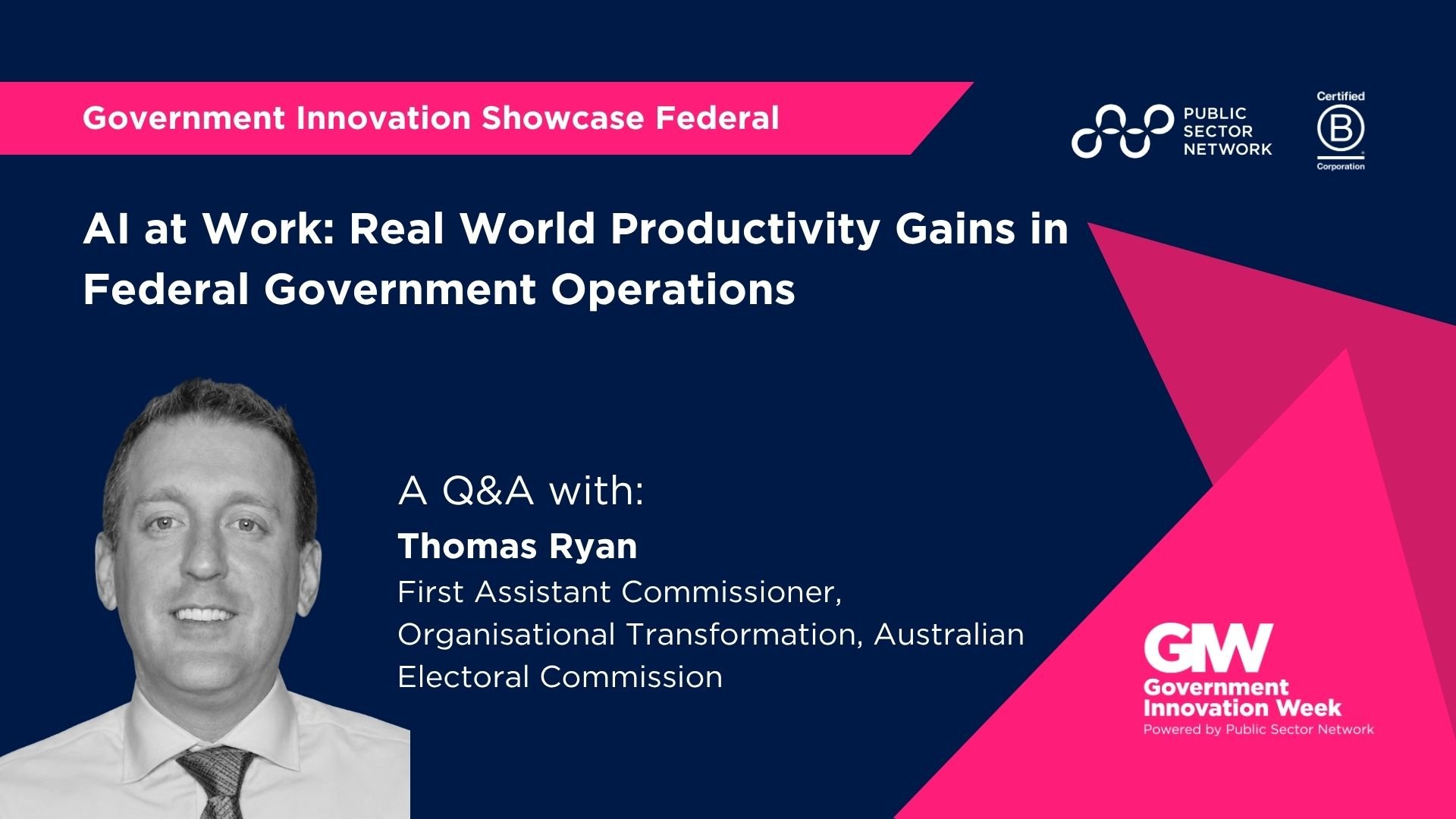
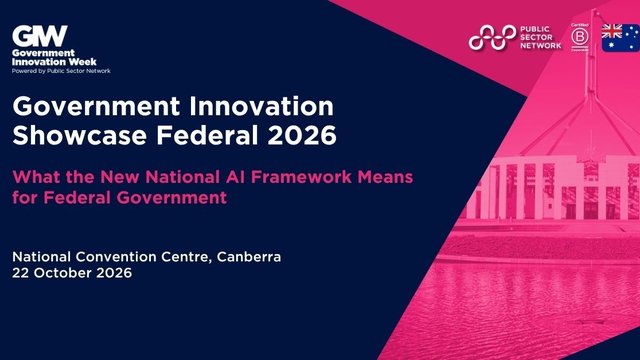
That is the perspective of Thomas Ryan, First Assistant Commissioner, Organisational Transformation, Australian Electoral Commission, who will speak at Government Innovation Showcase Federal 2026 as part of the AI Enhanced Productivity track.
Ahead of the event, Public Sector Network spoke with Thomas about how the AEC is approaching AI, the lessons major transformation programs can offer for adoption, how productivity should be measured and why trust must remain ahead of efficiency in high-integrity government environments.
Thomas will continue the conversation in the fireside chat “AI at Work: Real World Productivity Gains in Federal Government Operations”, alongside Jade Carson, Chief Information Officer, National Library of Australia.
The session takes place from 1:10 PM to 1:30 PM on Thursday, 22 October and will examine how government organisations can use AI to augment workforce capability, reduce administrative burden and create more meaningful, higher-value work.
Explore the event: Government Innovation Showcase Federal overview | Register now
Q&A with Thomas Ryan
Public Sector Network: In your role leading organisational transformation at the AEC, how are you thinking about AI as a tool to improve productivity while supporting the integrity and reliability of electoral services?
Thomas Ryan:
For me, AI is fundamentally about helping our people do their jobs better.
At the AEC, we're responsible for some of the most trusted functions in government, so we can't approach AI as a technology experiment. We have to approach it as an organisational capability that helps our workforce spend less time on administration, searching for information and repetitive tasks, and more time on decision-making, problem-solving and delivering electoral services.
The key is that productivity can never come at the expense of integrity.
If you're responsible for maintaining public confidence in democratic processes, trust has to come before efficiency every time.
That's why we've deliberately invested in governance, accountability and approved tools while exploring where AI can genuinely make a difference for our staff.
We prefer to be the fast follower rather than the first mover.
Public Sector Network: Your work has included major modernisation efforts such as Program Indigo. What lessons from that transformation are most relevant when moving AI from experimentation into scalable, embedded use?
Thomas Ryan:
One thing Program Indigo reinforced for me is that technology is often the easiest, but still difficult and complex, part of transformation.
The hardest part is bringing people with you, changing behaviours, building capability and embedding new ways of working.
We learned very early that delivering a platform doesn't automatically create value. People need to understand why change is happening, how it benefits them and how it supports organisational outcomes.
I think we're seeing exactly the same thing with AI.
Everyone is excited about the technology, but the real challenge is moving beyond pilots and proving tangible value at scale.
The agencies that will succeed are the ones that focus on adoption, capability uplift and business outcomes rather than simply deploying another tool or expending tokens at pace.
Public Sector Network: Where do you see the biggest opportunities for AI to augment public sector teams and create more meaningful, high-value work rather than simply automate existing processes?
Thomas Ryan:
I don't think the biggest opportunity is replacing work.
I think it's removing the friction around work for both public servants and the clients and citizens they serve.
Across government, we've got talented people spending significant amounts of time preparing documents, researching information, synthesising material and navigating complex processes. There is a lot of administrivia, as I call it. Some necessary, some not.
Those activities are important, but they're not necessarily where our people add their greatest value.
If AI can help us reduce some of that effort and better match capacity to demand, then our people can spend more time collaborating, engaging with stakeholders, solving problems and making decisions.
That's where public servants make the biggest contribution.
In many ways, I see AI as giving people back time to focus on the work that only humans should do and can do well.
Public Sector Network: How should agencies measure AI-enabled productivity beyond faster processes, including workforce outcomes, service improvements and the quality of decision-making?
Thomas Ryan:
I think we risk underselling AI if we only measure productivity through efficiency metrics.
Faster processes are important, but they're only part of the story.
For me, the more interesting questions are whether staff are spending more time on higher-value activities, whether services are improving, whether decisions are more informed and whether organisational knowledge is becoming easier to access.
In the public sector, success isn't simply about doing things faster.
It's about delivering better outcomes for citizens, creating a better experience for staff and making more informed decisions.
If AI helps us achieve those things, then that's a far more meaningful productivity dividend than just counting hours saved.
Public Sector Network: In high-trust operational environments, what governance principles should guide AI use to maintain fairness, privacy, transparency and accountability?
Thomas Ryan:
I often say that governance isn't the price we pay for innovation; it's what allows innovation to occur safely.
In trusted institutions, people need confidence that technology is being used responsibly and that someone remains accountable for outcomes.
I call these guardrails.
For me, the principles are relatively straightforward.
Humans remain accountable. Privacy and security must be baked in from the start. Agencies need transparency around how AI is being used. Risks need to be understood and actively managed. And there needs to be ongoing assurance that the technology is operating as intended.
If you get those foundations right, governance becomes an enabler rather than a barrier.
Public Sector Network: Looking ahead, what capabilities do agencies need to build across technology, data, people and governance to ensure AI delivers practical productivity gains while maintaining human judgement and public trust?
Thomas Ryan:
When I look across government, the agencies getting the most value from AI aren't necessarily the ones with the most advanced technology.
They're the ones investing across the whole system.
They have strong technology foundations, trusted data, capable people and mature governance.
You can't shortcut any of those elements.
Technology without governance creates risk. Governance without capability slows progress. Data without quality creates poor outcomes.
Ultimately, AI is not a technology challenge alone. It's a leadership challenge and an organisational capability challenge.
The agencies that recognise that will be best placed to realise long-term value.
Public Sector Network: What value do you see in bringing leaders from across government together at events like Government Innovation Showcase to share what's working, compare lessons and learn from one another?
Thomas Ryan:
One of the things I've always appreciated about the APS is the willingness to share lessons and support one another.
We call this stewardship, and Indigo Program people take this seriously.
No agency has all the answers when it comes to emerging technologies, and we're all navigating similar challenges around productivity, capability, governance and workforce transformation.
Forums like this give us the opportunity to move beyond theoretical discussions and learn from real experiences, both successes and failures.
I've often found that some of the most valuable insights come from hearing how another agency approached a problem we're facing ourselves.
The pace of change is simply too fast for organisations to learn in isolation.
We will move further and faster if we continue learning together.
AI at Work: Real World Productivity Gains in Federal Government Operations
Thomas's interview reflects the central question behind his upcoming fireside chat: what does AI-enabled productivity actually look like when it moves beyond experimentation and becomes part of everyday government operations?
Together with Jade Carson, Chief Information Officer, National Library of Australia, Thomas will examine practical AI use cases, what it takes to embed solutions at scale and how agencies can measure impact beyond simple efficiency gains.
The discussion will focus on:
- real-world AI applications improving productivity and service delivery
- moving from experimentation to scalable, embedded AI
- measuring workforce outcomes, productivity gains and service improvements
- maintaining fairness, privacy and explainability as automation increases
The session forms part of the AI Enhanced Productivity track, designed for operational, workforce, finance and functional leaders examining how AI can streamline processes, augment decision-making and unlock workforce capacity.
Productivity is more than time saved
A consistent theme throughout Thomas's responses is that government should be careful not to define AI productivity too narrowly.
Hours saved matter. But so does what happens with those hours.
Can public servants spend more time engaging with citizens and stakeholders? Are decisions better informed? Is organisational knowledge easier to access? Are staff able to concentrate on the judgement-intensive work that technology cannot replace?
Those are increasingly important measures as agencies move from AI pilots towards more embedded use.
They also speak to the broader focus of Government Innovation Showcase Federal 2026, where the conversation has shifted from whether government should adopt technologies such as AI to how they can be scaled responsibly and translated into enduring organisational change. The wider program spans AI, data, digital services, technology integration, workforce capability and responsible adoption.
Across four dedicated tracks, attendees will hear from leaders across government about practical implementation, service transformation, governance, workforce readiness and the foundations required to deliver AI and digital innovation at scale.
For Thomas, the underlying principle remains straightforward: technology needs to support people and outcomes, not become the outcome itself.
And in high-trust environments such as the AEC, the productivity dividend only matters if confidence and integrity are maintained along the way.
Government Innovation Showcase Federal 2026 takes place on Thursday, 22 October 2026 in Canberra. Registration is free for government attendees.
Explore the event: Government Innovation Showcase Federal overview | Register now




Help your peers
Share what you've learned with fellow public servants