
When Senator Katy Gallagher rose to circulate Budget Paper No. 4 on 12 May 2026, she wasn’t just tabling numbers. She was presenting the clearest articulation yet of what the Albanese Government believes the Australian Public Service should look like - and what it needs to become.
The headline figure is $833.3 billion in total agency resourcing across the General Government Sector. But the more consequential story is structural. This is a budget that invests in the machinery of government itself: in the people, systems, and capabilities needed to run the APS at a moment when the world (and what citizens expect from government) has changed profoundly.
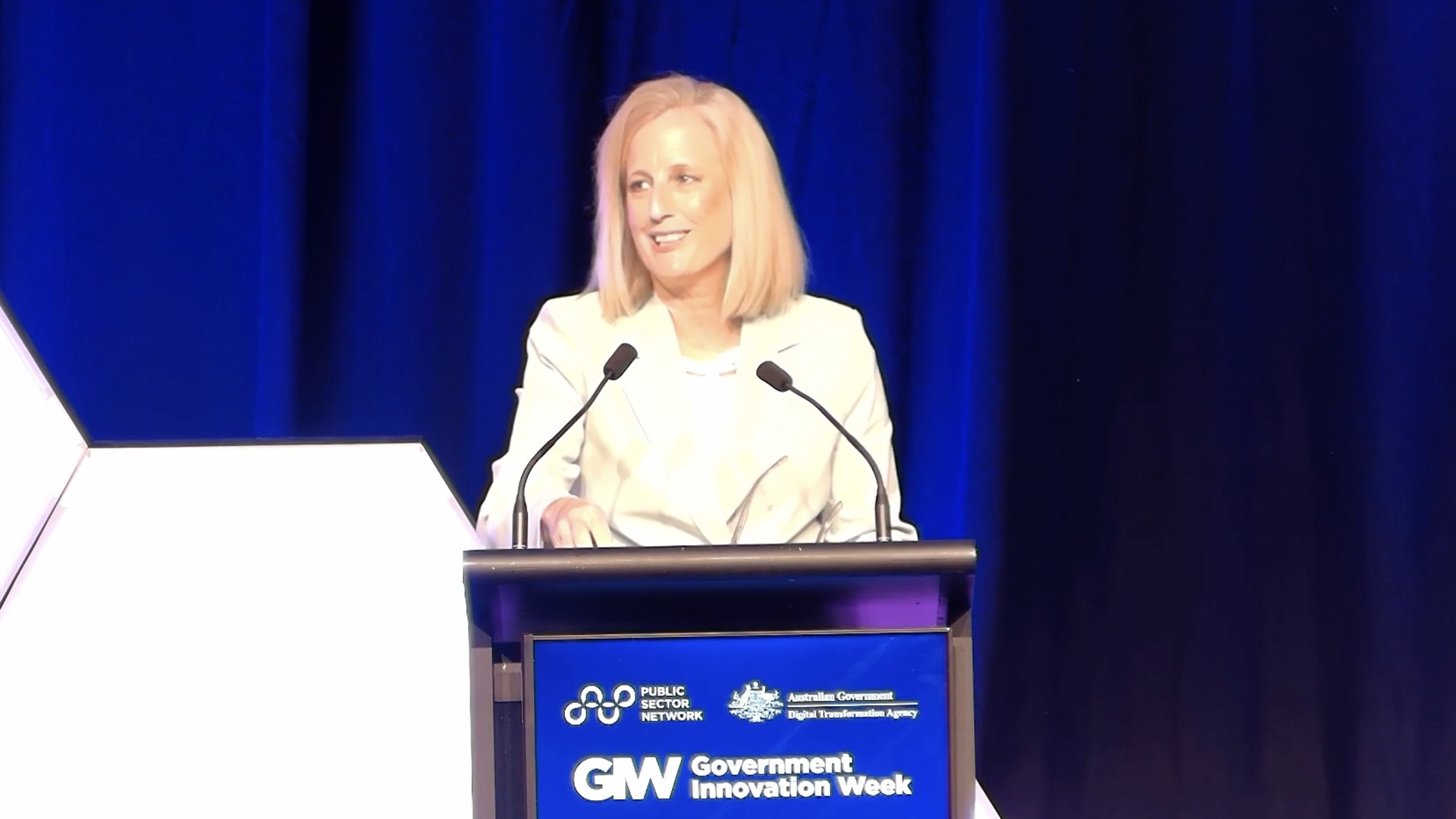
For those who have been following this agenda closely, the budget is the culmination of a reform program that Senator Gallagher has been building publicly since she took office. Speaking at a Public Sector Network event late last year (watch full video here), she laid out the intellectual foundation with characteristic directness: the APS had been hollowed out, and the work of rebuilding it was both urgent and unfinished.
“After years of attacks on the APS, where small government resulted in a diminished Service, where jobs were outsourced, where deep history and knowledge were ignored or eroded — we needed to do things differently.” — Senator the Hon. Katy Gallagher (speaking at GIW Federal 2025) |
The 2026–27 budget is the financial expression of that determination. For the 200,000+ public servants navigating this landscape - and the private sector organisations working alongside them - it is not background reading. It is the operating manual for the next twelve to eighteen months.
A Service Being Rebuilt From the Inside
The single most defining characteristic of this budget (and of the Government’s approach since 2022) is the deliberate, systematic effort to rebuild the APS as an institution capable of doing its own work.
Since the Albanese Government abolished the Average Staffing Level cap in its first term, more than 13,200 new public service roles have been created as a direct result of converting previously outsourced work. This budget adds nearly 1,400 more in 2026-27 alone, including 1,250 frontline service delivery roles at Services Australia.
To understand why this matters, it helps to understand the scale of what had gone wrong. When Gallagher’s team came to government in 2022 and completed their Audit of Employment, the picture was stark - and by the Minister’s own account at the PSN event, genuinely shocking.
“$20.8 billion in external labour - the equivalent to a shadow workforce of more than 50,000 people. On average, agencies spent approximately one in every $4 on external labour. That was money that was leaving the APS when, in many cases, it could have been spent on permanent employees and good jobs across the public service.” — Senator the Hon. Katy Gallagher (speaking at GIW Federal 2025) |
The Government’s argument, which Budget Paper No. 4 makes explicit, is that this created risk: to accountability, to institutional knowledge, and to the public interest. The answer is not just to bring that work back in-house, but to build a service genuinely capable of doing it.
NEW APS ROLES SINCE 2022 13,200+ Created by converting previously outsourced work - around one-third of total APS headcount growth |
That ambition is reflected in the establishment and permanent funding of Australian Government Consulting (AGC) - the APS’s own in-house consultancy, now scaling to 150 staff and 160 projects per year. The appetite for this model, it turns out, was always there. When the pilot opened its first round of recruitment, the response was overwhelming.
“There were over 900 applications for just a handful of positions in the first rollout - this is work that would almost definitely have been given to consultants.” — Senator the Hon. Katy Gallagher (speaking at GIW Federal 2025) |
AGC has already delivered over 40 projects for 16 agencies, with a client satisfaction score approaching 90 per cent. Its clients rate it better or much better than private sector consultants 80 per cent of the time. For the large advisory firms that have historically anchored their government practice around strategy and organisational work, this is not an abstraction. A further $2.7 billion in savings from reducing external labour is targeted for 2029–30, and new procurement rules require agency heads to apply greater scrutiny over contracts exceeding $2 million.
The Strategic Commissioning Framework - announced by the Minister and referenced extensively in this budget - makes the policy direction explicit: core functions such as drafting Cabinet submissions, leading policy development, or occupying executive roles must never be outsourced. Agency heads are accountable for rebalancing their workforces and must set and report targets publicly.
AI: From Pilot to Mandate
If the insourcing story is the structural shift of this budget, the AI story is the capability shift. And unlike many government technology announcements, this one comes with teeth.
The APS AI Plan is now being implemented through a centralised AI Delivery and Enablement function in the Department of Finance. GovAI Chat - giving every public servant access to AI capabilities in a government-managed environment - is the operational vehicle. Mandatory training is being rolled out. Adoption is tracked, reported, and embedded into governance.
The philosophical grounding for this approach was visible in an early signal the Gallagher Government sent at a PSN event: the very first Long Term Insights Briefing - commissioned by PM&C and covering the entire APS - was on a single question: ‘how might artificial intelligence affect the trustworthiness of public service delivery?’ The choice of topic was deliberate.
“Empathy and human connection are a crucial aspect of so many parts of APS service delivery. The role of the public service is not only to respond to near-term challenges, but also to think beyond the electoral cycle and prepare for the complex policy challenges that lie ahead.” — Senator the Hon. Katy Gallagher (speaking at GIW Federal 2025) |
That framing - AI as a capability question inseparable from values and trust - now runs through the entire budget. The evidence base being built is already substantial. The Department of Veterans’ Affairs is trialling an AI tool to extract key information from large claims documents, a task that previously contributed to a backlog once sitting at 42,000 cases. The Australian Taxation Office uses AI in myTax to provide real-time prompts that help taxpayers identify errors before lodgement. IP Australia is making the trademark system more accessible for small business. The National Library is using AI to transcribe 58,000 hours of oral history recordings.
These are not novelty projects. They are early proofs of a proposition that the Government is now committing to at scale: that AI, embedded thoughtfully and governed responsibly, makes the APS faster, more accurate, and better at serving Australians. What this creates (for agency leaders, SES officers, and senior practitioners) is an urgent need for practical peer intelligence. Not vendor pitches. But real conversation about what responsible adoption actually looks like inside a government agency.
Australia’s Digital Government Moment
There is a headline in this budget that deserves more attention than it has received. For the first time, Australia is ranked second globally on the OECD’s 2025 Digital Government Index - behind only Denmark, and ahead of the United Kingdom, the United States, and every other major economy.
The OECD specifically highlights the strength of Australia’s digital service delivery, national coordination, and focus on designing services around citizens’ needs. This is not a ranking based on technology investment alone. It reflects institutional maturity: the way government thinks about digital, not just the tools it uses.
The underpinning philosophy was articulated clearly by the Minister at PSN: Digital ID, she explained, was designed with ‘the Australian people front of mind’ - making it easier for citizens to engage with government while protecting their identity. That same citizen-centred design intent now runs through myGov (receiving $26.5 million to improve digital access and account security), My Health Record (covering 24.6 million Australians), and the broader Data and Digital Government Strategy.
OECD DIGITAL GOVERNMENT RANKING #2 Globally Australia ranked second in the world on the OECD 2025 Digital Government Index - behind only Denmark |
Services Australia - which processes $260 billion in payments annually - received a $1.7 billion investment in this budget. The results are measurable: aged care claims now take 14 days on average, down from 51. Disability Support Pension claims take 42 days, down from 109. Paid Parental Leave claims take 6 days, down from 31.
Security, Resilience, and the Changed World
The budget is also a document shaped by events. The Bondi terrorist attack on 14 December 2025, a global conflict that triggered a fuel crisis, cyclones, floods, and bushfires - Budget Paper No. 4 does not euphemize the environment the APS is operating in.
Since 2022, over 8,250 additional roles have been created in national security agencies. The 2026–27 budget adds $53 billion over ten years for Defence, substantial new investment in the AFP, DFAT, Home Affairs, AUSTRAC, and border protection, and launches the Defence Delivery Agency on 1 July 2027.
DEFENCE INVESTMENT $53 Billion Over 10 years from 2026–27, including $14B in the next four years, under the 2026 National Defence Strategy |
The National Fuel Security Reserve, the Fuel and Fertiliser Security Facility, and a raised Minimum Stockholding Obligation reflect a Government taking supply chain vulnerability seriously. For the public servants managing these portfolios - and the vendors and partners supporting them - this is a budget that says the environment is not improving. National resilience is not a theme. It is an operational requirement.
Integrity, Fraud, and the Accountability Premium
A thread running through the entire budget (and a defining pillar of the reform program Gallagher outlined at PSN) is integrity. The Government’s four-pillar APS reform framework places integrity first, and the budget reflects that priority.
The Fraud Fusion Taskforce, which brings together 24 agencies to address NDIS fraud and serious non-compliance, is now a permanent function. To date it has resulted in 28 successful prosecutions and over 200 NDIS providers and individuals banned, suspended, or deregistered. Medicare is receiving a new permanent integrity function. The ATO’s Counter Fraud Strategy enters Phase 2. The Commonwealth Fraud Prevention Centre is made ongoing.
For the data, analytics, and compliance technology sector, this creates clear procurement signals. Cross-agency data integration, real-time payment controls, and fraud detection at scale are areas where government capability alone is insufficient and where the right vendor partnerships are actively sought.
The Capability Gap; and the Work Still to Do
One of the most candid moments in the Minister’s PSN speech was her acknowledgement that rebuilding the APS is a long game - and that the capability erosion of the past decade cannot be reversed in a single term.
“The internal capability of the APS has eroded, particularly over the last 10 years, and one of the main symptoms of that has been the increased reliance on consultants and contractors. There is always more that can be done. But not everything can be done at once. And it is equally important to do things well and to deliver on the promises we’ve made.” — Senator the Hon. Katy Gallagher (speaking at GIW Federal 2025) |
The budget reflects that honesty. Capability Investment Fund bids are now open, with $6.5 million available to agencies for sector-wide capability projects. Priority areas include data analytics and policy integration, AI application in the public service, building capability for working in Asia and the Pacific, and cultural and psychological safety in the workplace. These are not marginal items. They are the building blocks of a more capable service.
The APS has completed its first four future-focus capability reviews - Infrastructure, APSC, Health, and Agriculture were the pioneers - with more to come. The Minister has been explicit that these reviews are not punitive or budget-related but focused on continuous improvement. Common themes have already emerged: workforce planning, strategic advice, using data better, and technology. The same four challenges that appear in almost every government transformation conversation worldwide.
What This Means for the Market
For organisations working in or selling to the Federal government in 2026-27, the budget maps a clear landscape of growth and contraction.
Where the market is growing:
- Technology and data infrastructure: AI adoption, Digital ID, myGov, My Health Record, GovAI, and cross-agency data sharing all require vendors with deep government expertise and security credentials
- Workforce capability and professional development: a workforce of over 200,000, many in new or converted roles, with a mandatory AI upskilling agenda and a growing expectation of credentialed professional development
- National security and resilience: defence capability delivery, border technology, emergency management systems, and biosecurity infrastructure are all growing
- Fraud detection and integrity analytics: permanent functions, not projects, requiring ongoing vendor capability
- Energy and critical infrastructure: the National Fuel Security Plan and clean energy transition create procurement opportunities across the supply chain
Where the market is contracting:
- External consulting and advisory services: the insourcing agenda is structural and long-term. The Consultancy Playbook, AGC at 160 projects per year, new $2M+ contract scrutiny rules, and the Strategic Commissioning Framework are not temporary. Firms that have built Federal revenue on strategy and organisational consulting face sustained pressure
- High-value, loosely-scoped contracts: new agency head accountability requirements and additional reporting obligations will reduce the large, rolling contracts that have historically been the most lucrative government revenue for advisory firms
- Promotional and hospitality spend: the ban on airline lounge memberships and promotional merchandise signals a cultural shift in how vendors engage with government
The question for vendors is not whether the Federal government is a good market. $833.3 billion says it is. The question is whether your value proposition aligns with what government actually needs right now. |
The question for vendors is not whether the Federal government is a good market. $833.3 billion in resourcing says it is. The question is whether your value proposition aligns with what government actually needs right now - and whether the relationships you have access to are with the decision-makers who control the budgets that matter.
The Conversation Government Leaders Need to Have
There is a version of every government budget that gets summarised in a table of agency appropriations and filed away. This is not that version.
The 2026–27 budget represents a genuine inflection point in the trajectory of the Australian Public Service. The evidence is visible: the OECD’s # 2 ranking, Services Australia’s dramatically improved processing times, 13,200 new public service roles, a permanent in-house consulting capability, and a mandatory AI adoption program. The strategy is working.
Which means the agenda for the next twelve months is not about whether to transform - it is about how to execute the transformation that is already underway. For the SES leaders, branch heads, and senior practitioners in every Federal agency, the questions are practical and pressing: How do we implement AI safely at scale? How do we build capability in a workforce that has been through years of structural change? How do we navigate procurement reform while delivering on our core mission?
These are not questions that strategy documents answer. They are questions that get answered through conversation - with peers who are running the same race, from agencies that have made progress, and from experts who understand both the policy intent and the operational reality.
It is exactly the kind of conversation that Public Sector Network has been hosting for over a decade - and that the Minister for Finance chose to have with us late last year.
JOIN US AT Government Innovation Week Federal in Canberra across 21-22 October.





Help your peers
Share what you've learned with fellow public servants