
This episode is brought to you by:
IBM - a leading provider of global hybrid cloud and AI, and consulting expertise. We help clients in more than 175 countries capitalize on insights from their data, streamline business processes, reduce costs and gain the competitive edge in their industries. Thousands of governments and corporate entities in critical infrastructure areas such as financial services, telecommunications and healthcare rely on IBM's hybrid cloud platform and Red Hat OpenShift to affect their digital transformations quickly, efficiently and securely. IBM's breakthrough innovations in AI, quantum computing, industry-specific cloud solutions and consulting deliver open and flexible options to our clients. All of this is backed by IBM's long-standing commitment to trust, transparency, responsibility, inclusivity and service. Visit www.ibm.com for more information.
Episode Overview
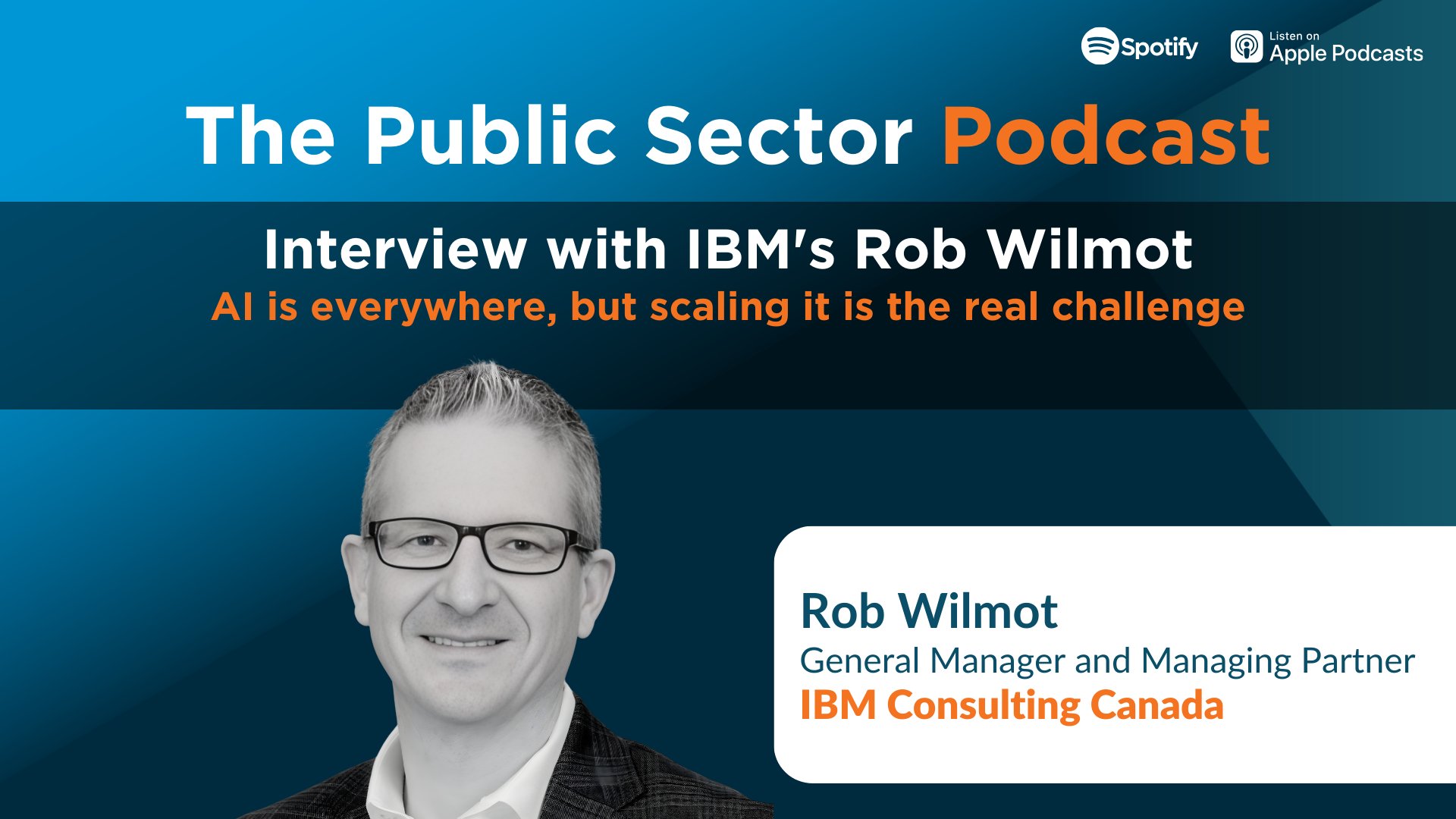
In this episode, we sit down with Rob Wilmot, General Manager and Managing Partner at IBM Consulting Canada, for a candid conversation on the real state of AI in government and why it is being positioned as a major productivity lever. Rob brings global experience across strategy, operations, and large-scale transformation, and frames AI as a rare opportunity for Canada to lift national productivity, improve public services, and compete for talent and investment in a fast-moving global landscape.
The discussion moves quickly from hype to practical reality: what AI is already improving today, where the biggest gains are likely to come from, and why the hard part is not running pilots, but scaling with discipline, governance, and secure, enterprise-grade tools. Rob argues AI will primarily augment public servants, shifting people away from repetitive work and toward higher-value outcomes, while also unlocking a less-discussed benefit: better digitised data that can drive smarter policy.
Key Themes
This episode centres on AI as a productivity and service-delivery catalyst, with a strong emphasis on what it takes to move from experimentation to measurable outcomes. Key themes include the difference between broad AI awareness versus true operational savings, why governments should focus on practical “boring” processes first, the role of governance and security in scaling, and the foundational challenge of messy, siloed data. The conversation also explores digital twins, workforce impacts, and the urgency for Canada to act with pace without losing responsible oversight.
What You’ll Learn
1) Why AI Is Being Linked to Public Sector Productivity
How productivity is being measured, why it is a national priority, and why AI is viewed as a tool to close the gap faster than traditional approaches.
2) The Scaling Gap: From Pilots to Enterprise Impact
Why many organisations can pilot AI, but few can scale it across departments and workflows, and what separates successful scaling from “proof of concept mania.”
3) Where AI Delivers Fast, Practical Value
Why repetitive, high-volume, rules-based work (HR, procurement, finance, claims) is often the quickest path to measurable efficiency and better service outcomes.
4) Better Citizen Experience and Better Outcomes
How AI can augment citizen-facing services through virtual assistants, case triage, and predictive analytics to allocate resources more effectively.
5) The Underestimated Benefit: Data Transparency and Policy Insight
How digitising workflows creates usable data that can be analysed to improve decisions and inform policy, not just speed up transactions.
6) Digital Twins, Explained Without the Sci-Fi
What digital twins are best used for in government, from large assets and logistics to planning and optimisation in complex systems.
7) AI and the Workforce: Augmentation Over Replacement
Why AI is likely to change the nature of work more than eliminate it, and how governments can “get more with the same” before doing different things with new skills.
8) Upskilling at the Speed of Change
How organisations can approach AI literacy and training despite rapid tool evolution, and why different cohorts will need different support.
Key Takeaways
- AI adoption is a productivity opportunity, but scaling is the hard part
- Broad experimentation helps familiarity, but real gains come from focused, disciplined execution
- High-volume operational processes are often the fastest path to measurable impact
- Governance, security, and rigor determine whether AI creates value or chaos
- Data quality and siloed systems are the biggest blockers to AI at scale
- AI will primarily augment public servants and shift work toward higher-value outcomes
- Faster movers will attract more talent, investment, and long-term advantage
Why You Should Listen
This episode is valuable for public sector leaders, CIOs, digital and data teams, transformation leads, and policy professionals who are trying to move AI beyond pilots and into real, repeatable outcomes. It offers a grounded view on how to focus efforts, scale responsibly, and avoid common misconceptions, while keeping an eye on the broader national stakes for productivity and competitiveness.





Help your peers
Share what you've learned with fellow public servants