
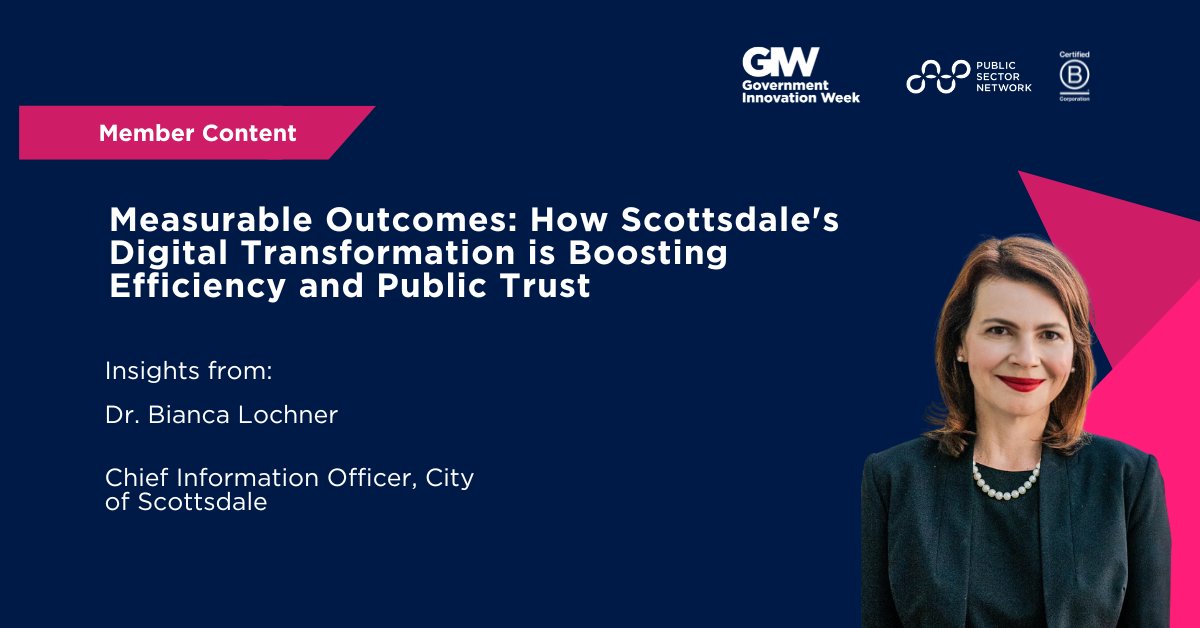
We recently had the opportunity to collaborate with Bianca Lochner, Chief Information Officer, City of Scottsdale whose thoughtful leadership is helping to shape the City of Scottsdale’s approach to innovation and citizen-centered services. As a speaker at the Government Innovation Showcase Arizona, Bianca brought valuable insights into how municipalities can strategically embrace new tools, optimize efficiency, and prioritize high-impact projects. Her work highlights the tangible ways digital transformation is reshaping how residents experience and engage with their local government.
May her insights inform and inspire your own innovation journey. Enjoy!
- Please share with us a bit about your role and focus areas.
I serve as the Chief Information Officer for the City of Scottsdale, Arizona, recognized as the #1 Digital City in the United States by the Center for Digital Government for the past two years. My role centers on aligning technology innovation with enterprise priorities to deliver value for residents, businesses, and city employees. Scottsdale’s IT organization is focused on five strategic priorities: strengthening community engagement, empowering innovation through people, advancing responsible AI adoption, safeguarding cybersecurity in a digital-first world, and enabling data-driven transformation.
- Beyond just adopting new tools, how has Arizona's strategic digitalization fundamentally transformed outdated processes to achieve tangible gains in efficiency at the City of Scottsdale?
We have fundamentally reimagined how government delivers services by eliminating silos and building modern, digital-first platforms. For example, our AI-powered virtual assistant, internally branded as Sadie, now provides city employees with instant access to IT support, reducing resolution times from days to minutes. Sadie also dynamically expands and curates our knowledge base, making information easier to find and reuse across the organization. Similarly, our enterprise-wide data governance program, combined with advanced analytics and intelligent automation platforms, has enabled us to shift from reactive reporting to proactive insights that drive efficiency across departments. These efforts go far beyond tools; they represent a cultural shift toward agility, accountability, and impactful outcomes.
- Could you share a specific example of how Scottsdale redesigned a service around user needs? What was the biggest hurdle in moving away from a traditional, government-out process?
A standout example for us is Scottsdale’s Short-Term Rental Resource Center, which we built in direct response to resident concerns about neighborhood impacts and the need for clear, consistent oversight. Rather than relying on fragmented reporting and manual processes, we created a digital platform that integrates licensing, compliance tracking, and resident reporting into a single, user-friendly system. This gives property owners clarity on their obligations while also providing residents with a transparent, accessible channel to raise concerns. The biggest hurdle was moving from a compliance model that was largely reactive to one that is proactive and data-driven. We overcame this by engaging residents, property owners, and enforcement teams early in the design process, ensuring the solution balanced community expectations with operational feasibility. The results speak for themselves: we are seeing improved compliance rates, faster resolution of issues, and a stronger sense of accountability and trust between the city and our community.
- Given the landscape of vast digital projects, prioritizing which services to digitize first is a key strategic decision. What framework does City of Scottsdale use to identify which processes would deliver the biggest efficiency payoff?
Scottsdale uses a structured, value-driven framework to prioritize digital initiatives. We assess opportunities across three key dimensions: constituent impact - does the service meaningfully improve quality of life or reach a large share of the community; organizational efficiency - does it streamline workflows, reduce redundancy, or eliminate manual-heavy processes; and strategic alignment - does it directly advance citywide priorities such as public safety, resident engagement, thoughtful innovation, or economic vitality. We also embed risk considerations into the process, ensuring that cybersecurity, compliance, privacy, and resilience are factored in from the start. his approach allows us to invest where outcomes are most visible and sustainable, delivering both near-term efficiency gains and long-term public value.
- What emerging technology are you most excited about or mindful of for the next phase of transforming citizen services in Arizona?
For us, artificial Intelligence is both the most exciting and the most carefully governed frontier. We have already deployed AI to streamline budgeting analysis, enhance resident engagement, and strengthen public safety through initiatives such as the Short-Term Rental Resource Center and the Real-Time Crime Center. These solutions have delivered measurable results, improving compliance and responsiveness in managing short-term rentals, while enabling faster, more data-driven interventions during public safety incidents. At the same time, we recognize that emerging technologies must be introduced with trust and transparency at the center. That is why we established an AI Governance Council and risk assessment framework to ensure that every deployment aligns with ethical standards, mitigates risk, and sustains long-term public confidence. Alongside AI, continued investment in cloud modernization and advanced cybersecurity remains vital to building the resilience needed for the next phase of digital government.
- Any advice you would give other agencies as they leverage digital technologies to improve service delivery and citizen engagement?
Start with the “why” and tie every initiative to a tangible public outcome. Invest in governance and risk frameworks early to ensure innovation is sustainable and trusted. Do not underestimate the importance of culture: empower your teams to innovate, and bring stakeholders along through transparency, pilots, and co-design. Finally, view technology as a long-term catalyst for value and not a one-time project. Success comes from building scalable, resilient foundations while continuously experimenting with new solutions.
Bianca Lochner’s leadership at the City of Scottsdale offers a powerful example of how strategic digital transformation can reshape public service from the ground up. By aligning emerging technologies with resident needs, fostering a culture of innovation, and embedding strong governance at every step, she demonstrates that modernization is not just about adopting tools—it’s about delivering measurable, meaningful outcomes for communities. For government professionals looking to drive change, her approach reinforces a critical truth: when innovation is people-centered, well-prioritized, and thoughtfully governed, it becomes a lasting engine for public value.


Help your peers
Share what you've learned with fellow public servants