
Episode Overview
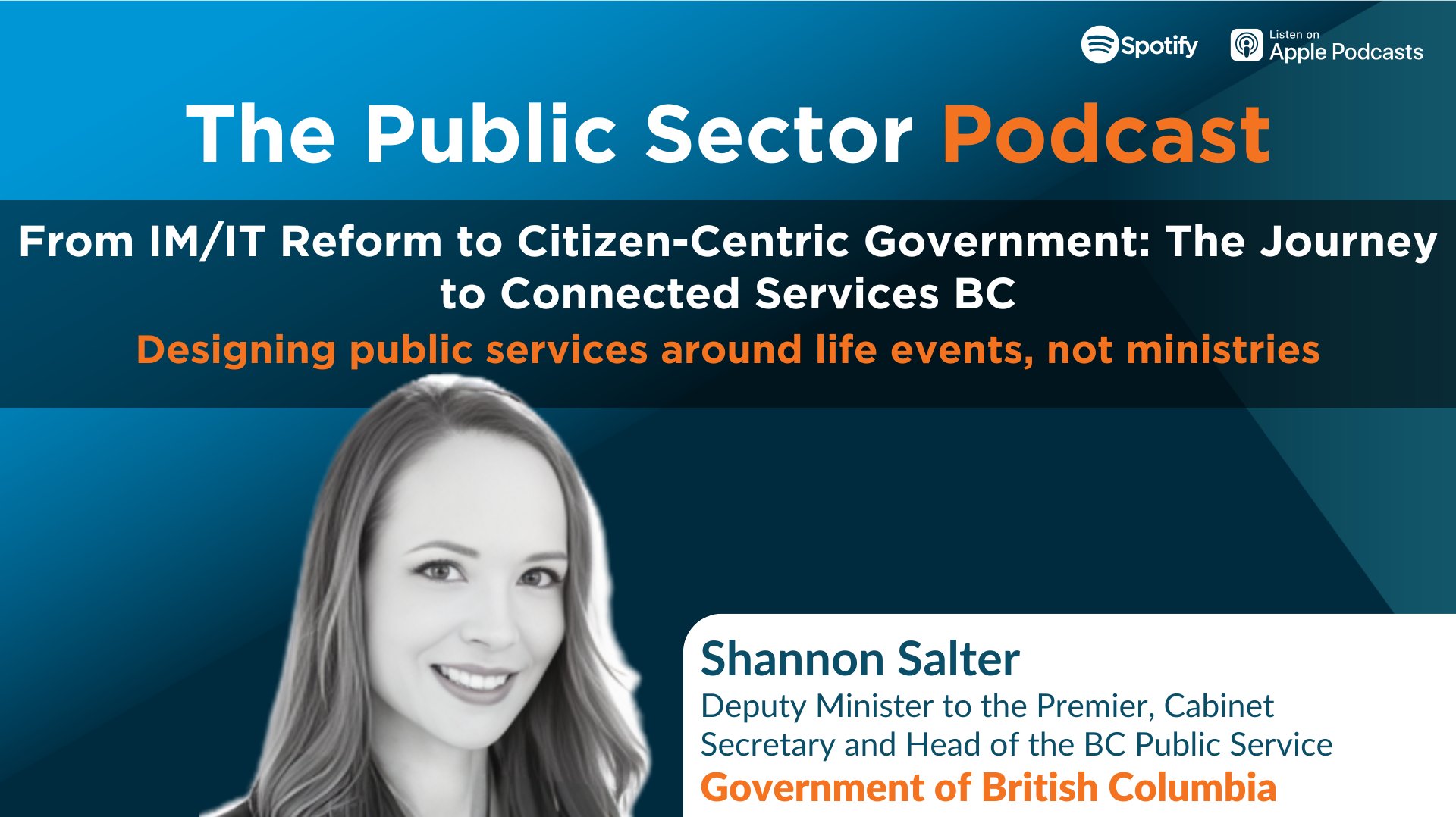
In this keynote, Shannon Salter — Deputy Minister to the Premier, Cabinet Secretary, and Head of the BC Public Service (Government of British Columbia) — shares British Columbia’s journey from incremental reform to truly citizen-centred government, anchored by a bold vision for 2030. Speaking from the territories of the lək̓ʷəŋən peoples, the Songhees and Esquimalt First Nations, Shannon outlines what it will take to deliver government as one connected experience: simple, intuitive and human — designed around real-life events rather than internal structures.
Key Themes
Shannon explains why technology alone won’t transform government, and why real change comes from pairing digital capability with clear purpose, collaboration, and trust. Drawing on the success of the Civil Resolution Tribunal (CRT) — Canada’s first online tribunal launched in 2014 — she demonstrates how reimagining services around user needs can deliver faster outcomes, lower costs, and higher satisfaction.
What You’ll Learn
1) The Vision for Government by 2030
What it means to move from a collection of ministries and programs to “one government, one experience” — where services feel connected, predictable and supportive across a person’s life.
2) What “Connected Services” Really Looks Like
How designing around life events (having a baby, finding housing, starting a business, caring for a family member, facing crisis) reduces friction through fewer forms, less duplication, and “tell your story once” service delivery.
3) Why Interoperability and Common Standards Matter
Why connected services require systems that can responsibly share data, follow common definitions and standards, and “speak the same language” — replacing patchwork fixes and inconsistent service experiences.
4) A Human Story That Defines the Problem
Shannon introduces Amina, living with an acquired brain injury, who must navigate multiple systems—health, housing, disability supports, legal help—repeating deeply personal information again and again. It’s a powerful example of how fragmented services can cause real harm, and why government must take on the work of navigation instead of pushing it onto citizens.
5) Inside Connected Services BC
An overview of Connected Services BC (launched October 1) and the four foundations Shannon says are required to make whole-of-government transformation real:
- Governance and structure (shared accountability and leadership)
- Legislation and policy (digital identity, privacy and secure data sharing)
- Shared meaning and common standards (consistent definitions, formats and rules)
- Technology (modern, scalable, secure platforms that support unified services)
6) Early Progress and Building Blocks
What BC has already put in motion, including growth in the BC Services Card app user base, steps toward a single digital identity approach, and modernising systems to support Indigenous names and languages in official records.
7) Trust, Risk and Culture Change in Government
In Q&A, Shannon addresses a common public sector challenge: new technology solutions being “watered down” to fit old environments. She argues for rebalancing government’s risk mindset by measuring not only the risks of action, but also the real harms of delay—especially for people stuck waiting or unable to access what they’re entitled to.
8) Inclusion Beyond Digital
Shannon reinforces that digital channels won’t work for everyone, and that services must be designed with flexibility—multiple channels, languages and modalities—grounded in lived experience and co-design with communities, advocates and frontline workers.
Why You Should Listen
This episode is essential for public sector leaders, service owners, digital transformation teams and partners who want to understand what whole-of-government service transformation looks like in practice. Shannon makes the case that connected services aren’t just a technology program—they’re a way to rebuild trust in public institutions by making government easier to navigate, fairer to access, and more supportive when people need it most.
Memorable Line of Thinking
When government truly works for people — when updating your address once actually means once, and applying for help doesn’t require retelling your story — trust grows. Connected services are an opportunity to fundamentally reset the relationship between citizens and government.





Help your peers
Share what you've learned with fellow public servants