
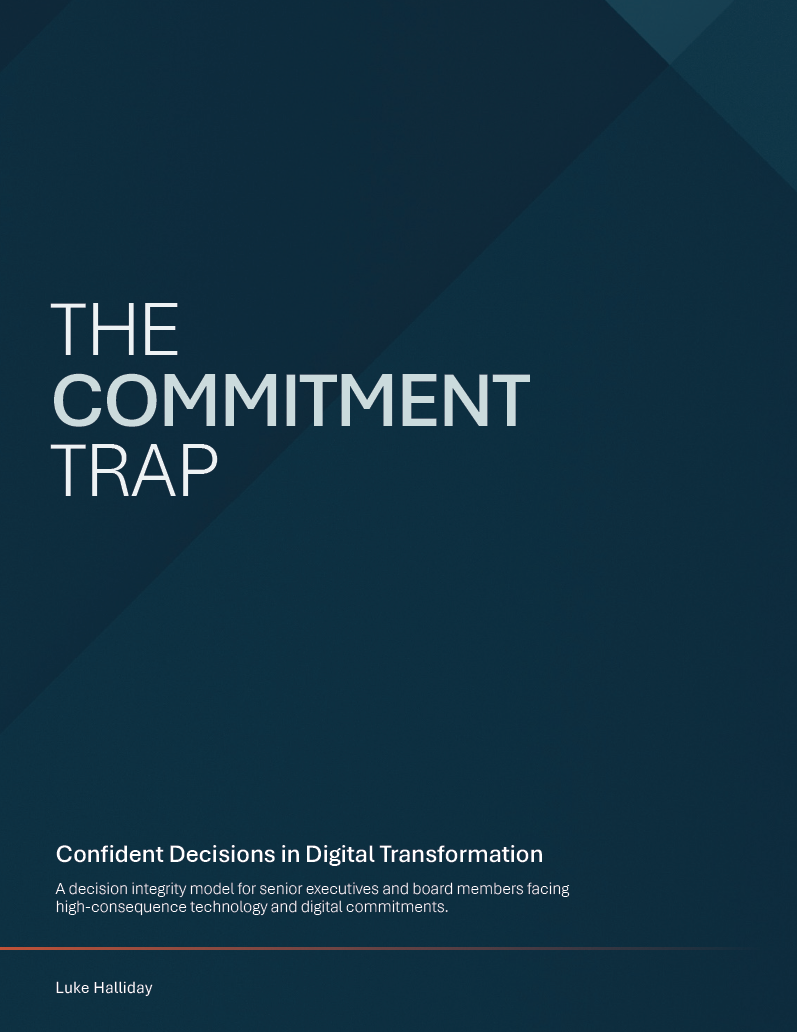
This paper is for Senior Executives and Directors responsible for technology investments targeting performance improvement, transformation or modernisation.
It is not an implementation guide or a delivery methodology. It is a thinking tool. It outlines a pattern that most executives will recognise but have not been able to name and offers a model for the decisions and sequencing that increase the likelihood of success in digital and technology-enabled transformation.
The premise is simple:
Success is not achieved by selecting the right technology solution, partner, or governance structure. While those things matter, success is made more likely by establishing clarity about what you are committing to, the consequences of the decision on the organisational environment, and who owns the result with authority to make decisions and resolve conflicts.
EXECUTIVE SUMMARY
The pressures that drive technology commitments, budget cycles, political urgency, vendor momentum, and peer movement, are not incidental to programme failure. They are its primary cause. They are designed, not by intent but by structure, to commit organisations before the conditions for a defensible decision exist.
The institutional response has been to invest in better delivery: stronger governance, more rigorous vendor management, improved methodologies. This response is understandable. It is also, in most cases, wrong. The evidence from audit findings, post-implementation reviews, and three decades of programme data shows that failure overwhelmingly begins before implementation starts in the quality of the decisions that set direction, sequence commitments, and allocate resources.
This paper presents a decision integrity model built on three conditions that must exist together for any high-consequence technology commitment to be defensible.
When these three conditions are present, organisations make decisions that can be explained, justified, and owned. Decisions grounded not only in the quality of the
technology or delivery capability, but in organisational readiness, operational impact, and the capacity to respond when conditions change. When any one is absent, the commitment is premature, regardless of how capable the organisation is or how strong the pressure to proceed.
The remainder of this paper provides the evidence base and a practical model for applying this discipline.
Clarity: the business outcome is defined in measurable terms and the end-to-end system being changed is understood.
Consequences: what the decision locks in, what it forecloses, and how the sequence of commitments creates either enabling conditions or compounding constraints.
Control: one named owner is accountable for the business outcome, with authority to resolve conflicts and the organisational safety to be honest about risk.
When these three conditions are present, organisations make decisions that can be explained, justified, and owned. Decisions grounded not only in the quality of the technology or delivery capability, but in organisational readiness, operational impact, and the capacity to respond when conditions change. When any one is absent, the commitment is premature, regardless of how capable the organisation is or how strong the pressure to proceed.
The remainder of this paper provides the evidence base and a practical model for applying this discipline.
Access the content here.






Help your peers
Share what you've learned with fellow public servants