

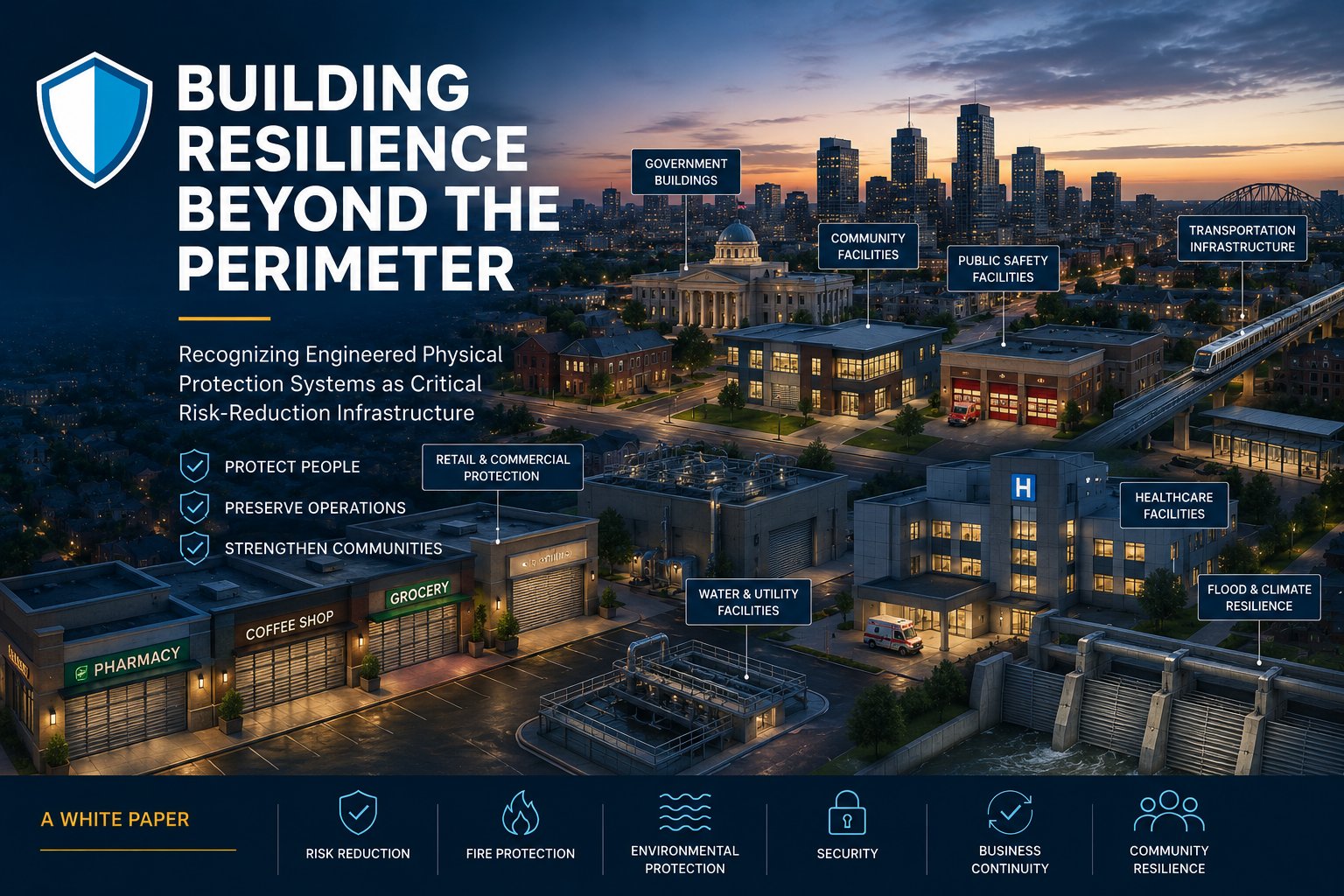
Building Resilience Beyond the Perimeter
Recognizing Engineered Physical Protection Systems as Critical Risk-Reduction Infrastructure
By Gill Roussel
Director of Operations, Security Shutter Ltd.
Executive Summary
Governments across Canada continue to invest heavily in cybersecurity, emergency preparedness, climate adaptation, critical infrastructure resilience & business continuity. Yet one category of engineered infrastructure is not always considered alongside other resilience investments, despite its potential to reduce both the likelihood & severity of physical loss.: Engineered Physical Protection Systems (EPPS).
Whether protecting healthcare facilities, emergency operations centres, water treatment plants, schools, transportation assets or municipal buildings, engineered protective opening systems represent an opportunity to shift public-sector thinking from responding to losses toward preventing them.
This paper proposes a broader framework for recognizing Engineered Physical Protection Systems as an important component of public-sector resilience, supporting organizations in protecting people, preserving operations & reducing disruption before it occurs.
The Changing Nature of Public Risk
Governments today face a more complex risk environment than ever before.
Organizations must prepare not only for traditional security concerns, but also:
Extreme weather
Wildfire
Flooding
Civil unrest
Organized theft
Infrastructure failures
Fire events
Supply chain disruptions
Increasing operational dependence on critical facilities
These risks share one common characteristic: Every hour of downtime has consequences that extend far beyond property damage.
When municipal facilities close, emergency services are disrupted.
When healthcare infrastructure fails, patient care suffers.
When utilities are compromised, entire communities are affected.
The conversation is no longer simply about replacing damaged assets. It is about maintaining essential public services.
From Loss Recovery to Loss Prevention
Traditional property insurance has focused on restoring organizations after a loss. Modern resilience strategies increasingly recognize that preventing losses creates greater value than simply recovering from them.
The most effective insurance claim is the one that never has to be filed.
This principle aligns with broader public-sector objectives:
protecting public assets
minimizing service disruption
reducing taxpayer costs
improving operational continuity
strengthening community resilience
The challenge becomes identifying infrastructure investments that meaningfully reduce organizational risk.
What Are Engineered Physical Protection Systems?
For this discussion, Engineered Physical Protection Systems (EPPS) refer to engineered risk-reduction infrastructure designed to prevent, limit or contain physical losses through the protection of vulnerable building openings, critical assets & essential infrastructure.
Examples of EPPS may include:
Fire-rated shutters
Fire curtains
Smoke containment systems
Security shutters
Security grilles
Flood barriers
Impact-resistant protective systems
Other engineered protective opening systems designed & certified for specific risk scenarios
These systems should always be evaluated based on their intended application, engineering, certifications & demonstrated performance.
Not every system addresses every hazard, but together they represent an important category of infrastructure designed to improve resilience.
Beyond Physical Security
Historically, protective opening systems have often been viewed primarily as security products. That perspective no longer reflects the role many engineered systems now play.
Today, these systems contribute to:
Fire compartmentation
Smoke containment
Critical infrastructure protection
Facility hardening
Business continuity
Asset preservation
Environmental protection
Emergency preparedness
They are increasingly integrated into the operational resilience strategies of organizations responsible for delivering essential public services.
Why This Matters for Government
Governments routinely evaluate investments through the lens of risk reduction.
Examples include:
cybersecurity controls
backup power systems
fire suppression systems
emergency communication systems
crime mitigation infrastructure
Each represents infrastructure designed not simply to respond to an incident, but to reduce its consequences.
Engineered Physical Protection Systems should be considered within this same conversation.
When appropriately engineered, installed & maintained, these systems can become part of a layered resilience strategy that helps reduce operational disruption before it occurs.
A Collaborative Opportunity
Recognizing Engineered Physical Protection Systems should not be viewed as a manufacturing initiative or a procurement exercise.
Rather, it represents an opportunity for collaboration between:
Government
Risk professionals
Architects
Facility managers/asset managers
Insurers
Engineers
Manufacturers
Installers
Emergency management professionals
Business continuity specialists
Together, these stakeholders can provide education on how these engineered protection measures contribute to organizational resilience.
Measuring What Matters
Future work should focus on developing evidence that helps quantify the contribution of EPPS to organizational resilience.
Potential areas of study include:
Reduction in insured losses
Business interruption avoided
Protection of critical assets
Operational continuity
Incident response outcomes
Lifecycle performance
Maintenance effectiveness
Cost-benefit analysis
Public-sector case studies
Developing a common evidence base will allow organizations to make more informed investment decisions.
Rethinking Resilience
Public-sector resilience is increasingly recognized as an integrated discipline. Cybersecurity protects information. Emergency management protects response capability. Business continuity protects operations.
Engineered Physical Protection Systems help protect the physical environments that enable all of these functions.
Resilience should not be viewed as separate initiatives competing for resources. It should be understood as an interconnected strategy for protecting communities.
Looking Forward
Canada has an opportunity to lead a broader discussion around recognizing engineered physical protection as a meaningful component of organizational resilience.
Rather than asking how quickly organizations can recover after disruption, we should increasingly ask:
How can we reduce the likelihood & severity of disruption in the first place?
Engineered Physical Protection Systems represent an important & often overlooked layer within a comprehensive resilience framework.
By bringing together government, insurers, engineers, manufacturers & practitioners, Canada can begin building a common understanding of how physical infrastructure contributes to stronger communities, more resilient organizations & more sustainable public investment.
Protection with Purpose
Resilience is strongest when it is designed into the built environment—not added after a loss occurs. As governments continue investing in climate adaptation, emergency preparedness & critical infrastructure, Engineered Physical Protection Systems deserve consideration alongside the many other measures that help communities withstand disruption.
Recognizing, evaluating & measuring these systems is not simply about protecting buildings.
It is about protecting the people, services & communities that depend on them.
About the Author
Gill Roussel is the Director of Operations at Security Shutter Ltd., working with public & private sector organizations to develop practical engineered protection solutions that support facility resilience, business continuity & critical infrastructure protection. Through collaboration with manufacturers, engineers & risk professionals, she advocates for recognizing engineered physical protection as an integral component of modern resilience planning.
Further Reading
Canada's National Adaptation Strategy
Public Safety Canada – National Strategy and Action Plan for Critical Infrastructure
Public Safety Canada – Critical Infrastructure Resilience resources
ISO 22301 – Business Continuity Management Systems
ISO 31000 – Risk Management Guidelines
National Building Code of Canada
NFPA 80 – Fire Doors and Other Opening Protectives
NFPA 105 – Smoke Door Assemblies and Other Opening Protectives
References
Government of Canada. (2023). Canada's National Adaptation Strategy: Building Resilient Communities and a Strong Economy. Government of Canada.
Public Safety Canada. National Strategy and Action Plan for Critical Infrastructure.
Public Safety Canada. Critical Infrastructure Resilience Strategy.
International Organization for Standardization (ISO). ISO 22301: Security and resilience — Business continuity management systems — Requirements.
International Organization for Standardization (ISO). ISO 31000: Risk Management — Guidelines.
National Fire Protection Association (NFPA)
National Research Council Canada. National Building Code of Canada
NFPA 80 – Standard for Fire Doors and Other Opening Protectives
NFPA 105 – Standard for Smoke Door Assemblies and Other Opening Protectives
NFPA 101 – Life Safety Code
NFPA 5000 – Building Construction and Safety Code
Disclaimer
This paper is intended to encourage discussion regarding resilience planning, risk reduction & engineered physical protection. References to standards, codes & guidance documents are provided for contextual purposes only & should not be interpreted as endorsements of any specific product, manufacturer or installation. Individual systems should always be evaluated based on their intended application, engineering, certification, testing & compliance with all applicable codes & standards.

Published by
About our partner
Security Shutter Ltd.
Cybersecurity Starts Before The Keyboard.The first layer of protection isn't software.It's controlling physical access.As technology continues to evolve, we're excited to explore new ways our products can support data centres, critical infrastructure & high-performance facilities.Explore how automated rolling shutters can help optimize airflow in data centres & critical infrastructure environments, improving cooling efficiency, reducing energy waste & helping facilities maintain consistent operating conditions.Protecting your data centre is not just about preventing theft; it's about creating a resilient environment capable of withstanding various challenges. Beyond shutter systems, SSL offers a complete suite of security solutions tailored to the specific needs of data centres. SSL security solutions are designed to provide peace of mind, knowing that your sensitive information & operations are secure.When it comes to critical infrastructure, we don’t cut corners - we just secure them.Call today to learn more about our specialized security solutions tailored for your space.💙 The SSL Dream Team 📞 1-866-765-5366 🌐 http://securityshutter.ca Your data works around the clock.Your security should too.Because great service never goes out of style. 💙SECURITY SHUTTER LTD. Safer Spaces. Higher Standards. Stronger Communities. 💙
Learn more




Help your peers
Share what you've learned with fellow public servants