

Blog by Mahdi Sheikhi, AI & Cloud Solutions Architect and Consultant at Agile Insights. Mahdi specialises in designing innovative technology strategies and intelligent automation to drive enterprise digital transformation.
What is Microsoft IQ?
Currently, many new AI agents start from near zero when it comes to business-specific context. They must relearn how a specific business operates, where the relevant data lives, and what governance rules and policies apply. Today, model capability is no longer the primary constraint for enterprise AI; the real constraint is context.
The Unified Enterprise Intelligence Layer Microsoft IQ is designed as the direct antidote to this fragmentation. It is an overarching, multi-layered enterprise intelligence stack introduced to provide AI agents and Copilots with comprehensive, context-rich, and trustworthy information.
Crucially, Microsoft IQ is not an AI model or a Large Language Model (LLM) itself. Rather, it is a unified solution layer, an “intelligence fabric,” that acts as a centralized brain, binding specialized knowledge domains together to apply AI to real business scenarios. It transforms raw enterprise data into a shared, continuously updated understanding of the organization that Microsoft 365 Copilot and every custom agent inherits by default. By uniting data, workflows, governance, and trusted context, it ensures that an agent built today instantly “knows” your company, and any subsequent agents can reason from the exact same grounded understanding, compounding value as AI adoption scales.
Important note: Microsoft IQ is used in this article as a conceptual framework for understanding Microsoft’s emerging enterprise intelligence architecture. While many of the underlying technologies discussed are Microsoft products and capabilities, the categorization into Work IQ, Fabric IQ, Foundry IQ, and Web IQ represents an architectural interpretation intended to explain how these capabilities work together in enterprise AI systems.
The Four Pillars of Intelligence and Their Architectural Boundaries Rather than creating a single monolithic database that awkwardly jams all enterprise data together, Microsoft has intentionally segmented enterprise intelligence into four specialized layers, or “pillars”: Work IQ, Fabric IQ, Foundry IQ, and Web IQ.
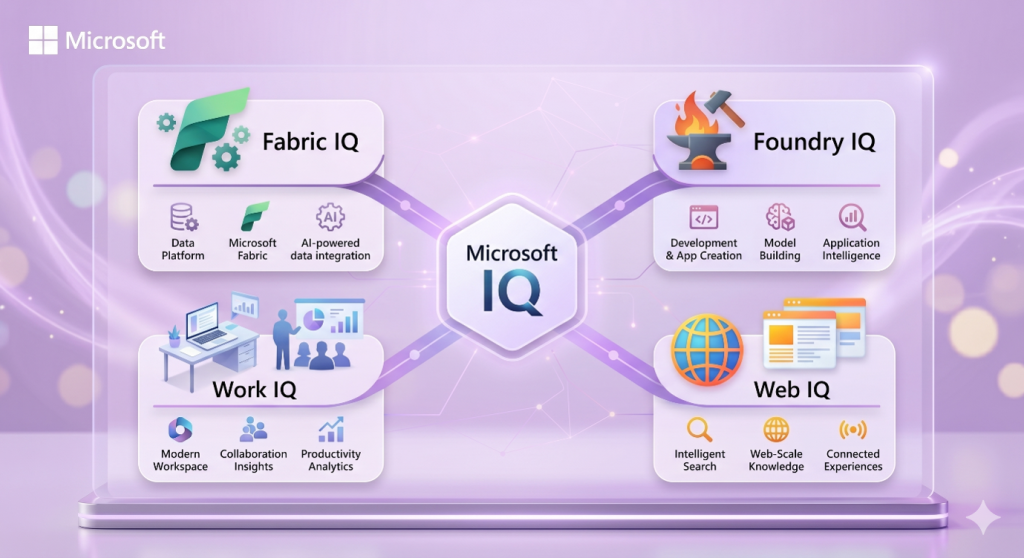
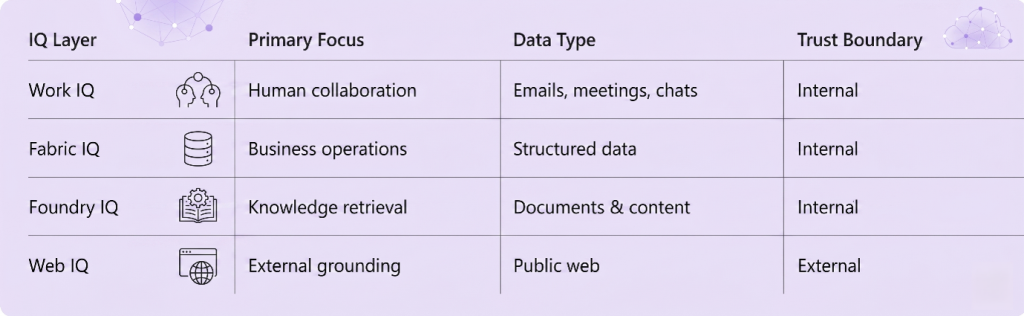
This segmentation is a vital architectural decision. By segregating duties across these distinct IQs, Microsoft maintains clear boundaries of responsibility, prevents overlap, and ensures AI agents can reason reliably within defined trust and security boundaries. Each layer handles a distinct dimension of organizational context:
- Work IQ (How work happens): This layer captures the living knowledge of daily operations, drawing on collaboration signals, communications, and human workflows strictly within the Microsoft 365 trust boundary. As the intelligence engine behind Microsoft 365 Copilot, it understands the people, relationships, and project dynamics behind the data.
- Fabric IQ (How the business operates): Serving as the semantic foundation for the enterprise, this layer elevates raw structured data (like analytics and real-time operational signals) into actionable business language. It defines shared metrics and business ontologies, so agents understand concepts like “Revenue” or “Customer” consistently.
- Foundry IQ (What the organization knows): This is the managed knowledge retrieval layer, built on Azure, that turns fragmented enterprise content into a governed repository. It orchestrates secure, permission-aware access to unstructured enterprise policies, wikis, and documents, acting as the retrieval engine for agents.
- Web IQ (What is happening in the world): Because AI agents often need real-time external facts, this layer provides fresh global intelligence from the open web (such as news, images, and market data). Importantly, it operates entirely outside the corporate trust boundary, ensuring internal proprietary data is safely partitioned from the public internet.
Work IQ: Mapping the Digital Graph of Collaboration
Defining Work IQ: The Human Context of Work To be truly effective, an AI agent needs to understand more than just facts and figures; it needs to understand the human dynamics of an organization. Work IQ is the unique intelligence layer behind Microsoft 365 Copilot and custom enterprise agents that provides a live, real-time understanding of how employees actually work. It operates entirely within the Microsoft 365 trust boundary, continuously processing collaboration signals from emails, calendar events, Teams meetings, chats, documents, and line-of-business systems.
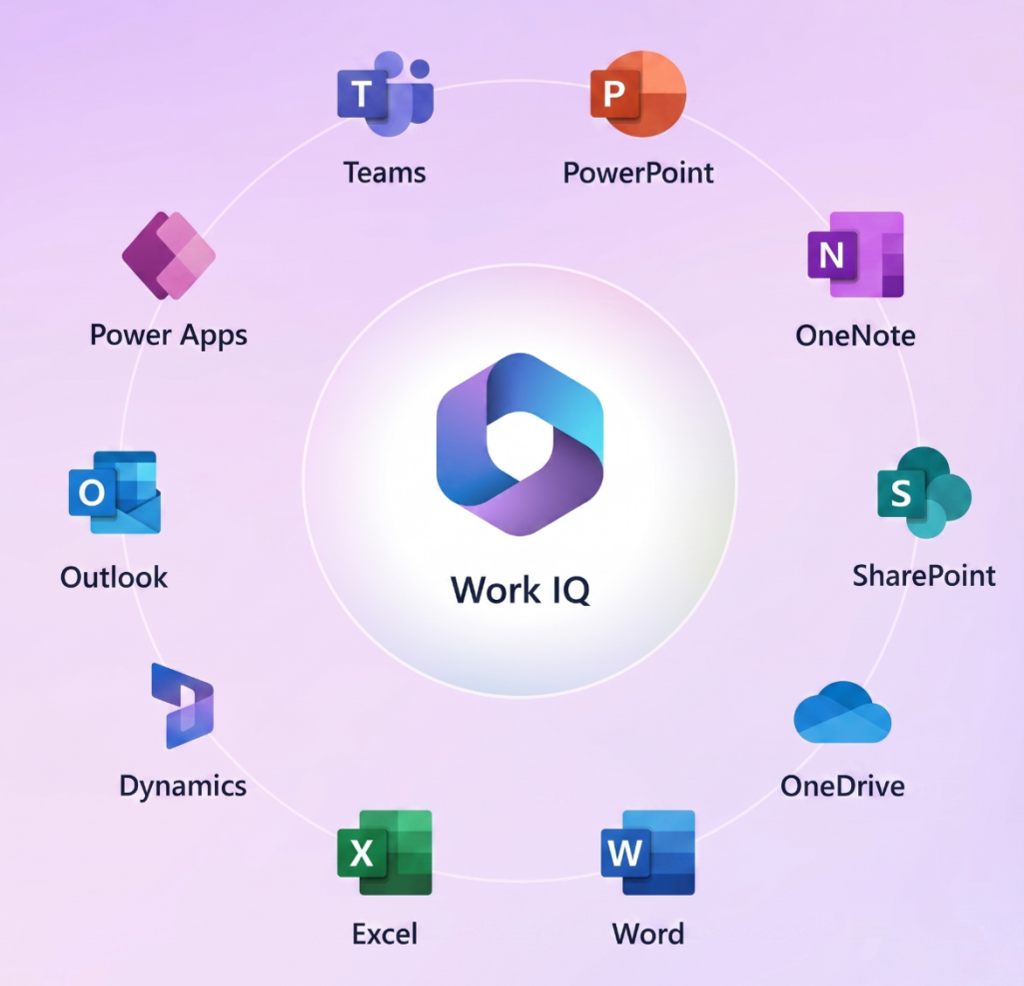
Unlike basic document indexing systems that merely know a file exists, Work IQ builds a semantic understanding of work patterns. It understands the context around a project: who made a decision in a meeting, what follow-up actions were agreed upon, and who the real subject-matter experts are for a specific topic. By capturing this living knowledge, Work IQ enables AI agents to transition from reacting to isolated prompts to responding with a deep understanding of user role, timing, and intent.
The “Work Chart” vs. The Official Org Chart Traditional enterprise applications typically rely on a static organizational chart pulled from Active Directory (Entra ID) to understand relationships. Work IQ goes far beyond this by building what can be thought of as a dynamic collaboration graph or “work chart.”
It analyzes who you communicate with most frequently, who co-authors documents with you, and your recurring meeting attendees. This real-time map of informal networks and project teams is often a much more accurate reflection of how work actually gets done than the formal HR hierarchy.
This intelligence is driven by three core components within Work IQ:
- Data: Drawing continuous signals from daily workflows to reflect how information moves through the company.
- Memory: Building a persistent model of collaboration and decision patterns, remembering how teams operate and personalizing to the user’s preferences over time.
- Inference: Connecting the dots between formal structures and real working relationships to anticipate what matters next and surface the most relevant connections at the moment of decision.
Powering Personalization and AI Teammates Because Work IQ understands interpersonal dynamics and project histories, it enables high levels of personalization and proactive assistance. For example, if you ask Microsoft 365 Copilot to “prepare a summary of my last budget meeting and draft a follow-up email,” Work IQ does the heavy lifting. It fetches the relevant meeting notes, recalls the list of attendees, reviews recent emails about the budget, and drafts a response that matches your typical tone, all while referencing the specific task assignments agreed upon during the call.
Boundaries, Trust, and Security Because Work IQ processes highly sensitive human collaboration data, Microsoft intentionally designed it with strict boundaries. Work IQ is heavily bounded to the internal Microsoft 365 ecosystem. It inherits the exact same zero-trust security model as your existing tenant; agents querying Work IQ will only ever retrieve data that the signed-in user is explicitly authorized to see via Entra ID permissions. It does not analyze structured numerical data, nor does it reach out to the public web.
Fabric IQ: The Semantic Foundation for Business Data
Defining Fabric IQ: Transforming Data into Business Understanding While modern enterprises capture massive amounts of data, raw databases and tables mean very little to an AI agent without proper context. Fabric IQ addresses this by acting as the semantic intelligence layer for Microsoft Fabric, transforming raw analytical and operational data into a shared, actionable business language. By sitting on top of the organization’s data estate, Fabric IQ elevates data so that both human analysts and AI agents can interpret it using consistent business concepts and objectives.
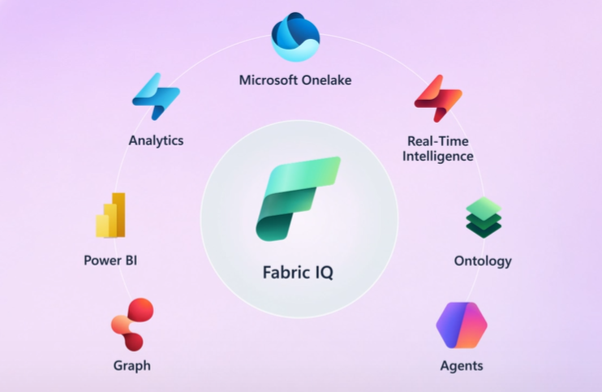
Instead of an AI agent struggling to infer the meaning of a column named “CUST_REV_03,” Fabric IQ ensures the agent understands the concept of “Revenue” and “Customer” exactly as the business defines them. By turning unified data into unified intelligence, Fabric IQ prevents the common issue of different AI agents or departments generating conflicting answers based on varying interpretations of raw data.
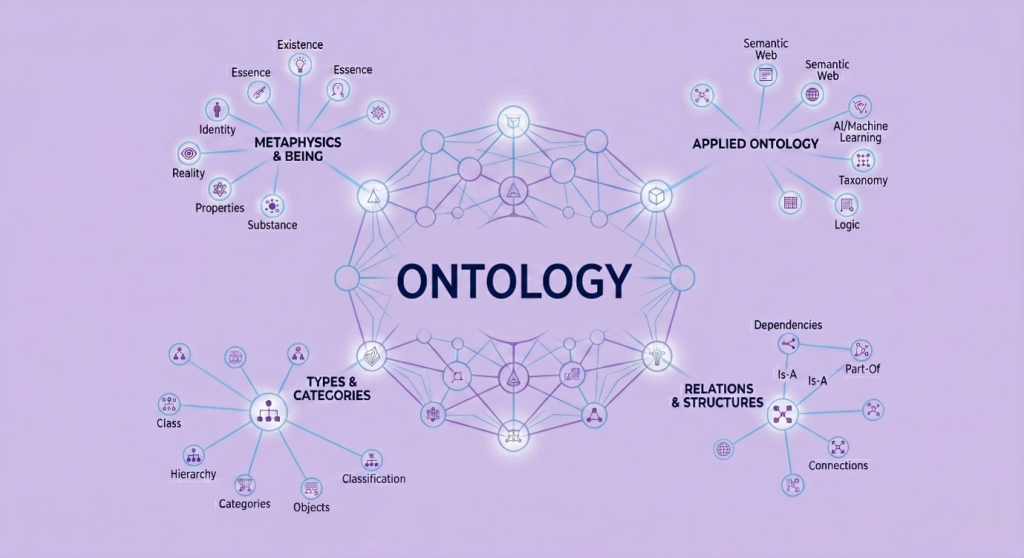
The Triad of Intelligence: OneLake, Semantic Models, and Ontologies Fabric IQ builds this semantic foundation across three integrated layers of context:
- Unified Data (OneLake): The foundational data lake that unifies operational, analytical, and real-time data from various multicloud sources into a single, governed repository without requiring data duplication.
- Business Intelligence (Semantic Models): Leveraging Power BI semantic models, this layer provides curated measures, dimensions, and KPI hierarchies. It acts as the established analytical baseline that standardizes how metrics are calculated.
- Operational Intelligence (Ontologies): The most advanced layer of Fabric IQ is the business ontology. Rather than organizing information around technical schemas, ontologies organize it around core business entities, such as Customers, Products, Orders, Assets, and Suppliers, and map their relationships, properties, and business rules.
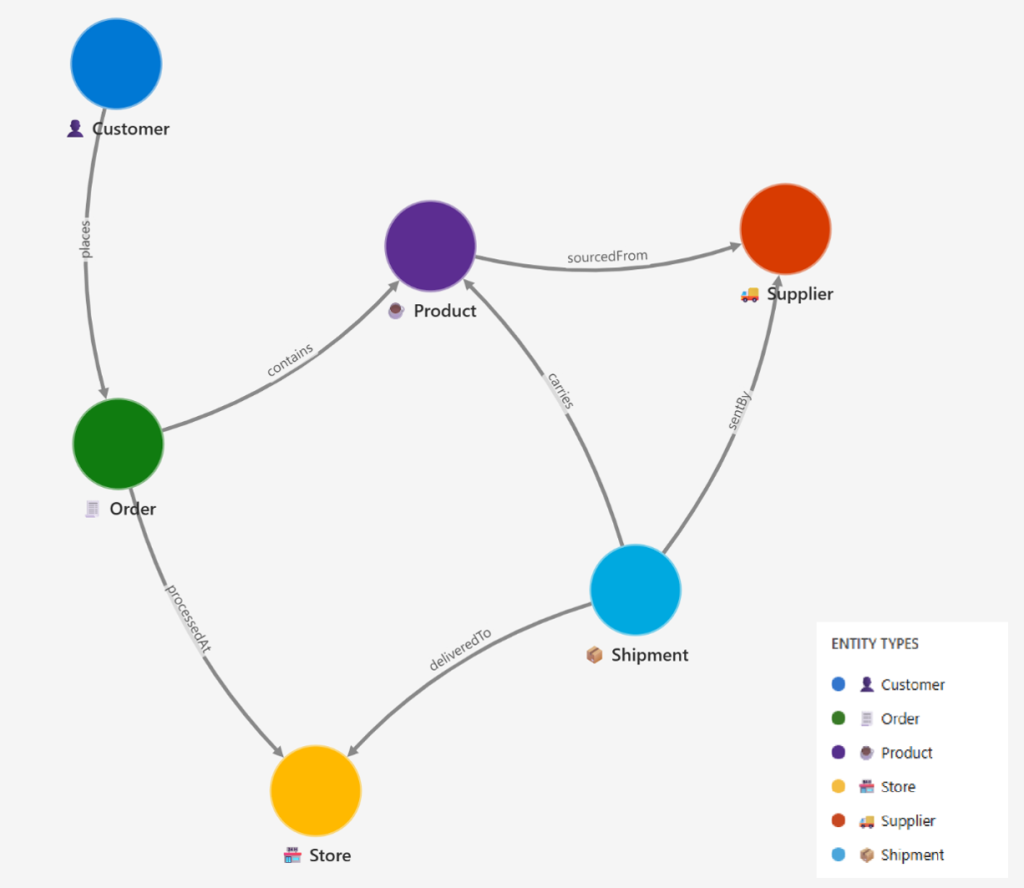
Implemented as a connected knowledge graph, the ontology allows AI to understand complex dependencies across the enterprise. For example, Fabric IQ allows an agent to understand the explicit relationship that a “Customer places an Order,” which is fulfilled by a “Shipment” containing a “Product”.
Boundaries, Governance, and Limitations To use Fabric IQ effectively, AI architects must understand its strict boundaries. Fabric IQ is exclusively focused on analytical, structured, and semi-structured enterprise data. It does not read unstructured human communications (which is the domain of Work IQ), nor does it crawl through text documents, PDFs, and corporate policies (which is handled by Foundry IQ). Furthermore, Fabric IQ does not magically fix broken data pipelines; it is highly dependent on mature data governance, requiring organizations to certify their data sources (for example, using Microsoft Purview) to determine authoritative master records. As of mid-2026, while the underlying semantic models are Generally Available, the advanced ontology workload remains in preview.
Foundry IQ: The Enterprise Knowledge & Retrieval Engine
Defining Foundry IQ: Unlocking Unstructured Knowledge Foundry IQ is Microsoft’s managed knowledge retrieval layer designed specifically for unstructured and semi-structured enterprise content. Described by Microsoft as a “context engineering platform,” it transforms fragmented enterprise data, such as internal policies, wikis, PDFs, and technical manuals , into governed, reusable knowledge bases. Rather than an agent guessing or relying on outdated training data, Foundry IQ connects AI agents to the exact right documents and systems across the organization, allowing them to provide grounded answers complete with precise, traceable citations.
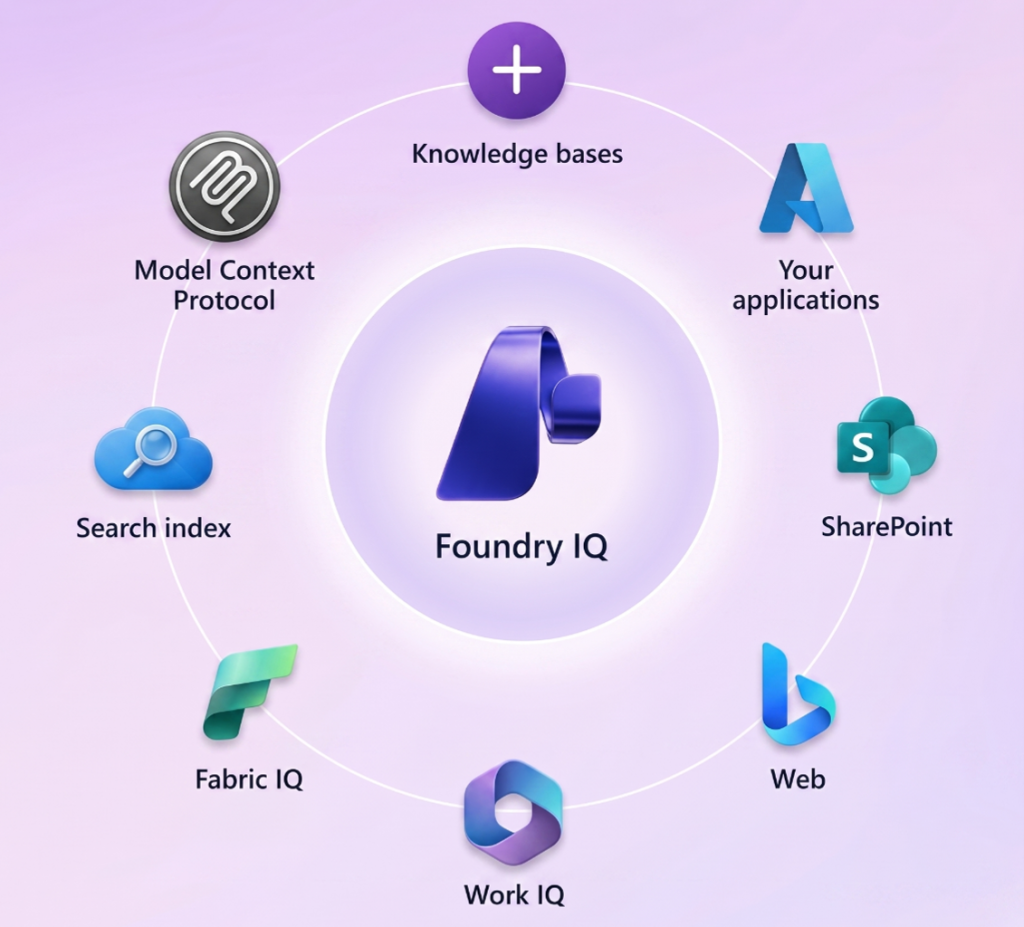
Agentic Retrieval at Scale: Replacing Fragile RAG Pipelines Historically, deploying enterprise AI meant developers had to manually build bespoke, fragile RAG (Retrieval-Augmented Generation) pipelines from scratch for every single new agent or project. Foundry IQ eliminates this repetitive engineering effort by providing a single, SLA-backed managed retrieval layer. It automatically handles the heavy lifting of data preparation, including document chunking, generating vector embeddings, and continuously refreshing search indexes.
The core of this system is an advanced agentic retrieval engine built on the backbone of Azure AI Search. When an agent is asked a complex question, Foundry IQ does not just execute a basic keyword search. Instead, an LLM acts as a planner to break the complex question down into focused subqueries. It then routes and executes these subqueries in parallel across the right sources, reranks the best candidate results, and finally synthesizes a unified, natural-language answer with citations linking directly back to the specific source chunks.
Orchestrating Knowledge Across the Enterprise A major strength of Foundry IQ is its ability to act as a federated retrieval hub that supports both indexed and remote sources. A single Foundry IQ Knowledge Base can pull from Azure Blob Storage, SharePoint, SQL databases, and Fabric OneLake. Furthermore, Foundry IQ acts as the ultimate orchestrator across the entire Microsoft IQ stack. Through Model Context Protocol (MCP) integrations and agent orchestration patterns, developers can connect capabilities associated with Work IQ, Fabric IQ, and Web IQ into Foundry-powered solutions, enabling cross-boundary AI reasoning across collaboration data, enterprise knowledge, business metrics, and external information sources.
Boundaries, Trust, and Security Enforcement In the realm of enterprise AI, ensuring that users do not access restricted information is a critical barrier to scale. Foundry IQ enforces zero-trust security by strictly honoring Microsoft Entra ID (Azure AD) identities, Purview sensitivity labels, and Access Control Lists (ACLs) at the exact moment of the query. Security permissions are preserved end-to-end, meaning an agent will never retrieve or summarize unauthorized content. While Foundry IQ acts as the central knowledge hub, architects must remember its boundaries: it specializes in unstructured knowledge retrieval and does not replace the numerical analytics of Fabric IQ or the human collaboration tracking of Work IQ.
Web IQ: Real-Time Grounding from the Open Web
Defining Web IQ: The Outside World Intelligence Layer While Work, Fabric, and Foundry IQ specialize in unlocking a company’s internal data, AI agents frequently require up-to-date, real-world facts that fall outside of the corporate firewall and beyond an LLM’s static training data cutoff. Web IQ serves as the “outside world” intelligence layer, giving AI agents fresh, real-time context from the open internet. In practice, this capability is typically delivered through Microsoft’s web-grounding and search technologies, allowing agents to access current information from trusted external sources while maintaining separation from internal enterprise data.
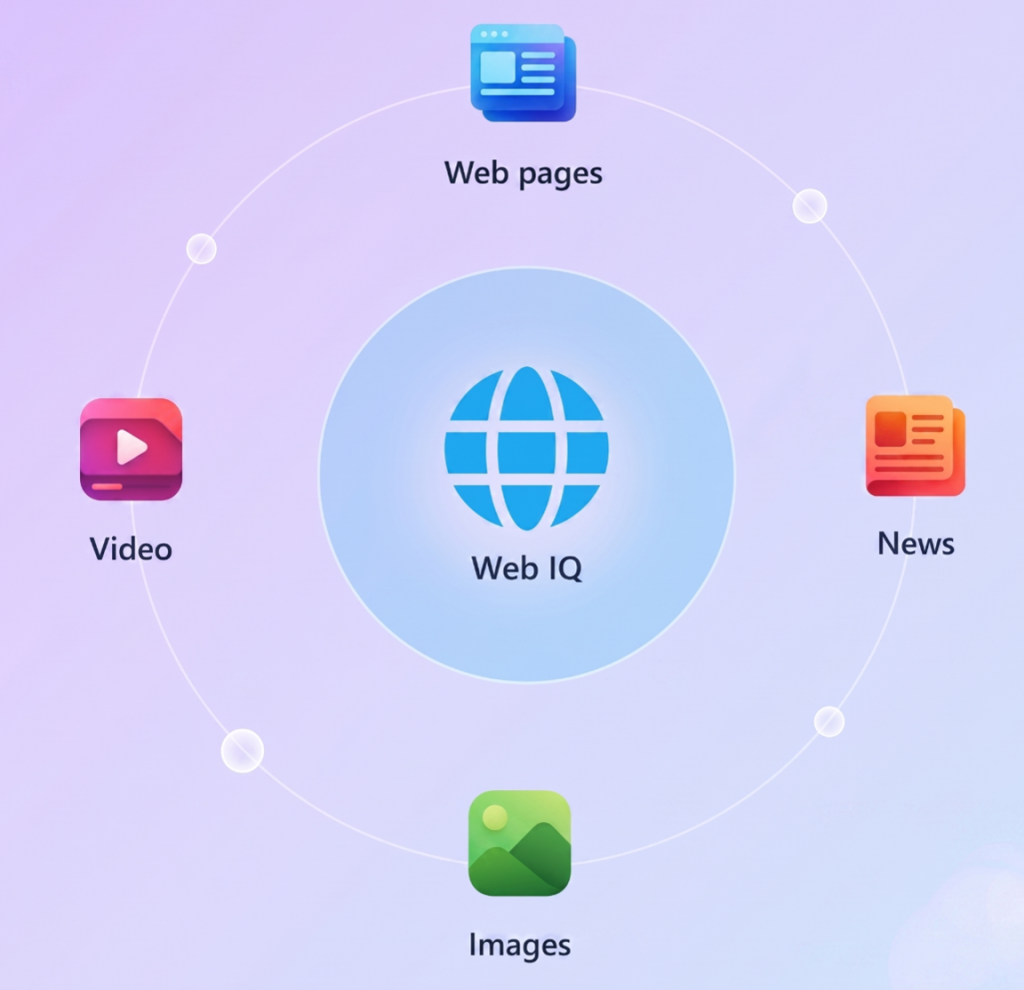
Re-architected for AI Agents, Not Humans To understand the power of Web IQ, it is important to distinguish it from traditional search engines. Standard web search APIs are built for human click behavior; they return a list of blue links that a human must manually click, read, and filter. If an AI agent must scrape and read full web pages, it consumes massive amounts of time and compute tokens.
Web IQ is fundamentally re-architected to serve agents, not browsers. Rather than returning a ranked list of URLs, it delivers pre-processed, structured intelligence directly consumable by an LLM. When an agent submits a query, Web IQ retrieves relevant web content, extracts the key facts, and returns a synthesized, citation-backed answer — eliminating the need for the agent to fetch, parse, or summarize raw HTML itself. This dramatically reduces latency and token overhead while improving answer reliability.
Under the hood, this is powered by Microsoft’s web grounding capabilities, which leverage Bing’s continuously refreshed index to surface timely, authoritative content. The system applies relevance ranking, content extraction, and source attribution in a single pass, meaning the agent receives clean, structured context rather than raw web noise. Grounding responses with verifiable citations also reduces the risk of hallucination, since the agent is reasoning from retrieved facts rather than relying solely on its training data.
Blending Internal and External Intelligence While its boundary is strictly external, Web IQ is designed to interlock perfectly with the rest of the Microsoft IQ stack. Through the Model Context Protocol (MCP), Web IQ acts as a built-in federated source for Foundry IQ knowledge bases. This enables powerful cross-boundary AI reasoning, allowing an agent to combine public market news from Web IQ with internal strategy documents from Foundry IQ in a single, coherent response.
Boundaries, Trust, and Security When bringing public internet data into corporate workflows, maintaining a zero-trust architecture is critical. Web IQ sits explicitly at the boundary between the enterprise and the open internet. Its defining security feature is that it has absolutely zero access to internal enterprise data. It cannot see your SharePoint files, Teams chats, or Fabric databases. By keeping Web IQ conceptually isolated from proprietary context, Microsoft ensures internal secrets are never inadvertently exposed to the public web during the external intelligence-gathering process. Furthermore, Web IQ offers data privacy with zero data retention by default and strictly honors publisher restrictions.
Architecting the Boundaries: How the IQ Layers Work Together
Distinct Domains, Minimal Overlap To build a truly reliable AI system, Microsoft intentionally avoided creating a single, monolithic “black box” database that haphazardly jams all enterprise data together. Instead, the Microsoft IQ architecture relies on a modular design where each layer is a standalone capability that feeds a very specific facet of context into the AI system. This deliberate separation ensures minimal overlap and maximum synergy.
By maintaining clear boundaries, the framework ensures that layers do not step on each other’s toes:
- Work IQ focuses purely on how people collaborate and communicate, but it does not attempt to interpret raw business metrics.
- Fabric IQ handles the complex logic of business metrics and structured data analytics, but it does not crawl through unstructured text documents or human communications.
- Foundry IQ manages unstructured institutional knowledge and policies, but it does not generate numerical analytics or track human workflow patterns.
- Web IQ acts as the AI’s window to the outside world, but it stays strictly outside the enterprise data sphere and has zero access to internal proprietary secrets.
Because these domains are kept distinct, AI agents can seamlessly incorporate multiple contexts simultaneously without confusion. When an agent answers a complex question, it keeps each source distinct and properly documented, which dramatically reduces the risk of AI “hallucinating” or misusing information from one context in another.
Foundry IQ as the Orchestrator While each IQ layer can operate independently, their true power is unlocked when they are combined. In this ecosystem, Foundry IQ often sits on top of the other layers, acting as the ultimate retrieval orchestrator. Through Model Context Protocol (MCP) integrations and related orchestration frameworks, Foundry-powered solutions can coordinate access to collaboration signals, enterprise knowledge, business data, and external web intelligence. This architecture enables agents to reason across multiple domains while maintaining governance and security boundaries.
This architecture enables sophisticated, cross-boundary AI reasoning, allowing an agent to analyze a supply chain disruption by checking real-time inventory (Fabric IQ), supplier contracts (Foundry IQ), procurement emails (Work IQ), and breaking news (Web IQ) in a single, coherent retrieval call.
Conclusion: Transitioning to an Agentic Workforce
As organizations scale enterprise AI, Microsoft’s modular IQ framework offers a clear strategic blueprint: use the right IQ for the right job. Rather than relying on a single, unmanageable database, AI architects should design agents to tap into specialized context providers:
- Work IQ: For understanding human dynamics, team collaboration, and daily workflows.
- Fabric IQ: For evaluating structured business metrics and operational semantics.
- Foundry IQ: For retrieving institutional knowledge, policies, and standard operating procedures.
- Web IQ: For fetching real-time external facts, market trends, and competitor news.
By intentionally combining these layers, organizations can build highly capable, context-aware AI agents.


Published by
About our partner
Agile Insights
Agile Insights is a leading Australian consulting firm, specialising in Data and Al solutions. With a deep commitment to empowering organisations through technology, we proudly serve mid-to-large size businesses and government agencies across Australia.Learn more on what we do for Government here https://www.agile-insights.com.au/industry-government/
Learn more



Help your peers
Share what you've learned with fellow public servants