
When Paul N. Wagner talks about digital government, he avoids the word “transformation.” For him, the better phrase is digital evolution. Transformation suggests a one-time leap. Evolution recognises that governments change in increments, layer by layer, often unevenly and across decades. The point is not to chase slogans but to keep moving - delivering services people can trust, investing in the infrastructure that makes progress possible, and creating the conditions for sustainable improvement.
That pragmatic tone ran throughout a recent conversation between The Hon. Victor Dominello and Paul, who serves as Chief Executive Officer of the Canadian Digital Service. and was one of the architects behind the first iteration of the country’s Digital Ambition. His perspective is grounded in both technical depth and policy experience, shaped by years working on Canada’s biggest service platforms. The message is consistent: government must be judged by the services it delivers and the trust it earns. Everything else is secondary.
Fixing the plumbing
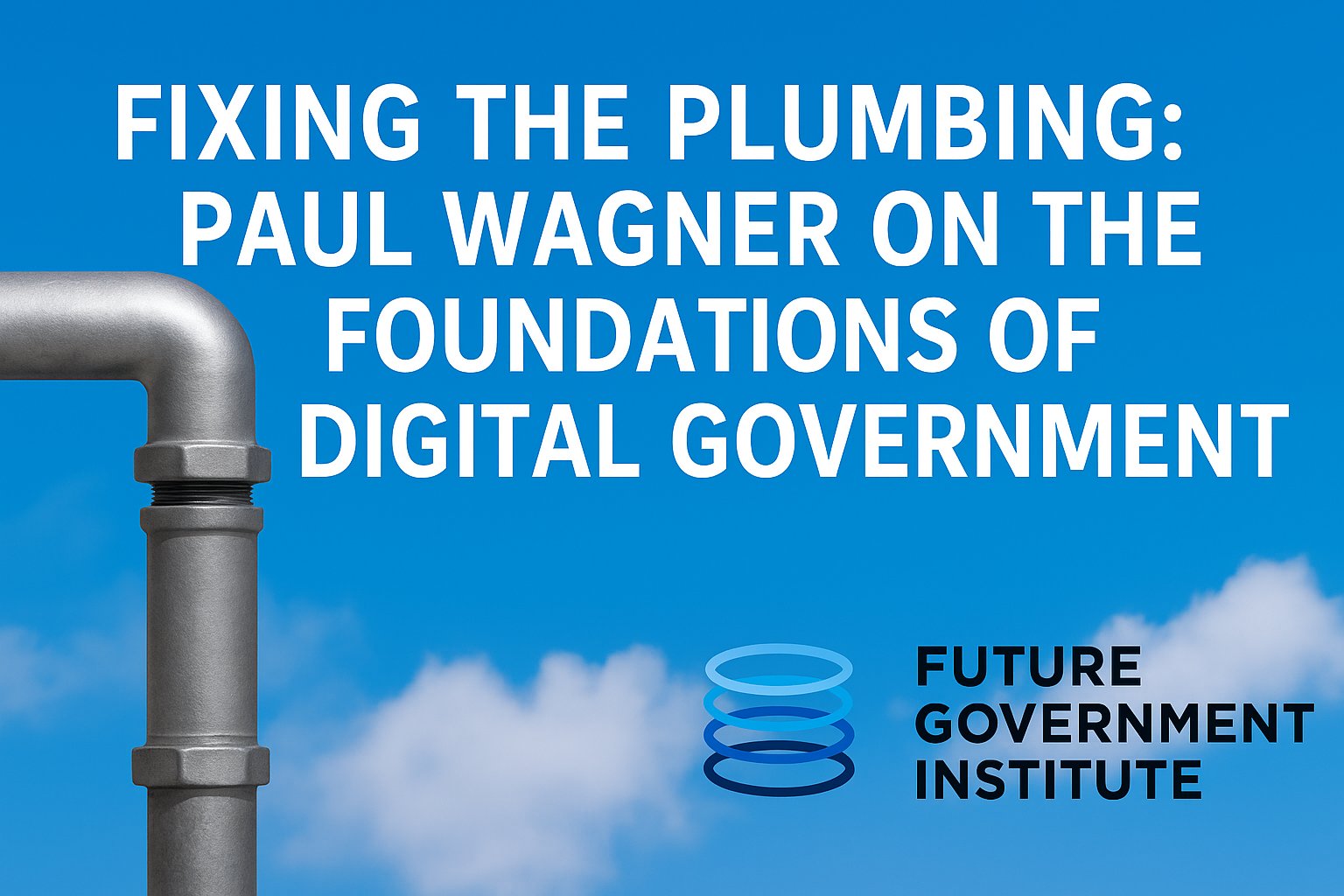
Paul likes to describe much of his work as “plumbing.” It is the unglamorous foundation - data standards, hosting strategies, secure networks, shared identity - that most people never see but which determines whether anything else works. Without reliable plumbing, services fail, trust collapses, and every new program piles complexity onto already fragile systems.
The Canadian Digital Ambition leans into this. It identifies shared foundations - digital identity, payments, data exchange, security - as public infrastructure, no less important than roads or bridges. These are the capabilities that allow governments to deliver consistently, to scale quickly, and to reduce duplication across departments. Investing in them may not make headlines, but without them no government can hope to move beyond fragmented projects.
Focus on domains, not abstractions
Another theme Paul returned to was the need to keep digital reform tied to specific domains. He cautioned against talking about “government at large” as if it were a single organisation. The better lens is to look at the systems that matter most to citizens: benefits delivery, immigration, public safety, public health, science and research.
Each of these domains has its own challenges, but they share common foundations. The task of government leaders is to build those foundations once, to the right standard, and make them available everywhere. Doing so not only reduces cost but also creates coherence: the citizen experiences government as one, not as dozens of different log-ins and processes.
Service and trust at the centre
Paul played a central role in shaping Canada’s Digital Ambition. Its first principle is unambiguous: build and deliver services that people trust. Trust is both the input and the outcome. Without trust, digital services will not be used. Without services that work, trust will never be earned.
This is why Paul avoids rhetorical flourishes. A glossy strategy is meaningless if people still cannot access benefits on time, if immigration systems crash, or if forms remain incomprehensible. He argued that trust comes from competence, reliability, and respect. Citizens judge government by the simplicity of their daily interactions, not by promises of future reform.
Digital public infrastructure as shared capital
The concept of digital public infrastructure (DPI) has become a global movement, and Paul sees it as central to Canada’s path forward. DPI means identity systems that let people authenticate themselves easily and securely; payment systems that can move funds quickly; and data exchange platforms that let departments share information without citizens having to resubmit the same details repeatedly.
The emphasis is on building these components once, maintaining them as shared capital, and ensuring they are governed transparently. Paul pointed to the role of standards as crucial: interoperability does not happen by accident; it happens because governments enforce common rules. Without standards, duplication flourishes and trust erodes.
Trust and belonging
Paul also reflected on how digital infrastructure can foster a deeper sense of belonging. He pointed to examples like Germany’s digital IDcard, which allows citizens to authenticate themselves securely for a wide range of services (he’s a dual citizen and has experienced this first-hand). It is not only convenient, it also signals respect: the state recognises you, protects your data, and makes your life easier.
These small, tangible interactions are where trust is built. When government gets the basics right - identity, payments, access - it creates daily reminders that institutions can be relied upon. In an era of declining confidence, these reminders matter.
AI and capability
No conversation about digital government in 2025 is complete without AI. Paul’s stance is balanced: Canada is cautious, but deliberate. Ethical frameworks are in place, memoranda of understanding are being developed, and experiments are being run in low-risk contexts. The priority is not to rush but to build competence.
He emphasised the need for public servants to become fluent in AI, not as data scientists, but as informed leaders and practitioners who can ask the right questions. Without literacy, AI will be either blindly adopted or reflexively rejected. With literacy, it can be applied thoughtfully, augmenting decision-making while keeping humans accountable for outcomes.
Experimentation and social licence
To build capability, Paul supports starting with lower-risk domains. Parks Canada, for example, has very successfully transformed its platform for visitor information and digital engagement. These initiatives are not life-or-death services, but they build competence, confidence, and social licence. Once the tools are proven in these safer contexts, they can gradually move into higher-stakes services.
This sequencing matters. Governments cannot afford high-profile failures in critical domains. By starting small and scaling, they reduce risk while still building the muscles needed for more ambitious reforms.
Transparency and literacy
Trust in digital systems, and especially in AI, requires transparency. Citizens must know how decisions are made, how data are used, and where to appeal. Paul stressed that transparency is not only about compliance, but also about education. Citizens need to become more literate in how digital services work, just as governments need to become more literate in how citizens experience them.
He also highlighted the value of “reverse mentoring” - younger, more digitally native staff helping senior leaders understand new technologies. This both accelerates competence and changes culture, making digital less the preserve of specialists and more a shared language across the public service.
Collaboration and partnerships
Paul is clear that government cannot do this alone. Partnerships with industry, academia, and communities are essential. But he cautioned against transactional, short-term contracting models. True partnership means co-investment, shared risk, and long-term commitment.
He pointed to Indigenous and community-based talent programs as examples where partnership goes beyond procurement to capability-building. Governments should see themselves not only as buyers of technology but as builders of ecosystems that sustain innovation.
The long view
What stood out in the conversation with Victor was Paul’s long view. Digital government is not a sprint, and it is not a single project. It is a generational shift, requiring patience, persistence, and humility. Leaders will face pressure to promise more than they can deliver, but trust will only come from steady improvement and openness about limitations.
He and Victor agreed that the test is simple: are services getting better, faster, and more respectful of people? Are citizens beginning to feel that government is coherent, not fragmented? Is trust being rebuilt one interaction at a time? If the answer to those questions is yes, then digital evolution is working.
Conclusion
Paul’s perspective is a useful counterweight to the hype that often surrounds digital government. By framing the task as evolution rather than transformation, he grounds it in the reality of incremental progress. By focusing on plumbing and shared infrastructure, he reminds leaders that foundations matter as much as innovation. By insisting on trust as the ultimate outcome, he ties digital reform to the broader democratic challenge of declining faith in institutions.
The conversation with Victor underscored that Government 3.0 will not arrive through a single leap. It will be built step by step: investing in digital public infrastructure, building AI literacy, creating safe spaces for experimentation, and delivering services that are simple, transparent, and respectful. The work is demanding, often invisible, and never finished. But it is also the work that matters most.









Help your peers
Share what you've learned with fellow public servants