

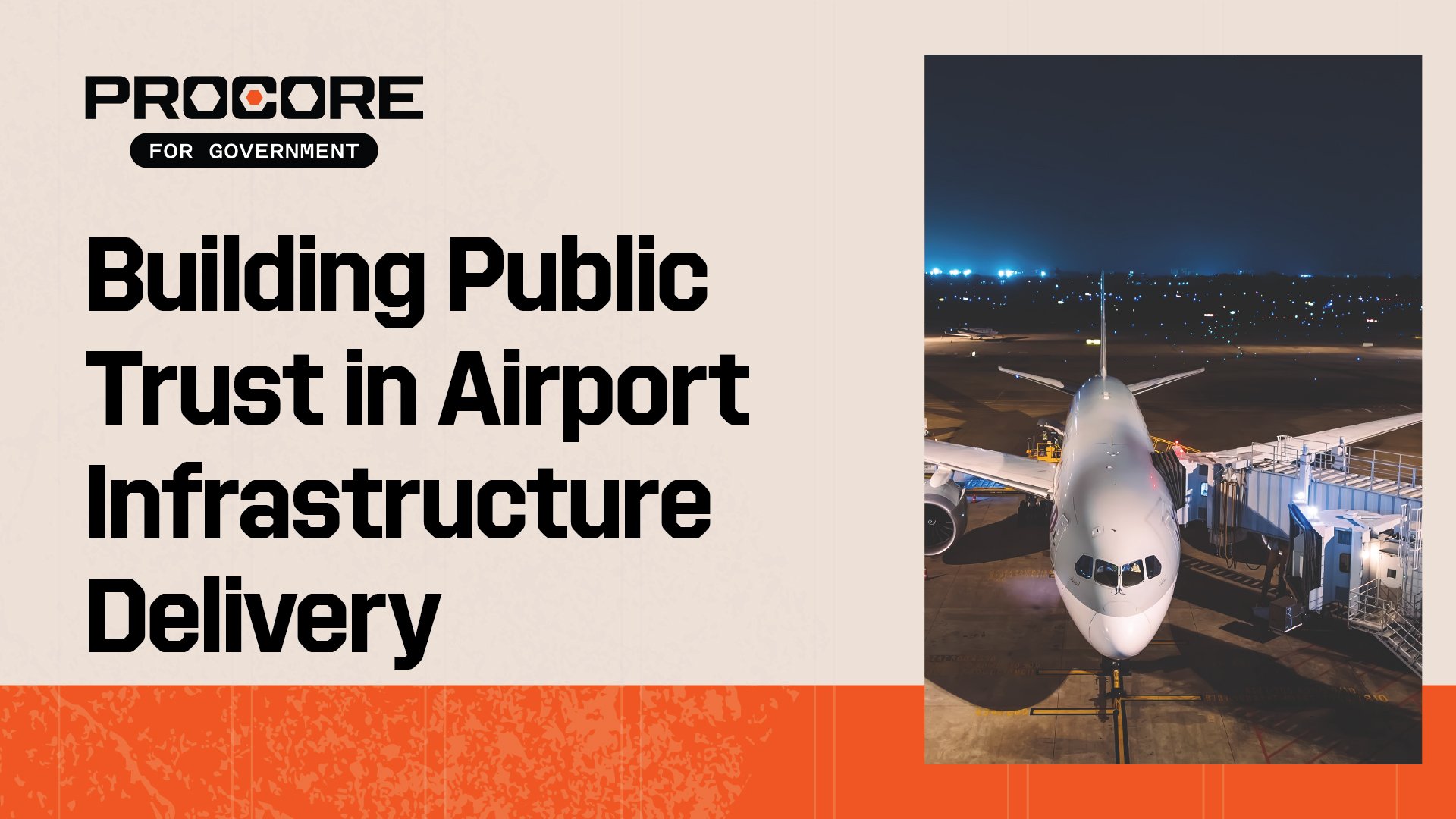
Building Public Trust in Airport Infrastructure Delivery
Airports are among the most visible and complex public infrastructure environments in the country. They are economic engines, transportation hubs, emergency response assets, and gateways for millions of passengers every year. As federal infrastructure investment continues to flow into aviation modernization, airport authorities are taking on ambitious capital programs that include terminal expansions, runway rehabilitation, sustainability improvements, security upgrades, and digital infrastructure enhancements.
But the challenge facing airport leaders is not simply how to build more. It is how to build with greater transparency, stronger accountability, and less disruption to daily operations.
Airport construction now sits at the intersection of public funding, regulatory oversight, operational continuity, and passenger experience. Every project must be delivered in a way that protects safety, maintains service, satisfies compliance requirements, and demonstrates responsible stewardship of public dollars. In this environment, trust is not a communications objective. It is an operational requirement.
Construction in a live operating environment
Unlike many capital projects, airport construction rarely happens behind closed gates or away from public activity. Work often takes place while aircraft are moving, passengers are boarding, security operations are continuing, and concession, baggage, maintenance, and ground transportation systems remain active.
That creates a delivery environment with little tolerance for error. A delayed gate project can affect airline schedules. A runway closure can influence capacity. A terminal improvement can alter passenger flow. A missed coordination point can create safety, security, or operational consequences.
Airport authorities must coordinate across a wide range of stakeholders, including airlines, contractors, consultants, Transportation Security Administration teams, Federal Aviation Administration representatives, local governments, tenants, and internal operations staff. Each group depends on timely, accurate information to make decisions and keep the airport functioning.
When communication is slow or project data is incomplete, small issues can quickly become larger operational risks.
Rising expectations for compliance and accountability
The current infrastructure environment has also increased pressure on airport authorities to demonstrate how funds are being managed. Many aviation programs rely on blended funding sources, including FAA Airport Improvement Program grants, Bipartisan Infrastructure Law allocations, state funding, local capital budgets, bond proceeds, and passenger facility charges.
Each funding stream may carry its own requirements, timelines, reporting expectations, and documentation standards. That means compliance cannot be treated as a final step at project closeout. It must be built into the full delivery lifecycle.
Airport leaders need to know whether funds are being spent as intended, whether procurement and reporting requirements are being met, and whether project records can withstand audit scrutiny. Oversight bodies, elected officials, funding partners, and the public all expect clear answers.
When project documentation lives across spreadsheets, email chains, shared drives, contractor systems, and legacy platforms, those answers become harder to produce. Teams may spend valuable time reconciling information instead of managing performance. In the worst cases, fragmented records can create audit findings, slow reimbursements, or put future funding at risk.
The problem with fragmented project data
Capital programs generate enormous amounts of information: budgets, schedules, contracts, change orders, inspections, field reports, drawings, risk logs, invoices, compliance records, and asset data. When these records are disconnected, airport authorities lose the single source of truth needed to manage confidently.
Fragmented data creates several recurring problems. Reports may differ depending on which system they come from. Cost and schedule issues may surface too late. Compliance documentation may be difficult to locate. Leaders may lack portfolio-level visibility across multiple projects. Operations teams may not receive the asset information they need when construction is complete.
This is not just a technology issue. It is a governance issue. Without consistent data standards, clear workflows, and shared visibility, even well-run teams can struggle to maintain control across large capital programs.
Data governance as a foundation for trust
For airport authorities, stronger data governance can become a practical foundation for better delivery. Governance ensures that project information is captured consistently, standardized across teams, accessible to the right stakeholders, and protected in secure environments.
When embedded into daily workflows, data governance supports more accurate reporting, faster decision-making, and stronger collaboration. It also creates the audit trail needed to demonstrate compliance throughout the project lifecycle.
This is especially important in public sector aviation, where decisions must be defensible. Leaders need confidence that the information they are using is current, complete, and reliable. Project teams need clarity on what data must be captured, who owns it, and how it will be used. Stakeholders need visibility without creating unnecessary administrative burden.
In this way, governance is not about adding bureaucracy. It is about creating the conditions for trust.
Connecting construction to operations
One of the most important moments in any airport capital project is the handoff from construction to operations. A project may be physically complete, but if asset records, warranty information, maintenance data, and closeout documentation are incomplete or difficult to access, the airport may still face delays in achieving full operational value.
This handoff gap can affect facilities teams, maintenance planning, asset management, passenger services, and long-term lifecycle costs. In a high-volume airport environment, incomplete information can quickly lead to inefficiency.
By maintaining continuity of data from planning through construction and activation, airport authorities can support smoother transitions, reduce rework, and enable operations teams with the information they need from day one.
A more transparent model for airport delivery
The future of airport capital delivery will depend on connected, defensible, and transparent program management. Leading agencies are moving toward integrated approaches that unify cost, schedule, field activity, compliance documentation, and operational readiness data.
This shift allows leaders to identify risks earlier, communicate progress more clearly, and demonstrate accountability at every stage. It also helps airport authorities move beyond reactive reporting toward proactive management.
As airports modernize to meet growing demand, the public sector has an opportunity to set a higher standard for infrastructure delivery. Success will not be measured only by new terminals, rehabilitated runways, or upgraded systems. It will be measured by whether those investments are delivered safely, transparently, compliantly, and with lasting value for the communities they serve.

Published by
About our partner
Procore
Procore helps public sector entities and their contractors manage and build construction projects through a secure, unified platform.Built for the industry, Procore’s unified technology platform drives efficiency and mitigates risk through AI & data-driven insights and decision making. Over three million projects have run on Procore across 150+ countries. For more information, visit https://www.procore.com/government.
Learn more





Help your peers
Share what you've learned with fellow public servants