

What Homer can Teach Us about Information Management in the Age of AI:
From oral tradition to digital accountability across Australia and New Zealand
By Brandon Voight, Fellow, Future Government Institute.
“Preservation is not passive. Information survives because someone recognises its value, provides context, protects its integrity and carries it forward.” |
A story carried across centuries
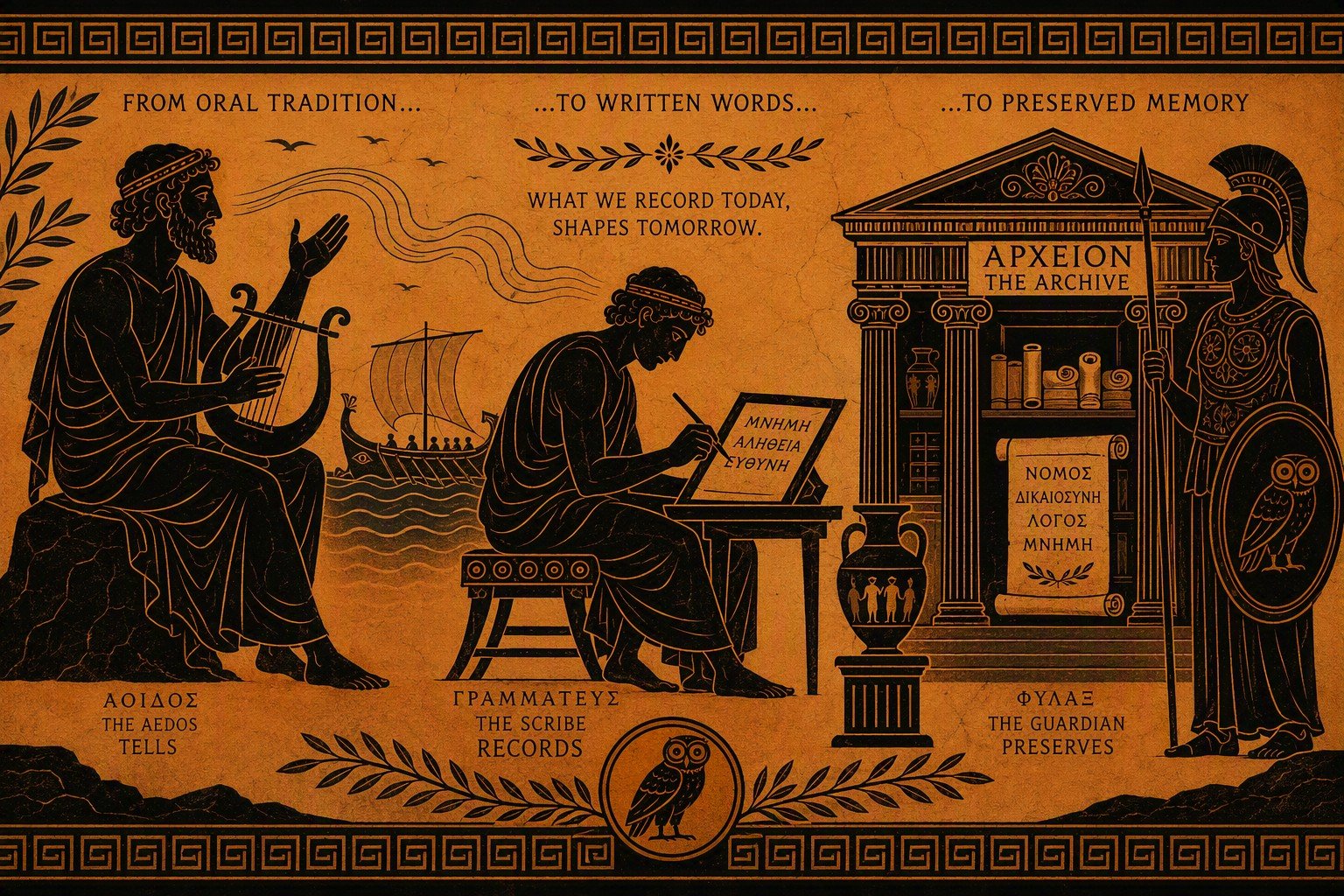
I recently watched “The Odyssey”, something I had been looking forward to as a long-time admirer of Greco-Roman culture, ancient history and Greek mythology. Beyond the adventure of Odysseus and his long journey home, the film prompted me to reflect on another remarkable journey: how Homer’s stories travelled across centuries to reach us.
The Iliad and the Odyssey emerged from a sophisticated oral tradition. Long before most people encountered them as written texts, their stories were performed, remembered and transmitted by generations of poets. The National Library of Australia’s collection includes G.S. Kirk’s Homer and the Oral Tradition, which examines the relationship between oral poetry and the literary epics that survive today. Modern scholarship recognises that the Homeric poems circulated through oral performance before being recorded in written form.
Had that chain of memory and performance been broken, or had the poems never been recorded, copied and preserved, we might have lost two of the foundational works of Western literature.
Preservation is not passive
The survival of Homer’s poetry reminds us that preservation does not happen by accident. In the ancient world, responsibility rested with oral poets, scribes, librarians and manuscript custodians. Today, it rests increasingly with records managers, information managers, archivists, data professionals and information-governance leaders.
Their work is sometimes described as administrative or technical. In reality, it is an act of institutional and cultural stewardship. Records provide evidence of decisions, protect rights and entitlements, enable accountability and preserve collective memory. An archive is not simply a repository of old material. It is infrastructure through which a society can understand what happened, why it happened and who was responsible. For government, this is fundamental to public trust.
The public record is evolving
Across Australia, recordkeeping obligations are being reshaped by digital government, cloud platforms, automated decision-making and artificial intelligence. At the Commonwealth level, the Archives Act 1983 continues to provide the legislative framework for preserving and using Commonwealth archival resources. Queensland’s Public Records Act 2023 provides a contemporary framework for making, managing and accessing public records for present and future generations.
Australia’s privacy framework is also developing. In August 2026, the Australian Government released proposed reforms through the draft Privacy Amendment (Personal Data Protection) Bill 2026. The consultation package includes proposals concerning fair and reasonable handling of personal information, data security and minimisation, consent and a proposed right to erasure in specified circumstances. These developments reinforce an important point: information management can no longer be separated from privacy, cybersecurity, risk, digital service delivery or AI governance.
A New Zealand perspective
Aotearoa New Zealand provides an equally important perspective. Under the Public Records Act 2005, public offices and local authorities must create and maintain full and accurate records, preserve information of long-term value and support public access and government accountability. Archives New Zealand describes information and records as strategic assets that underpin decision-making, public services, corporate memory and public confidence.
Archives New Zealand has also issued guidance specifically addressing AI. It states that outputs created using AI can be public and local-authority records and that organisations should document how AI affects the formation, capture and interpretation of information. This documentation supports integrity, context, transparency and accountability. That message has clear relevance on both sides of the Tasman.
AI makes records professionals more important, not less
There is a tendency to assume that AI will automate information management. It will certainly change the profession, but I believe it will also make records and information professionals more important, more visible and more influential.
The National Archives of Australia’s guidance confirms that AI-generated information is subject to the same Commonwealth records obligations as other government information. Agencies do not need to retain every prompt or output, but they should apply a consistent, risk-based approach. Prompts, source data and metadata may need to be retained when they provide necessary context or demonstrate how a decision was reached.
This is where professional judgement becomes indispensable. AI can generate content, identify patterns and recommend classifications, but it cannot independently determine what a society should remember, what evidence a future inquiry may require, or what context will be necessary to understand an automated decision years later.
Records professionals will increasingly help organisations answer critical questions:
- What information was used to train or inform an AI system?
- Which version of a record influenced a decision?
- Can the provenance and integrity of an AI-generated output be demonstrated?
- What must be retained for accountability, appeal, audit or historical value?
- What should be lawfully destroyed to reduce privacy, security and operational risk?
These are not back-office questions. They are questions of governance, ethics and public legitimacy.
From the archive to the public stage
Homer’s epics survived because generations took responsibility for transmitting them. Our digital records face a different set of risks: platform obsolescence, inaccessible formats, poor metadata, unmanaged collaboration environments, indiscriminate deletion and vast volumes of AI-generated content.
The response cannot be to keep everything forever. Nor can it be to assume technology will determine what matters. We need deliberate appraisal, defensible disposal, strong metadata, reliable context and long-term preservation.
I expect records managers, archivists and information managers to become increasingly public-facing figures in the age of AI. Their expertise will be needed in executive discussions, digital-transformation programs, privacy assessments, AI governance boards and public inquiries.
The essential task remains the same as it was in Homer’s world: ensuring that information of enduring value survives its journey. The difference is that today, the volume is greater, the technology is faster and the consequences of getting it wrong are far more immediate.
Sources
1. National Library of Australia: Homer and the Oral Tradition
2. National Archives of Australia: Information management for records created using AI technologies
3. Federal Register of Legislation: Archives Act 1983
4. Queensland Legislation: Public Records Act 2023
5. Attorney-General’s Department: Privacy Reform Consultation Paper
6. Archives New Zealand: Artificial intelligence and public records
7. Archives New Zealand: Key recordkeeping requirements of the Public Records Act 2005


Published by
About our partner
OpenText
OpenText™ is the leading Information Management software and services company in the world. We help organizations solve complex global problems with a comprehensive suite of Business Clouds, Business AI, and Business Technology. For more information about OpenText (NASDAQ/TSX: OTEX), please visit us at: Public Sector | OpenText
Learn more


Help your peers
Share what you've learned with fellow public servants