
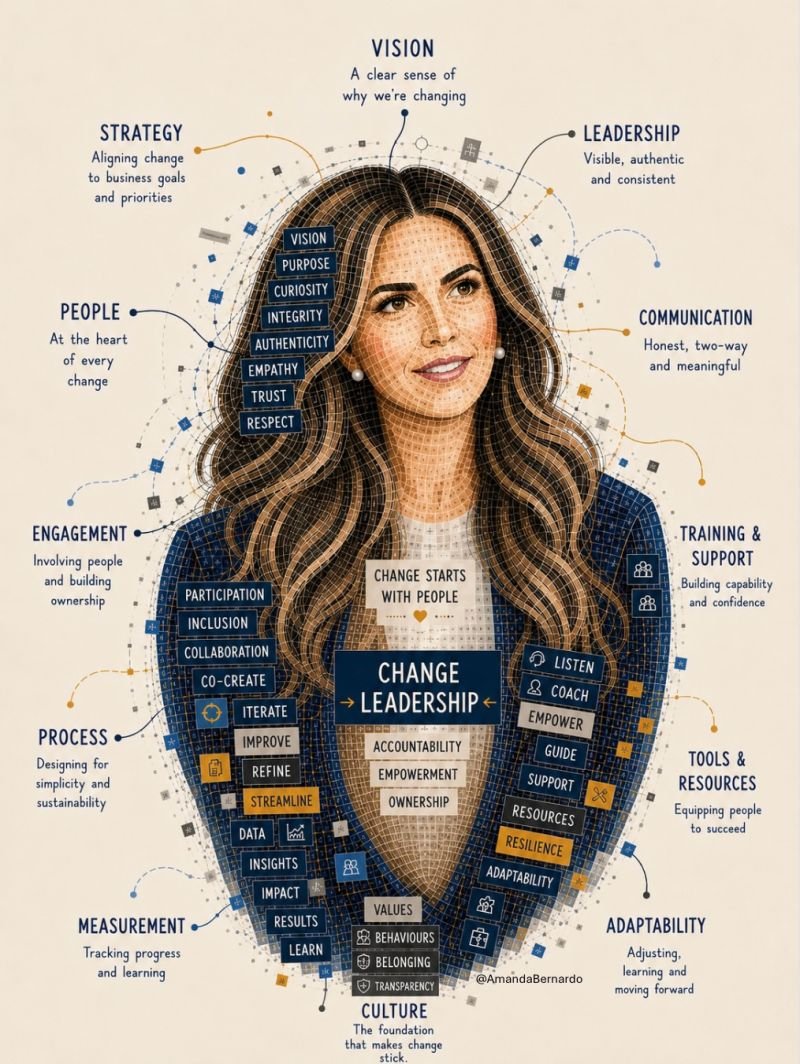
We need to stop treating change leadership as a specialty.
It’s leadership.
Every leader is leading change, whether they’re implementing a new strategy, hiring a team, navigating uncertainty, introducing AI, or simply asking people to work differently than they did yesterday.
Yet many still believe change belongs to project teams, change managers, or communications specialists.
It doesn’t.
Change leadership happens in the everyday moments. It’s the conversation after a difficult meeting. The decision to explain the why instead of simply announcing the what. It’s listening before solving. Creating clarity when others feel uncertain. Being visible when it would be easier to disappear. Building trust before asking for commitment.
When people think about organizational change, they often picture roadmaps, plans, communications, training, and dashboards.
Those things matter. But they’re only the visible pieces.
Underneath them are hundreds of leadership behaviours that determine whether people choose to follow.
- Empathy
- Curiosity
- Psychological safety
- Transparency
- Consistency
- Accountability
- Adaptability
- Coaching
- Recognition
These aren’t “soft skills.” They’re the infrastructure that makes transformation possible. The organizations that adapt fastest won’t necessarily have the best technology or the biggest budgets. They’ll have leaders who know how to help people move through uncertainty together.
If every leader saw themselves as a change leader, how different would our organizations look?









Help your peers
Share what you've learned with fellow public servants