
Tennessee’s government is reshaping how it delivers technology and services to citizens. In recent years, the state has accelerated its digital transformation—modernizing core systems, strengthening cybersecurity, and rethinking how procurement can serve as a bridge between innovation and accountability. With technology evolving faster than traditional procurement cycles, Tennessee is positioning itself as a model for how states can adapt to change while keeping citizen needs front and center.
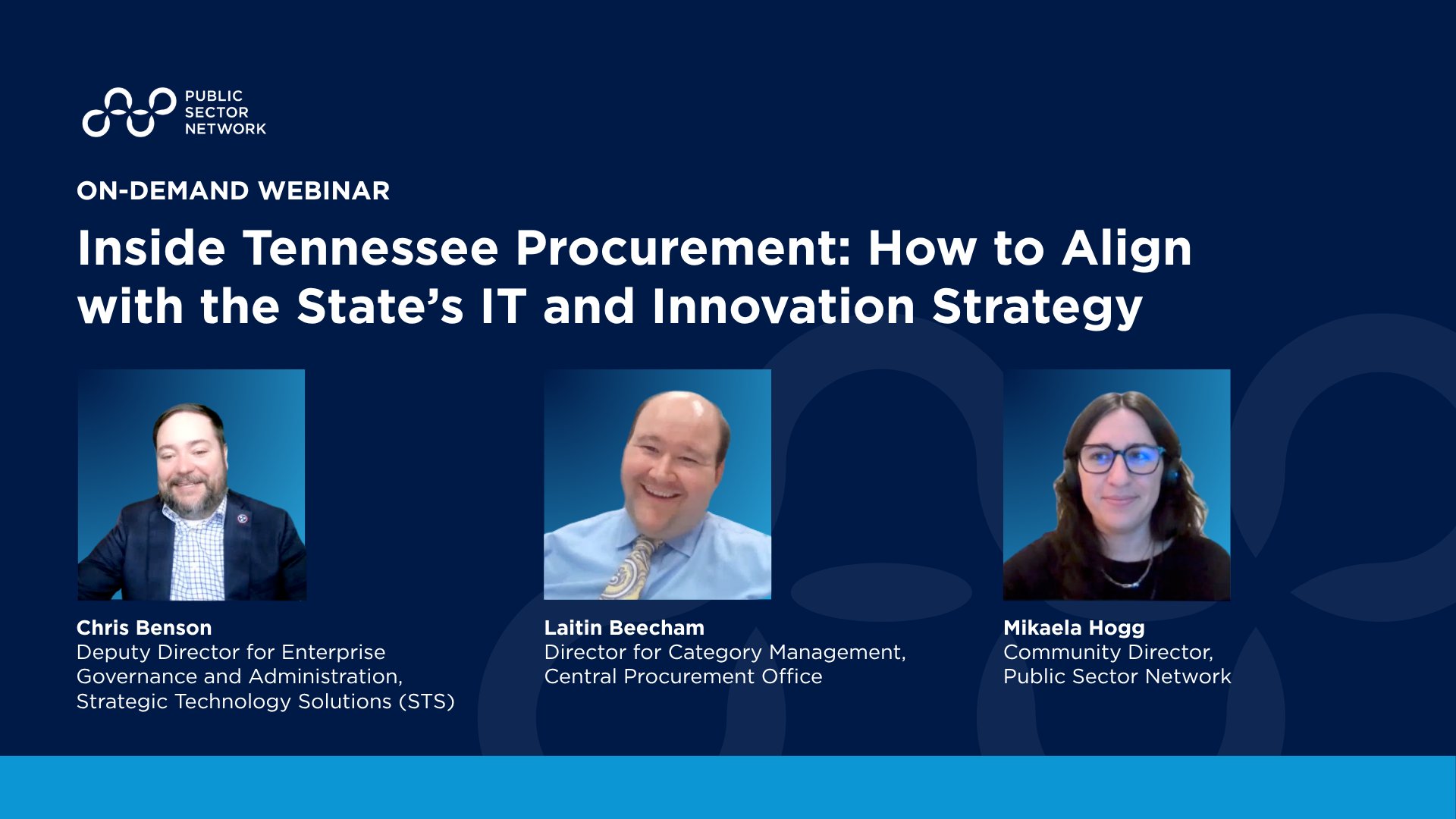
In a recent webinar, Mikaela Hogg, Community Director at Public Sector Network, led a discussion with Chris Benson, Deputy Director for Enterprise Governance and Administration at Strategic Technology Solutions (STS), and Laitin Beecham, Director for Category Management at the Central Procurement Office. Together, they explored how Tennessee is modernizing IT infrastructure, evolving procurement practices, and building a culture of innovation across government.
From AI innovation and cybersecurity to procurement modernization and compliance, the state is rethinking how it partners with the private sector to deliver digital value for Tennesseans. For vendors, this conversation offers a rare inside look at how to align solutions with Tennessee’s priorities, engage effectively through RFPs and cooperative contracts, and contribute to the next wave of government modernization.
📺 Watch the full webinar featuring Chris Benson and Laitin Beecham by downloading the video at the bottom of this article or by clicking here.
Q&A Highlights
How does Tennessee define IT success?
Tennessee’s IT leaders emphasize that technology success is about public impact, not system counts or modernization metrics. The real measure of progress lies in how digital services improve everyday experiences for Tennesseans and support the employees who deliver them. For vendors, that means aligning solutions with tangible service outcomes and citizen benefit, not just technical performance.
Key Takeaways:
- Lead with citizen impact and service outcomes.
- Demonstrate how your solution drives reliability, security, and user experience.
- Show measurable improvement in how agencies deliver public value.
Tennessee measures IT success through the reliability, security, and effectiveness of its digital services—focusing on how technology improves access, simplifies processes, and enables employees to better serve residents across the state.
What priorities are shaping IT strategy in the year ahead?
The state is investing in AI, data analytics, and system modernization to accelerate efficiency and improve outcomes. Tennessee has established an AI Innovation Lab and is strengthening its data infrastructure to ensure agencies can adopt emerging tools responsibly. Vendors should be prepared to support initiatives that merge innovation with governance, emphasizing scalable, secure, and ethical technology use.
Key Takeaways:
- Expect increased demand for AI-ready and data-driven solutions.
- Prioritize data governance and integration capabilities.
- Align offerings with long-term modernization and cloud goals.
Tennessee’s technology priorities center on alignment—ensuring modernization, cybersecurity, data, and AI initiatives move in sync to create measurable value for both agencies and citizens. This coordinated approach ensures innovation remains secure, data-driven, and directly tied to improved public services.
What external factors are driving procurement evolution?
Procurement in Tennessee is adapting to new compliance and accessibility requirements, particularly under the Americans with Disabilities Act (ADA). Vendors must ensure digital assets and services meet accessibility standards. The state’s participation in the NASPO Cloud and Software Solutions cooperative also signals a move toward faster, pre-vetted technology contracts—opening the door for more agile partnerships.
Key Takeaways:
- Accessibility compliance is a non-negotiable requirement.
- Participation in NASPO cooperative contracts can shorten time to market.
- Build accessibility and compliance into every proposal and deliverable.
All state documents and mobile applications, including those developed by third-party vendors, must now meet ADA accessibility standards. This requirement reflects Tennessee’s broader modernization approach, ensuring that digital government services are designed to be inclusive and accessible to every resident, regardless of ability.
How do national trends influence Tennessee’s approach?
Rapid technological advancements, particularly in AI, have exposed the limitations of traditional RFP processes. Tennessee is adopting more agile and outcomes-based procurement models to keep pace. Vendors who can demonstrate adaptability, speed, and a strong understanding of evolving public-sector needs will find themselves well-positioned to partner with the state.
Key Takeaways:
- Be ready for faster, more flexible procurement cycles.
- Offer iterative delivery models and responsive implementation plans.
- Emphasize your ability to adapt to evolving technologies mid-project.
As technology continues to evolve rapidly, Tennessee is rethinking how it procures and deploys new systems to ensure its processes move at the same pace as innovation. This shift is helping the state stay ahead of change while giving vendors room to propose more adaptive, future-ready solutions.
What pressures shape Tennessee’s IT strategy?
Like most states, Tennessee is balancing innovation with limited resources, growing cyber threats, and workforce challenges. The focus is on enterprise-level projects that deliver measurable value across agencies. Vendors who can deliver scalable, secure, and cost-effective solutions that enhance efficiency are most aligned with this strategy.
Key Takeaways:
- Design solutions for statewide scalability and efficiency.
- Highlight measurable ROI and workforce impact.
- Align proposals with sustainability and operational improvement goals.
Tennessee’s IT strategy centers on enterprise solutions that deliver broad value across agencies. The state aims to balance modernization with sustainability by prioritizing high-impact projects, committing the right resources, and ensuring successful delivery rather than spreading efforts thin across multiple smaller initiatives.
How does Tennessee engage with vendors and peers to drive innovation?
The state takes an open and collaborative approach to innovation, learning from both successes and failures in other jurisdictions. Through RFIs, sandbox environments, and national partnerships, Tennessee is continuously evaluating new tools and methods. Vendors who share lessons learned and engage early in the process can help shape requirements before formal procurement begins.
Key Takeaways:
- Engage early through RFIs, demos, and pilot discussions.
- Share insights and lessons learned from other state projects.
- Build trust by positioning yourself as a knowledge partner, not just a vendor.
Tennessee’s technology leaders place equal value on learning from what hasn’t worked as from what has. Recognizing that not every project goes according to plan, the state emphasizes open collaboration and the sharing of both successes and setbacks as a way to strengthen outcomes and avoid repeating common challenges.
What can vendors do to better align with Tennessee’s goals?
Tennessee’s technology strategy is transparent and publicly available. Vendors who study it and tailor their proposals to align with statewide priorities—such as cybersecurity, AI governance, and citizen experience—stand out. The state values understanding, collaboration, and commitment to shared outcomes over one-size-fits-all solutions.
Key Takeaways:
- Review Tennessee’s strategic IT and procurement frameworks.
- Tailor offerings to support specific agency priorities.
- Lead with partnership and solution alignment, not product features.
Vendors that make the biggest impact are those who take time to understand Tennessee’s strategic initiatives and align their proposals accordingly. Generic, one-size-fits-all pitches rarely stand out. The most effective partners demonstrate how their solutions strengthen cybersecurity, enhance citizen experience, and support the state’s long-term digital goals.
What are the foundational digital priorities for FY26?
Tennessee’s digital roadmap includes several large-scale initiatives: the MyTN mobile app, the Business Gateway, a single digital identity, ERP modernization, and AI governance. These efforts are designed to make citizen and business interactions with government seamless, secure, and consistent. Vendors with expertise in integration, data security, and digital experience design will find strong alignment here.
Key Takeaways:
- Prioritize offerings that enhance interoperability and usability.
- Support unified digital platforms through integration and identity tools.
- Demonstrate how your solution simplifies citizen or business interactions.
Business Gateway will streamline how entrepreneurs and companies interact with multiple agencies through a single digital experience. In parallel, Tennessee is advancing a single digital identity, a modernized ERP system, and robust AI governance—all foundational elements shaping how the state will deliver digital services in the years ahead.
Both procurement leaders emphasized collaboration as the foundation for success. Tennessee seeks partners who bring creativity, transparency, and shared purpose—not just technology. For companies pursuing opportunities with the state, the path forward is clear: collaborate early, align with citizen-focused outcomes, and treat innovation as a team effort.
Tennessee’s technology and procurement leaders are proving that transformation happens through partnership, agility, and purpose. Their message is clear: success in government IT depends on collaboration between public and private sectors, a shared focus on citizen outcomes, and a willingness to innovate responsibly.
Watch the full conversation to hear directly from Chris Benson and Laitin Beecham as they discuss Tennessee’s 2026 digital strategy, AI innovation, and the future of public procurement.
👉 Download the full video here.









Help your peers
Share what you've learned with fellow public servants