

Managing Up
I wish I’d known how important Managing Up and Stakeholder Management were earlier on in my 10-year career as a Commissioned Officer in the British Royal Air Force.
It would certainly have made my life - and my managers’ lives - a lot easier! And I’d very likely have had a much smoother career path without the millstone around my neck of being that bolshy, ‘pain in the proverbial’ troublemaker some of my bosses saw me as…
Part of the challenge is that ‘Managing Up’ and ‘Stakeholder Management’ are often seen as these nebulous necromancer-like charms, and/or associated with manipulation, spin and marketing BS (far too much of all that around, that’s for sure!).
When done ethically with integrity, however, Managing Up and Stakeholder Management are most definitely NOT manipulation, spin and marketing BS. Nor are they charms or spells reserved for wizards and whisperers.
Another part of the challenge is we don’t really know what Managing Up means in terms of actions in our day-today workplaces.
“You need to Manage Up better, Simon!” Me: “Um yeah, I know… urgh, how do I actually do that?”
There’s also often the misconception that Managing Up is all about ‘kissing your manager’s proverbial’ and being a ‘yes person’. It most definitely is not about doing either of those things.
Many of us are also under the misconception that Managing Up is really something you only need to develop as you get more senior in the leadership hierarchy.
Again, it most definitely is not – It will benefit you at every level of your career, which I know all too well with my blindingly bright 20:20 hindsight!
If you’re working in any sort of workplace or team, or running your own business as your own boss, you will need to Manage Up sooner rather than later.
Yes, it does become more critically important as you climb the management ladder (over 90% of all 1:1 Executive Coaching programs we do at SCC&D contains a good element of coaching around Managing Up, so if you’re getting Executive Coaching, make sure Managing Up is on your development agenda).
When I founded Southern Cross Coaching & Development in 2006, I can remember congratulating myself that as I was now the CEO, I’d never have to Manage Up again…oh how terribly naïve I was! 🤦♂️
Levels and Definitions of Managing Up
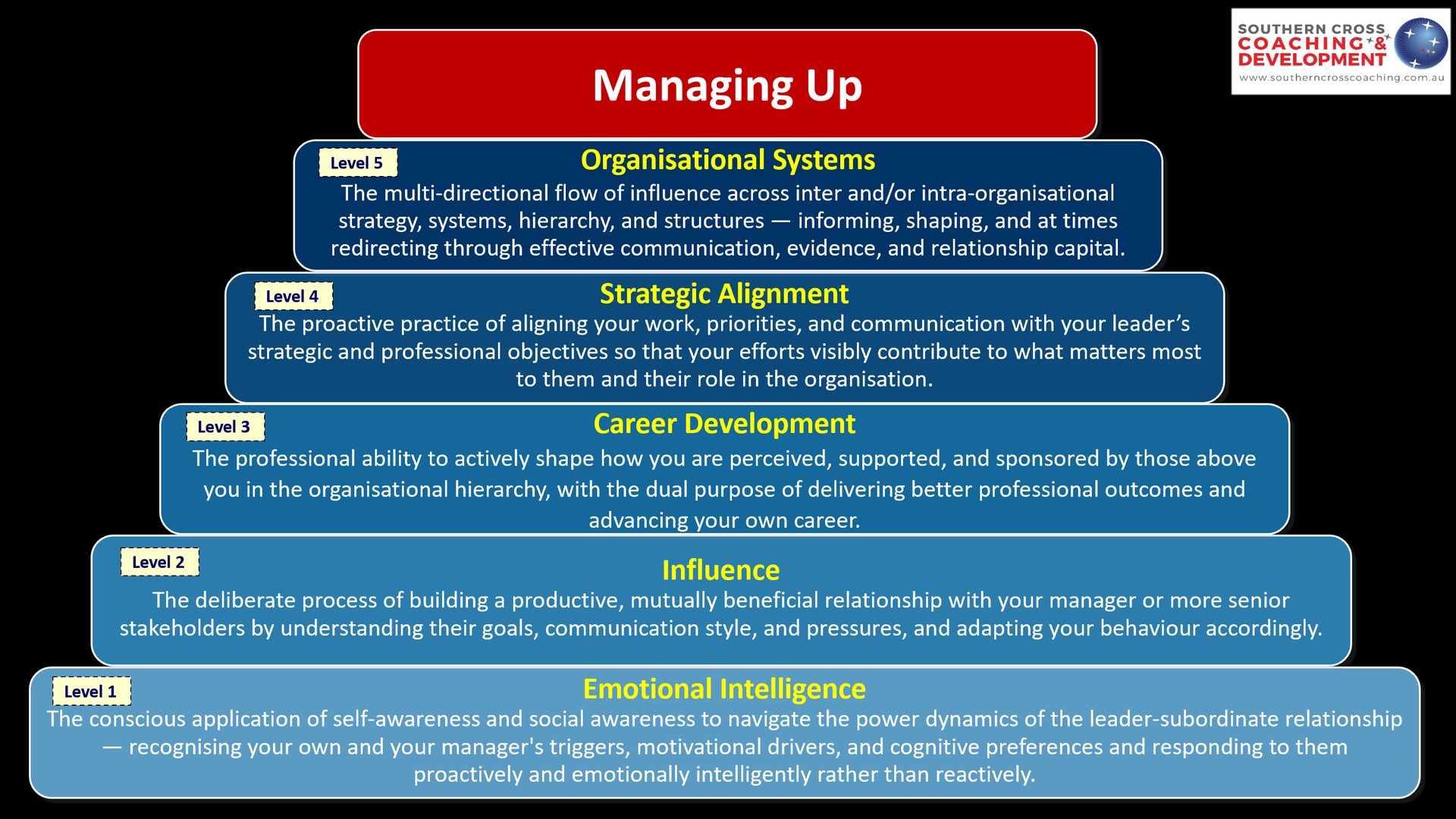
Here at Southern Cross Coaching & Development, we break down Managing Up (which includes Stakeholder Management) into 5 distinct and defined levels:
Level 1: Emotional Intelligence
The conscious application of self-awareness and social awareness to navigate the power dynamics of the leader-subordinate relationship.
Recognising your own and your manager's triggers, motivational drivers, and cognitive preferences and responding to them proactively and emotionally intelligently rather than reactively.
Level 2: Influence
The deliberate process of building a productive, mutually beneficial relationship with your manager or more senior stakeholders by understanding their goals, communication style, and pressures, and adapting your behaviour accordingly.
Level 3: Career Development
The professional ability to actively shape how you are perceived, supported, and sponsored by those above you in the organisational hierarchy, with the dual purpose of delivering better professional outcomes and advancing your own career.
Level 4: Strategic Alignment
The proactive practice of aligning your work, priorities, and communication with your leader’s strategic and professional objectives so that your efforts visibly contribute to what matters most to them and their role in the organisation.
Level 5: Organisational Systems
The multi-directional flow of influence across inter and/or intra-organisational strategy, systems, hierarchy, and structures — informing, shaping, and at times redirecting through effective communication, evidence, and relationship capital.
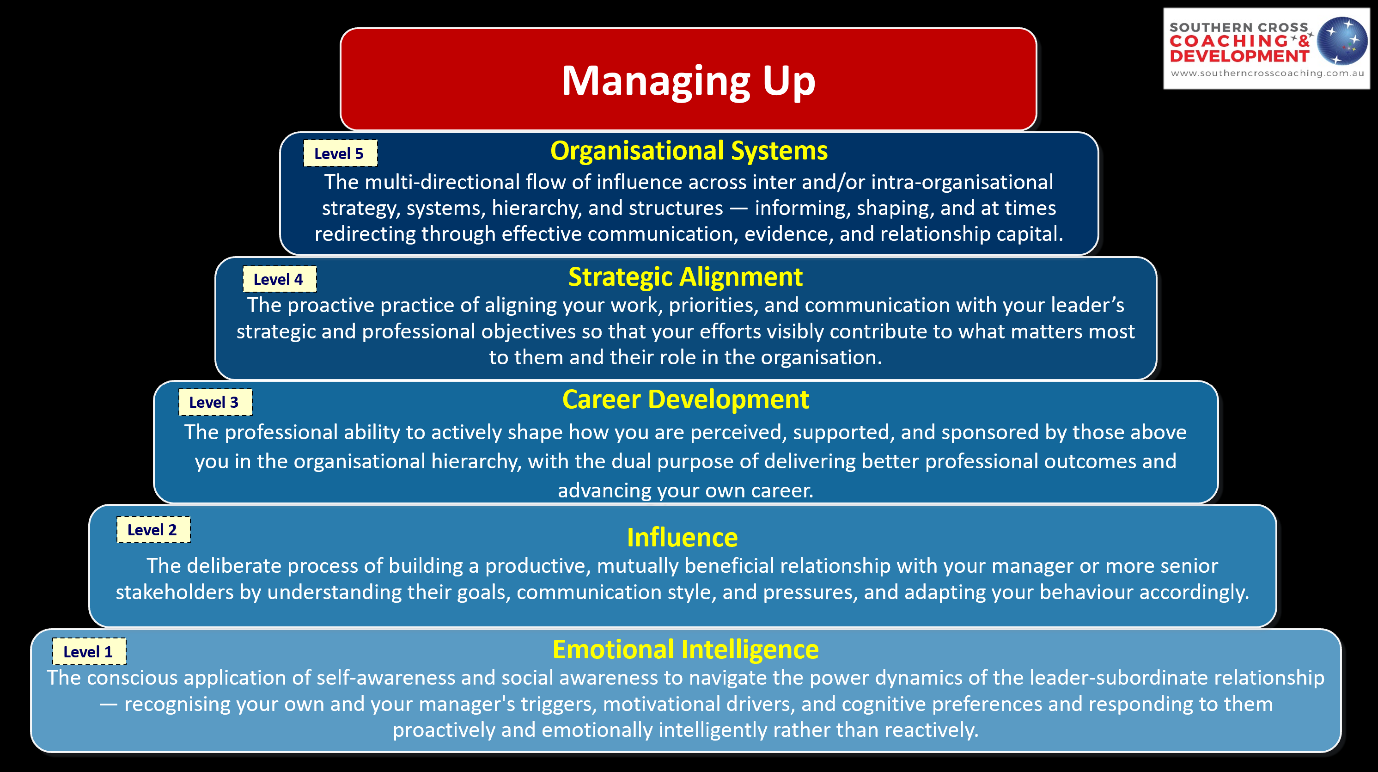 While there are 5 quite distinct and separate levels, practically there are many overlaps and interconnections.
That said, I 💯% recommend you start at Level 1 and 2 of the pyramid and build your skills from there.
Level 1 and Level 2 skills are the foundational skills you’ll need to build on to be at your peak effectiveness as you step up through the levels.
Do the Managing Up levels equate to seniority?
In many ways, yes, they do, but the Level 1 and 2 skills are still just as important at the top of the pyramid.
Level 1 and 2 skills are generally what you need to focus most on and what will be the most effective early on in your career – and they’re the foundational skills you’ll need to mature when you start cultivating your Level 3-5 skills.
For example, at Level 3, where you’re proactively focusing on and managing your Managing up from a Career Development perspective you need to have competent mastery of Levels 1 and 2 to be effective.
As you get more senior, Levels 4 and Levels 5 become your Managing Up and Stakeholder Management focus, where things can get markedly complex in many organisations and roles – and you’ll need advanced Level 1 and 2 skills.
Is Managing Up just about my Manager?
No. That’s a big part of it of course - and usually that’s where it’s best to focus your Level 1 and 2 efforts as that will likely get you the best outcomes, especially early in your career.
Managing Up covers a range of Stakeholder Management and Influencing skills that apply to influencing and managing many stakeholders inside and outside your team and organisation, in addition to your immediate manager.
How many levels above me do I need to Manage Up?
That’s an important and incisive question.
As a rule of thumb, you need to be Managing Up to your Manager and ideally at least your Manager’s Manager - and sometimes beyond that.
What’s the thinking around that?
I’ll tell you a short - true - story to illustrate the point.
I once coached a senior executive (I’ll call him Pablo, not his real name), who came to me because he was on the verge of either being fired by his CEO (I’ll call him Sandy) or quitting.
Pablo just couldn’t understand what he was doing wrong. He was regularly and comprehensively briefing his boss on how well his team were working together, how engaged they were, the great feedback they got from clients, how they walked the talk of company values and integrity, and more - like he used to do with his old boss who Sandy took over from.
What Pablo failed to see was that while Sandy did deep down genuinely care about Pablo’s leadership and his team, Sandy had very different Career Development (Level 3), Strategic Alignment (Level 4) and Organisational Systems (Level 5) agendas she was managing up to.
Sandy’s boss was a Vice-President in New York (I’ll call her Ally). Ally’s boss was Senior Vice-President reporting to the Global CEO.
One aspect was that while Sandy did care about the people, Sandy actually felt threatened by Pablo’s constant narrative on his well respected, very human leadership - because Sandy was not good at ‘people, culture and engagement leadership stuff’, and she felt Pablo potentially showed her up where she felt she was lacking. Not helpful for Pablo’s Level 3 Career Development Managing Up!
More importantly, Sandy’s boss Ally didn’t really care about the people at all – and this is what Sandy in particular had to Manage Up to (Level 4, Strategic Alignment).
All Ally cared about was the numbers, the revenue, the profit margin, the deals pipeline value, and the percentage chance a deal would get finalised, and by when.
That’s what Ally had to report to the Global CEO because that’s they cared about and ultimately reported on to the Board (Level 5, Organisational Systems), and that’s what she needed from Sandy.
It wasn’t about changing Pablo’s passion for leading and looking after his team – that was what made him so successful at what he did, and we didn’t want to interfere with or undermine his major strengths.
What we worked on was a detailed analysis of the entire chain of stakeholders Pablo had to report up to, and what information they needed and consequently what Pablo needed to deliver and report up the chain.
When briefing Sandy, Pablo started to align his narrative with and communications to what mattered most to Sandy – the all-important numbers and narrative around the numbers…which was what she had to report on to Ally…
We realised that Sandy very likely had ambitions to step into Ally’s shoes in the future, so Pablo’s adaptation of what he reported also made Sandy feel supported by Pablo as it put Sandy in a good spotlight with Ally. Which in turn cascaded down to Pablo.
The outcome of the story was that from considered Managing Up, Pablo’s situation completely turned around.
Within a few months Pablo went from constantly looking over his shoulder waiting to be fired and looking around for a potential new job, to building deep trust with Sandy - to the point where she trusted Pablo to step into her role on a regular basis.
Pablo still manages his team in his deeply human, thoughtful and supportive leadership style - he hasn’t changed who he is or what he stands for.
What Pablo learned was how to Manage UP not just to his immediate boss and stakeholders, but to look more deeply and widely across the organisation and adapt his upwards management style accordingly.


Published by
About our partner
Southern Cross Coaching & Development
2025 Best Training & Development Program award, Defence and National Security Workforce Awards Australia; 2025 Mentor of the Year, Gold Titan International Awards; Finalist Training & Mentoring Program of the Year, Australian Defence Industry Awards (national).NEUROSCIENCE-based.Leadership and People Development training, Executive Coaching (also with 360-degree assessments), Emotional Intelligence, Change Management and Resilience, and more. Job Application and Interview Skills training. Panel Recruitment Skills Training.Highly practical, extremely down to earth, individualised. ALL of our programs translate directly into real life action and results.30% INCREASE IN PRODUCTIVITY: that's what our clients tell us our innovative, but super-simple TOAD (TM) Coaching Leadership tool has achieved! Ask us about it, we’re happy to come & talk to you to discuss it. 26% INCREASE IN PRODUCTIVITY: That's what Gartner told us our Giving and Receiving Feedback program produced for a large NSW Government department.We deliver solutions from a single training or coaching program to multi-site, multi-team programs across Australia and the Asia Pacific Japan region.SES & Executives, Middle Managers, Managers through to Front Line Staff.📨: [email protected] 📱📞 +61 2 7901 5618 🌐www.southerncrosscoaching.com.au For our Coaching Assignments, we have our unique Coach/Coachee Matching Matrix. We've never got a coach/ coachee match wrong since we started using our unique Coach/Coachee Matching Matrix in 2007!We are specialists in neuroscience-based Coaching Culture Leadership. Our clients tell us our innovative but super-simple TOAD (TM) Coaching Leadership tool is revolutionary and makes a real difference in the workplace (and at home!).Full Qualification Status - NSW Government Pre-qualification Scheme SCM-0005: Performance & Management Services. Supplier for Department of Defence (DLB and DSTG across the ADF, APS/ EL1-2 and SES).
Learn more



Help your peers
Share what you've learned with fellow public servants