
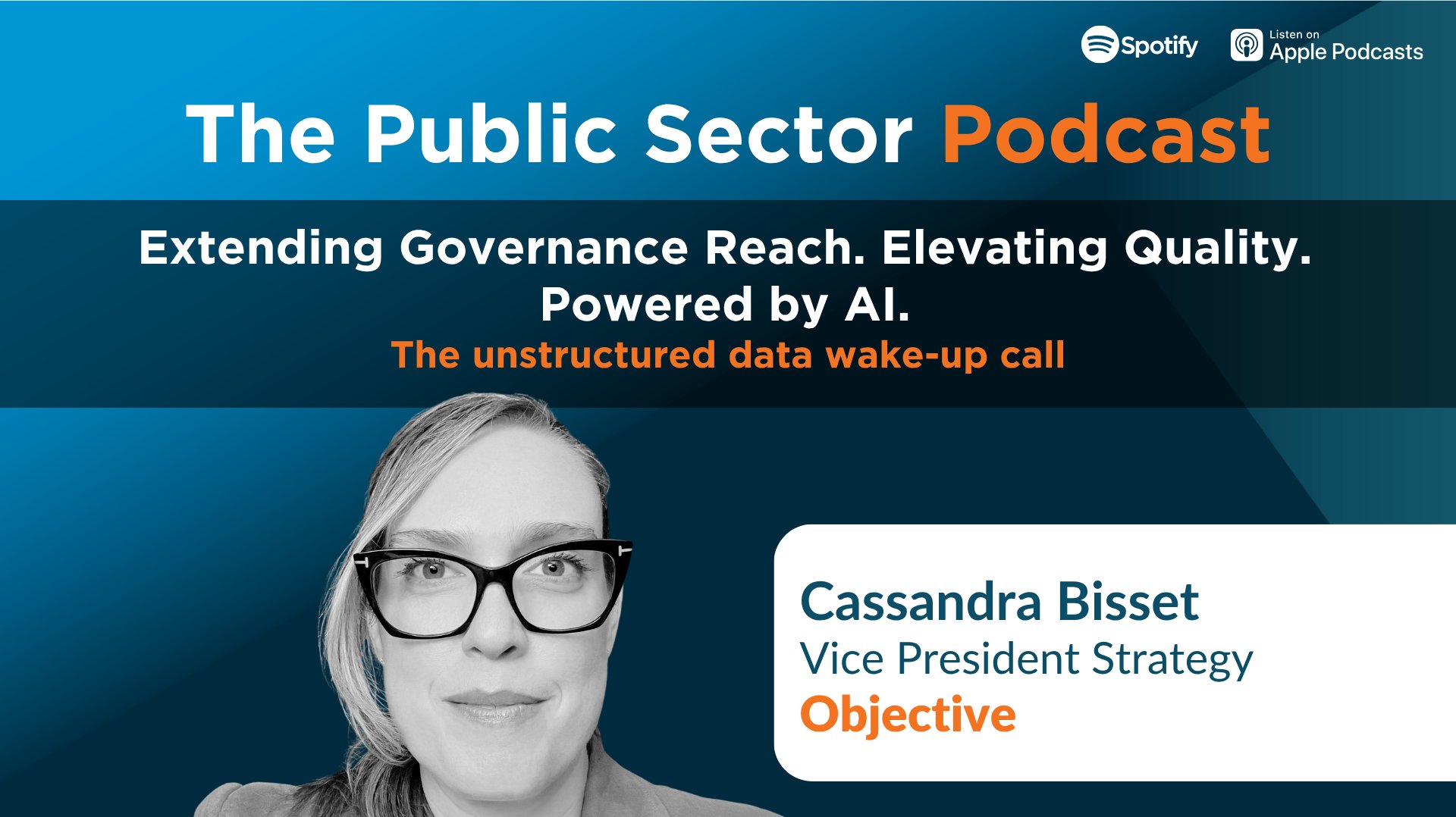
This episode is brought to you by Objective.
Objective creates software that makes a difference. Helping public sector organisations take control of their information; strengthening governance, reducing risk, and enabling better decisions. Because when information is trusted, everything works better. As AI reshapes how governments operate, trusted information isn’t optional; it’s critical. That’s why the public sector relies on Objective.
Episode Overview
In this episode, Cassandra Bisset, Vice President Strategy, Objective rewinds back to last year’s Innovate VIC and reflects on how quickly the AI and digital landscape has shifted. What felt like emerging opportunity and uncertainty 12 months ago is now a full-speed acceleration, with public sector leaders facing growing pressure to embed AI into projects while still managing trust, risk, and constrained budgets.
Drawing on global signals from events like SXSW and insights on “convergence”, Cassandra makes the case that the challenge is no longer tracking trends. It is building the capability and foundations to deliver outcomes as expectations rise, resources tighten, and the pace of change continues to climb.
Key Themes
A central theme is readiness over hype: AI progress is moving faster than many governance, policy, and workforce structures can adapt, and that gap is widening. The episode also highlights the shift from quick productivity wins to deeper transformation, where the biggest returns come from reshaping major activities and service outcomes, not just saving minutes in a day.
Another recurring theme is trust. With AI project failure rates sitting around 50% in global analysis, the episode stresses that the missing piece for many organisations is not ambition. It is clarity on “what good looks like”, strong information foundations, and practical implementation pathways that prevent dead ends and rebuild confidence.
What You’ll Learn
1) From Last Year’s Conversations to Today’s Reality
What dominated the discussion at Innovate VIC last year and why the last 12 months have changed the urgency and expectations.
2) Why the Pace of Change Now Demands Long-Range Thinking
How global signals are pushing leaders to plan beyond “the next problem in front of us” and prepare for what will be expected in 10 to 20 years.
3) The Public Sector Funding and Capacity Tension
Why “do more with less” is colliding with rising digital expectations, and how that is shaping priorities and investment decisions.
4) Productivity vs Transformation (and Where the Real Returns Are)
What Gartner-style value frameworks suggest about why low-effort productivity plays often disappoint, and why the bigger gains come from tackling complex, high-impact change.
5) Why So Many AI Projects Fail
What sits behind failure rates, including unclear pathways, lack of shared examples, and the absence of a visible breadcrumb trail for implementation.
6) Data Readiness, Unstructured Information, and Trust
Why unstructured information is often where the most valuable business questions live, and how poor information quality erodes confidence in AI outputs.
7) “Dull AI” and the Foundations That Make AI Work
Why governance, classification, information integrity, and audit-ready controls are the enabling layer for sustainable AI, not optional “boring work”.
Key Takeaways
- The pace of AI change has outstripped most organisational readiness
- “Do more with less” is intensifying the pressure to prioritise the right use cases
- The biggest value often comes from reshaping major activities, not small productivity boosts
- AI success depends on trusted, curated, AI-ready information, especially unstructured content
- High failure rates highlight the need for clearer implementation pathways and shared “what good looks like” examples
- “Dull AI” foundations enable a future Trust Centre where answers stand up to audit and public trust expectations
Why You Should Listen
This episode is for public sector leaders, policy teams, digital and data professionals, and transformation teams who are navigating AI pressure, budget constraints, and growing expectations, and want a grounded view of what it takes to move from prototypes to trusted, high-value outcomes.
Memorable Line of Thinking
The shiny tools are not the hard part. The organisations that win will be the ones that do the foundational work that makes AI trustworthy, sustainable, and useful at scale.





Help your peers
Share what you've learned with fellow public servants