
Queensland’s Digital Government Pulse: Priorities, Barriers, and the Road Ahead
As digital transformation reshapes Australia’s public sector, Queensland leaders are navigating a landscape where automation, workforce culture, and technological disruption dominate the agenda. Recent polling provides a comparative look at Queensland’s digital priorities and barriers against national benchmarks, offering fresh insights into where the state is leading and where gaps remain.
The results reveal a clear emphasis on transforming and automating processes, paired with a strong focus on workplace culture and upskilling. At the same time, Queensland agencies are candid about lagging in workforce strategies, with talent shortages and flexible work opportunities emerging as sharper challenges than elsewhere in the country. Interestingly, technological disruption — rather than budget pressures — stands out as Queensland’s biggest external challenge, underscoring the state’s awareness of the risks posed by the digital divide and the pace of technological change.
These findings set the stage for a closer examination of Queensland’s approach to digital government. From collaboration and service expansion to data utilisation and talent management, the polling results highlight both the opportunities Queensland is seizing and the risks it must address to build a digitally mature, citizen-centred public sector.
Queensland’s Digital Priorities: Driving Automation and Workforce Culture Forward
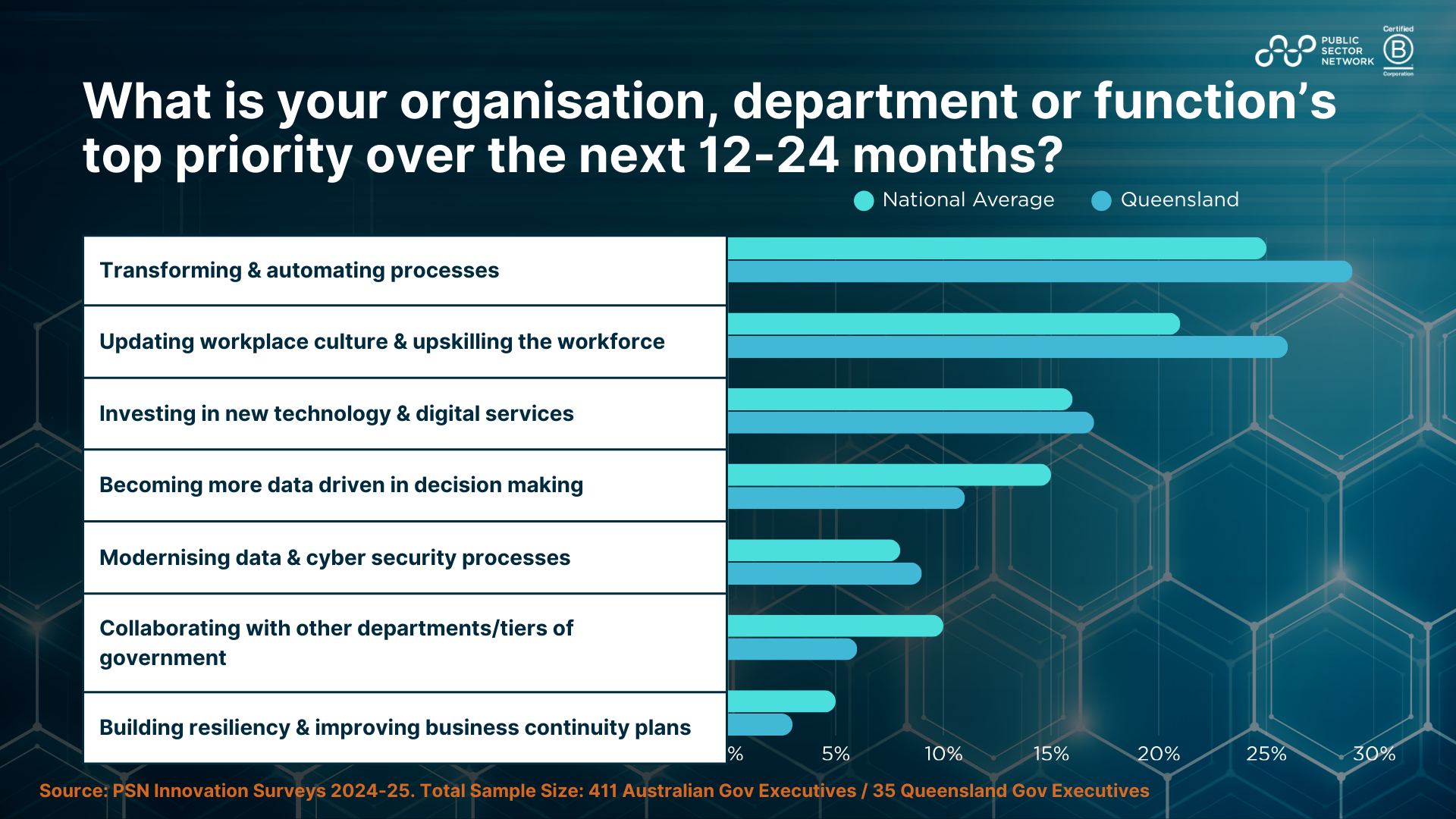 Queensland’s leading priority is transforming and automating processes (29%), sitting four percentage points above the national average (25%). This result demonstrates the state’s strong alignment with broader national ambitions to harness technology for improving efficiency, productivity, and customer experience. It also reflects the prevailing global trend where automation is viewed as a key enabler of digital government service delivery.
The most marked difference between Queensland and the national average is in updating workplace culture and upskilling the workforce, where Queensland recorded 26% compared to 21% nationally. This signals a heightened recognition across the state of the pressing need to modernise organisational culture and equip the public sector workforce with future-ready digital skills. It highlights a strong local focus on preparing people, not just systems, for the evolving digital environment.
Conversely, Queensland was notably less focused on becoming more data driven in decision making (11%) than the national benchmark of 15%. This suggests that, while other jurisdictions may be prioritising data as a strategic asset, Queensland agencies appear more immediately concerned with human capability and operational transformation.
Collaboration with other departments and tiers of government was also a lower priority in Queensland (6% versus 10% nationally). This gap points to an opportunity for greater emphasis on inter-agency partnerships, which are widely recognised as essential to unlocking shared digital infrastructure and ensuring coherent citizen services.
Queensland’s Innovation Barriers: Balancing Budgets with Skills for the Future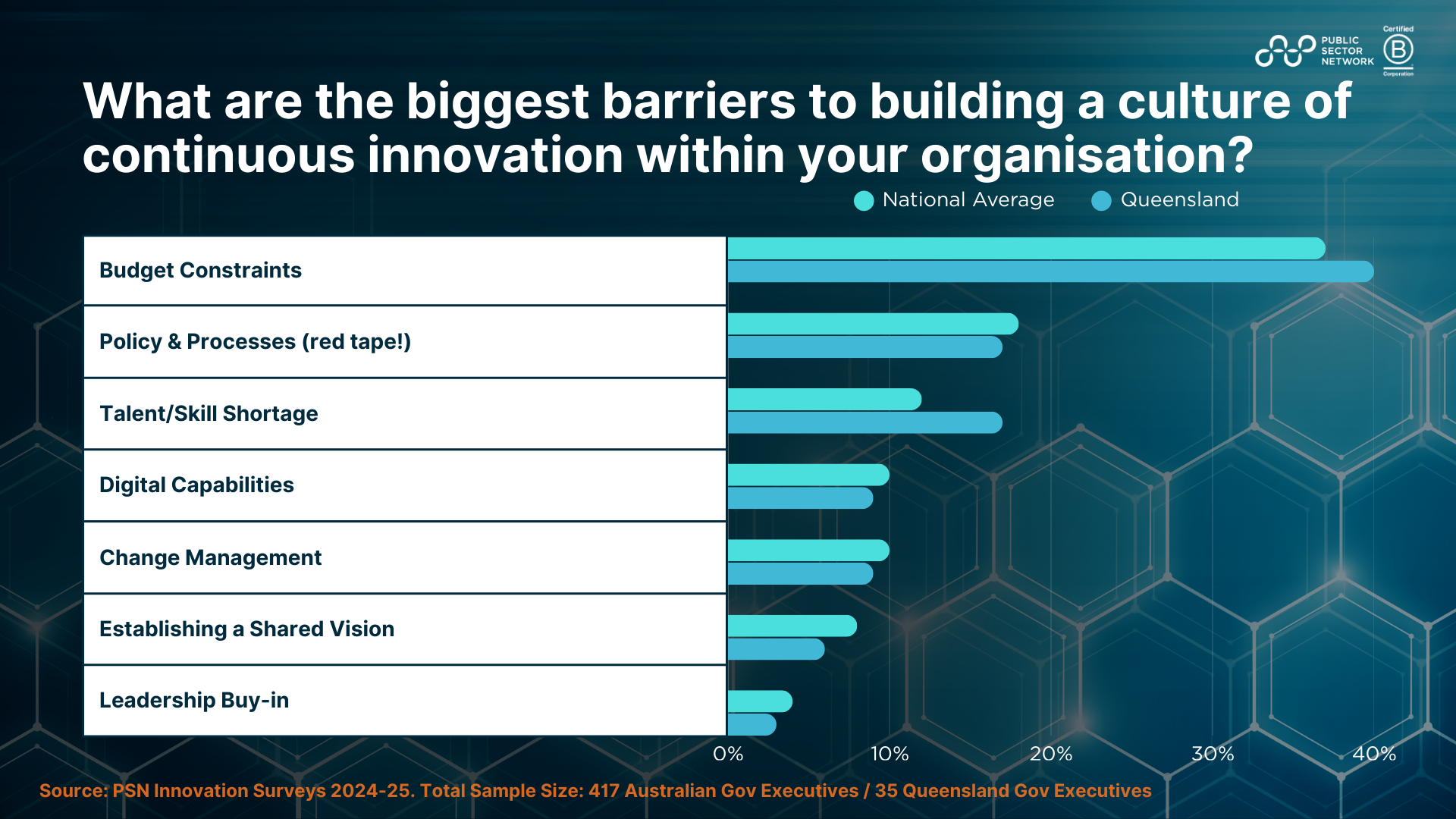
Budget constraints are the leading barrier to innovation in Queensland (40%), slightly higher than the national average of 37%. This consistency reflects the enduring challenge for governments across Australia to balance ambition in digital transformation with the fiscal realities of constrained resources. It highlights how investment limitations remain the dominant hurdle to embedding a culture of innovation.
The standout divergence between Queensland and the national picture lies in talent and skills shortages. Queensland respondents reported this as a barrier at 17%, compared with only 12% nationally. This five-point difference signals a sharper state-level concern about workforce capability, underscoring the need to not only attract but also retain and continuously upskill digital talent within the public sector.
In most other categories, Queensland responses broadly tracked national averages. Policy and processes (17% in QLD versus 18% nationally), as well as challenges around digital capabilities (9% versus 10%) and change management (9% versus 10%), were near-identical. This indicates that structural and technical barriers are perceived relatively uniformly across the country.
Queensland’s Biggest Challenge: Is the Digital Divide Outpacing Fiscal Concerns?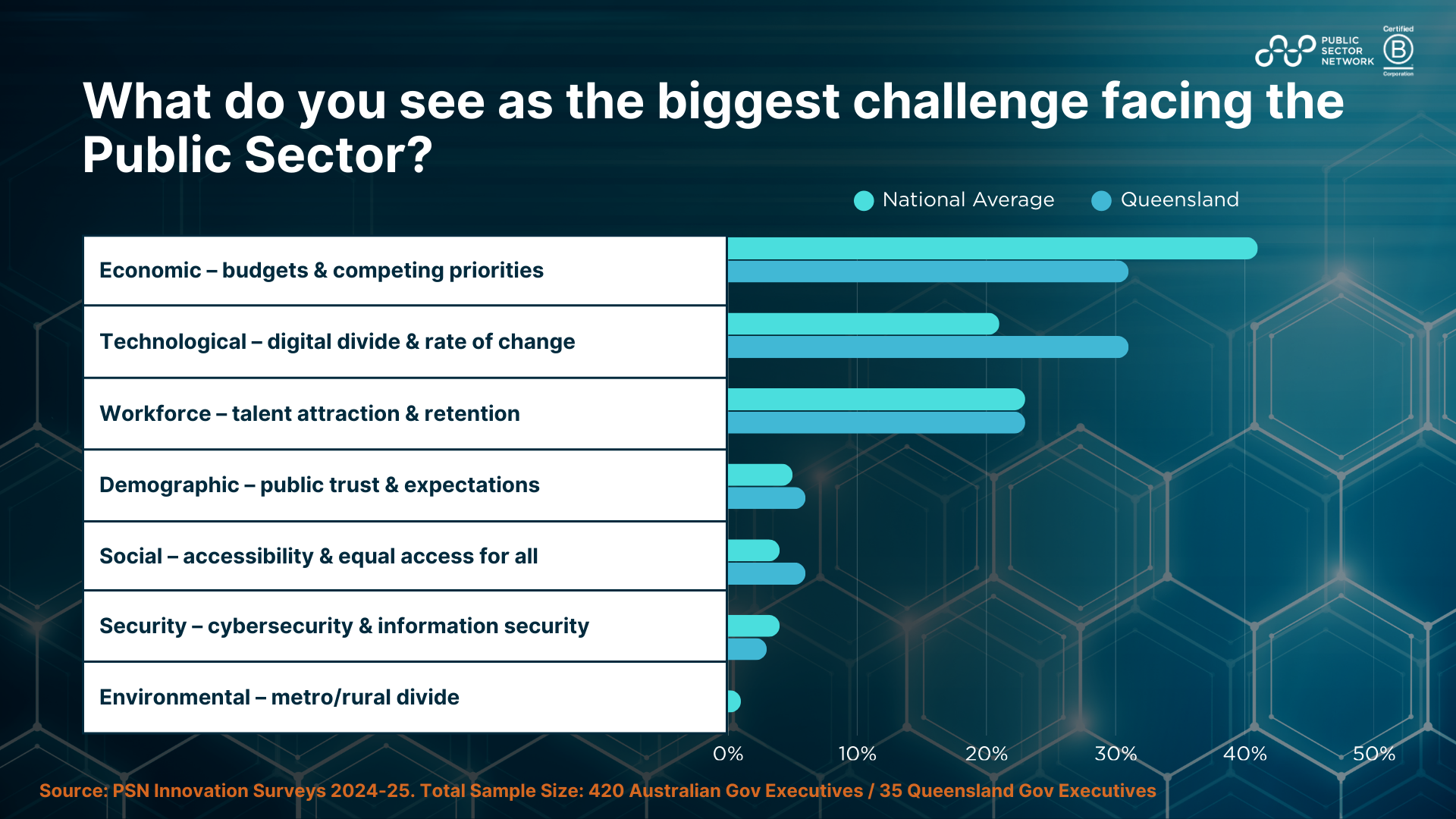
Queensland respondents identified technological challenges, specifically the digital divide and the rapid rate of change, as their most pressing issue (31%), ten points higher than the national average of 21%. This marks a clear departure from the broader Australian picture, where economic pressures dominate. It underscores Queensland’s heightened awareness of the pace of digital transformation and the risks of uneven access, placing technology readiness at the forefront of public sector concerns in the state.
In contrast, economic pressures such as budgets and competing priorities were rated lower in Queensland (31%) compared to the national benchmark of 41%. This significant ten-point gap suggests that while fiscal concerns remain important, they are not perceived with the same intensity as in other jurisdictions. The shift in focus highlights a stronger state-level emphasis on grappling with technological disruption rather than purely financial limitations.
Workforce-related challenges, centred on talent attraction and retention, were consistent between Queensland and the national average (23%). This parity signals that the struggle to secure and retain skilled staff is a shared, nationwide issue, cutting across both economic and technological pressures.
Shaping Tomorrow’s Workforce: Queensland’s Approach to Talent and Capability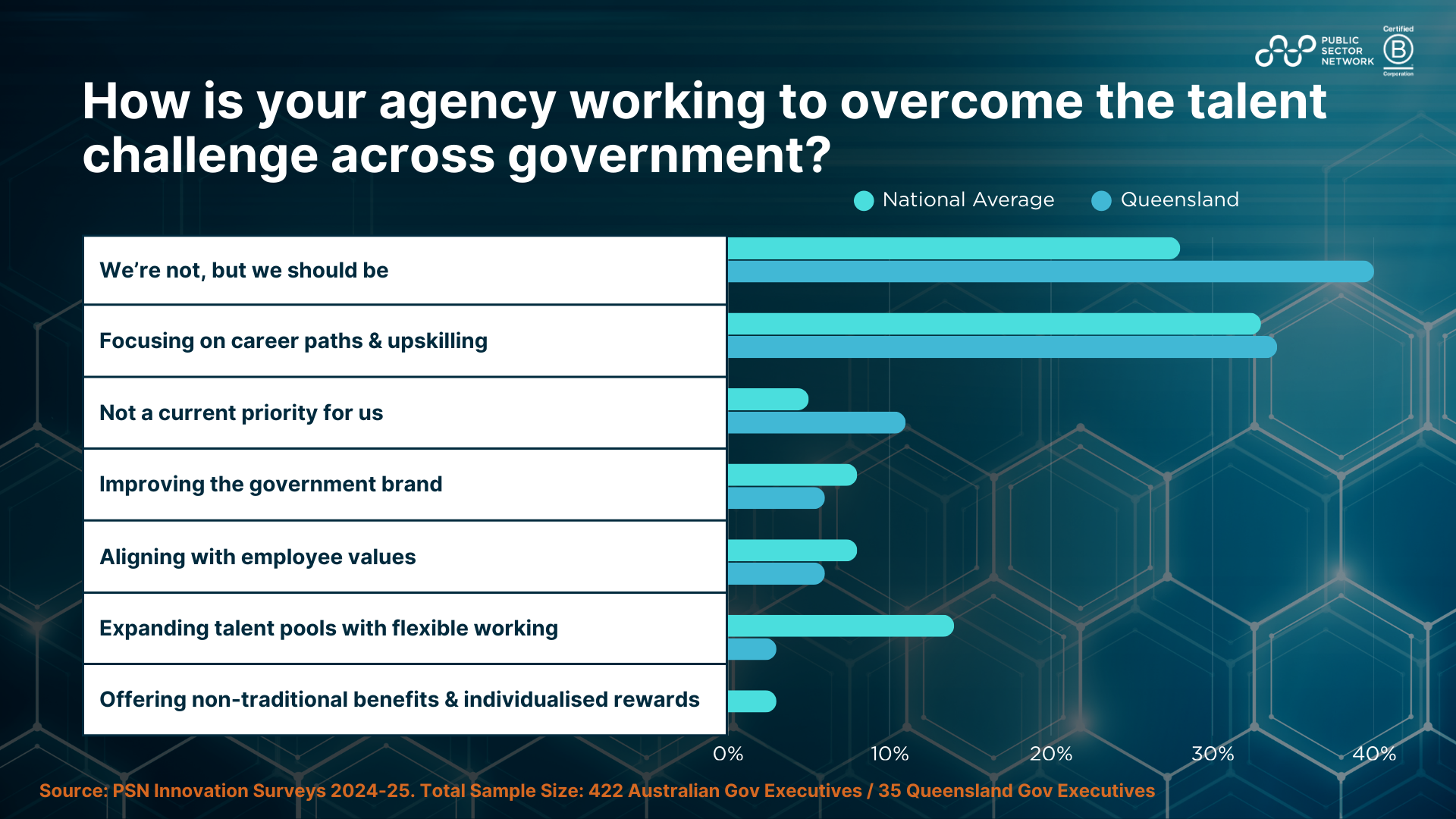
Queensland agencies were significantly more likely to say they are not yet addressing the talent challenge, though they recognise the need to (40% versus 28% nationally). This twelve-point difference indicates a sharper admission within the state of lagging progress in workforce strategy, underscoring the urgency for stronger interventions in recruitment, retention, and capability-building.
The focus on career paths and upskilling was broadly consistent between Queensland (34%) and the national average (33%), highlighting a shared recognition that long-term workforce resilience depends on sustained investment in professional development. This alignment reflects the sector’s collective effort to build a pipeline of skilled talent ready to meet future service demands.
Notably, Queensland agencies were more likely to report that overcoming the talent challenge is “not a current priority” (11% compared to 5% nationally). This gap raises concerns that parts of the state’s public sector may still underplay the significance of workforce transformation, potentially exposing them to deeper capability risks in the medium term.
Queensland respondents were less focused on expanding talent pools through flexible work arrangements (3% versus 14% nationally). This sharp underrepresentation suggests that, relative to peers, Queensland agencies may be underutilising one of the most effective levers for broadening workforce participation and improving retention in a competitive talent market.
Queensland’s #1 Change for Government: Partnerships and Platforms Over People Power?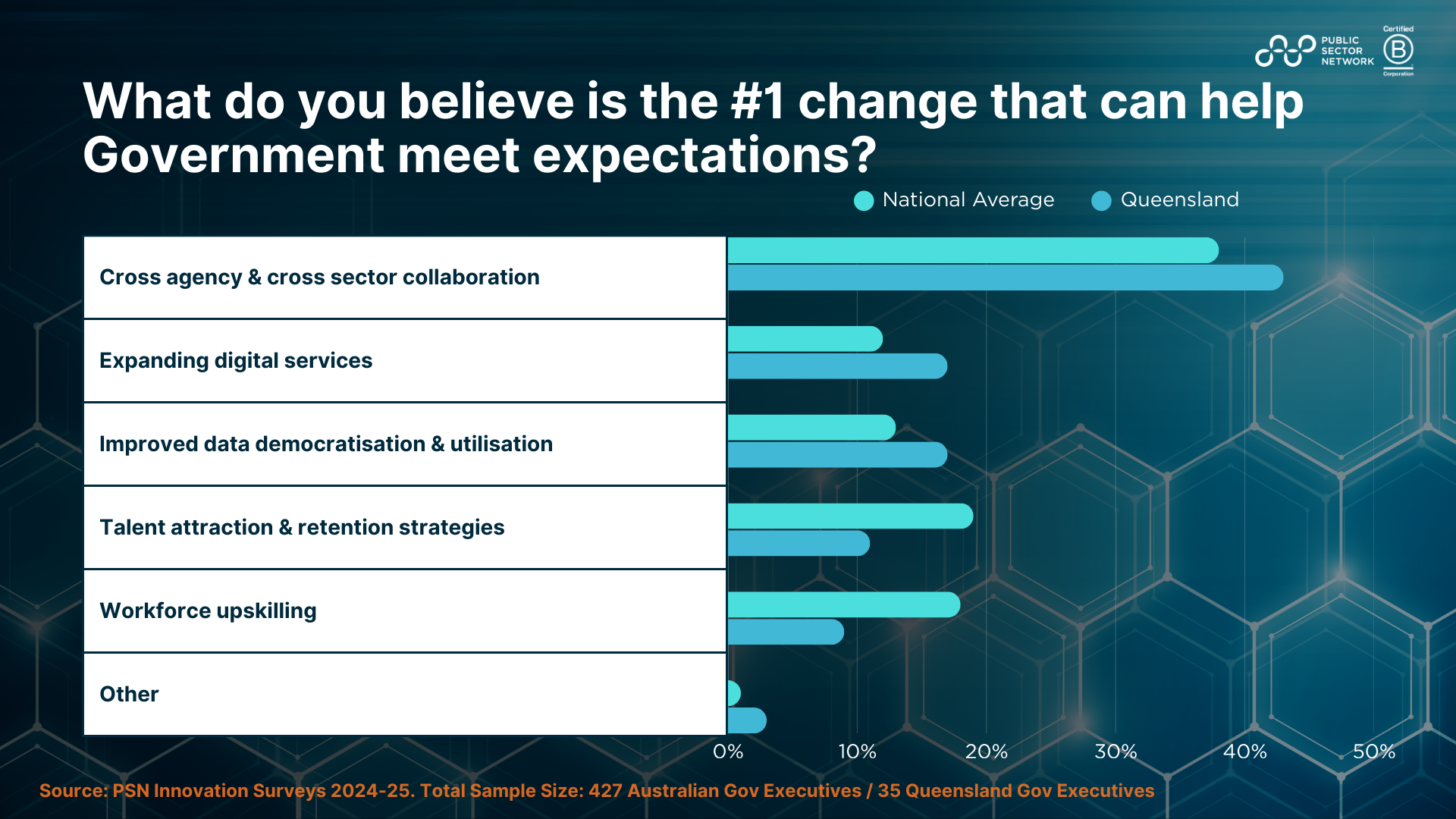
Queensland respondents ranked cross-agency and cross-sector collaboration as the single most important change to help government meet expectations (43%), five points higher than the national average (38%). This emphasis reflects a strong recognition in Queensland that silos must be broken down to deliver coherent, citizen-centred services. It also highlights alignment with global digital government trends that increasingly prioritise joined-up service delivery across agencies and sectors.
Expanding digital services (17% in QLD versus 12% nationally) and improving data democratisation and utilisation (17% versus 13%) were both elevated priorities in Queensland. These results suggest the state is leaning into service accessibility and evidence-based decision making as complementary strategies to enhance government performance. Together, these areas indicate Queensland is positioning digital enablement and data use as core enablers of collaborative, modern government.
In contrast, Queensland placed considerably less emphasis on workforce-focused strategies. Talent attraction and retention was nominated by just 11% of Queensland respondents, compared with 19% nationally, while workforce upskilling registered only 9% compared to 18% nationally. This sharp gap suggests that while Queensland sees collaboration and technology as primary levers for transformation, there may be an underestimation of the critical role of people capability in sustaining innovation and meeting rising public expectations.
Conclusion: Queensland’s Digital Government at a Crossroads — Strong on Collaboration and Technology, But Workforce Risks Loom
Queensland’s polling results reveal a state leaning heavily into process automation, collaboration, and digital service delivery as the key levers for modernising government. Elevated concerns about technological disruption demonstrate a forward-looking recognition that closing the digital divide and managing rapid change are critical to citizen trust and service performance.
Yet this technology-first and collaboration-focused outlook comes with clear risks. Workforce attraction, retention, and upskilling consistently lag behind national averages, while flexible work and innovative benefits remain underutilised. Unless Queensland strengthens its workforce strategies, talent shortages may undermine progress on its broader digital agenda.
Budget pressures remain a challenge, but less defining than in other jurisdictions. Instead, Queensland’s profile highlights a distinct shift towards tackling technological and cultural transformation head-on. This sets the state apart nationally but also places greater pressure on agencies to ensure that people, as much as processes and platforms, are equipped to sustain change.
Queensland should be commended for its prioritisation of collaboration and digital enablement as cornerstones of transformation. To fully realise its ambitions, the state can seek to plug its workforce gaps and align people strategies with its technology vision. By doing so, Queensland can accelerate towards a resilient, integrated, and future-ready model of digital government that meets rising citizen expectations.






Help your peers
Share what you've learned with fellow public servants