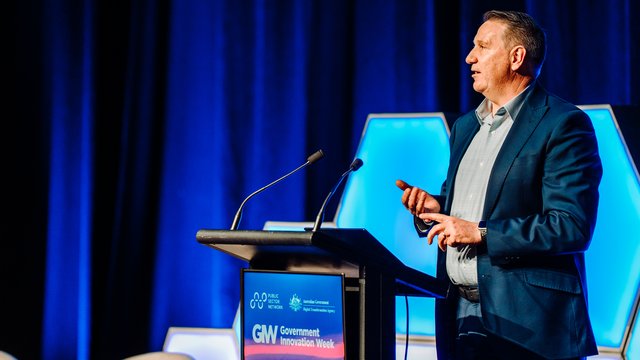
In one of the most grounded and human-centred sessions of the event, the audience heard a rare blend of lived experience, innovation leadership, and practical technology insights. Paralympic legend and national wheelchair racing coach Louise Sauvage OAM, together with Salesforce’s Gazelle Kapetarian (Senior Director Public Sector ANZ) and Pieter Hanebalken (Lead Account Executive), unpacked what an “empowered, connected, and empathetic government” could truly look like in practice.
What began as a light-hearted stage introduction quickly shifted into a meaningful conversation on government service accessibility—both its current shortcomings and its extraordinary potential with the right technology foundations.
“Most of us don’t think about engaging with government until we absolutely have to.”
Gazelle Kapetarian opened with a reflection on the universal frustration of dealing with government systems—repeating information, navigating disconnected services, and facing barriers at every turn. She positioned the conversation around a future where government is not a roadblock, but an enabler.
“I’ve had to explain myself so many times — flights, hotels, transport… I’m constantly repeating my access needs.” – Louise Sauvage
Louise illustrated what "service delivery" means when accessibility is not the default. From hotels not showing accessible bathroom layouts, to trains leaving her stranded at stations, she highlighted how everyday tasks become obstacles — obstacles that technology could remove.
“Human-centric innovation has always been rooted in our thinking. AI isn’t the product — enabling accessible government is.” – Pieter Hanebalken
Pieter explained Salesforce’s approach to AI as an enabler of personalised, guided, and empathetic digital government. He emphasized that the goal isn’t to replace human decision-making, but to meet citizen needs without forcing them through complexity.
"NSW is already ahead- not just in Australia, but globally". - Kapetarian
The panel recognised the Department of Customer Service and NSW public sector partners in the room for leading the shift toward shared service operability and agentic government.
The lived reality that needs fixing (Louise's daily barriers)
Louise shared real, everyday obstacles that exemplify systemic gaps:
Hotels not showing accessible bathroom layouts
Airlines require disability information every single time
Public transport leaves wheelchair users behind
Systems that don’t “talk to each other,” causing constant repetition
Simple tasks are becoming multi-step barriers due to poor system design
Her message was clear: inclusion shouldn’t rely on personal persistence — it should be built into every service.
Key Metrics & Notable Points Raised
NSW positioned as a global leader in agentic government adoption
Shared service operability already underway across departments
AI as a front-line enabler, not a replacement for human service roles
Technology is now capable of:
single-entry citizen data
personalised guidance
predictive service support
real-time accessibility features
Government services are shifting from transactional to empathetic and adaptive
Key Takeaways
Accessibility is still fragmented, and lived experience must inform design.
AI is shaping a future where citizens no longer navigate government complexity—technology does it for them.
Empathy and inclusion are becoming core pillars of digital transformation, not optional add-ons.
Government’s role is evolving from “service provider” to “enabler.”
NSW public sector is leading the way, setting examples for Australia and the world.
The best innovations come from partnership — public sector, technology providers, and lived-experience advocates together.
Help your peers
Share what you've learned with fellow public servants
Recommendations
Leading Through Change: Building Capacity, Confidence, and Collaboration Across Government
Managing Third-Party Risk in Modern Government Software Supply Chains
Make the Outcome the Boss
Local Government’s Digital Transformation Moment: Protecting Data, Partnering Smarter, and Creating Community Value