

The Legacy Analytics Crossroads
Across Canadian public sector organizations, from federal departments and Crown corporations to provincial agencies and health authorities, SAS has been a trusted workhorse for decades. It powers critical use-cases such as actuarial models, fraud detection models, citizen services analytics, epidemiological studies, and statistical reporting that informs critical decisions.
But the ground beneath legacy analytics platforms is shifting. Licensing costs are climbing, the talent pool of seasoned people experienced in the technology is shrinking, and consumers now expect digital services backed by real-time, AI-driven insights. Meanwhile, modern, cloud-native platforms such as Databricks, Snowflake and Microsoft Fabric have matured into full-featured, enterprise-grade environments capable of meeting even the most stringent requirements.
The question public sector data leaders are asking is no longer if they should modernize their SAS platform, but what to consider, and how to do it without disrupting mission-critical services.
This article lays out a practical playbook, informed by our company's vast SAS migration experience as former SAS partners and integrators.
Why Modernize? The Case for Change
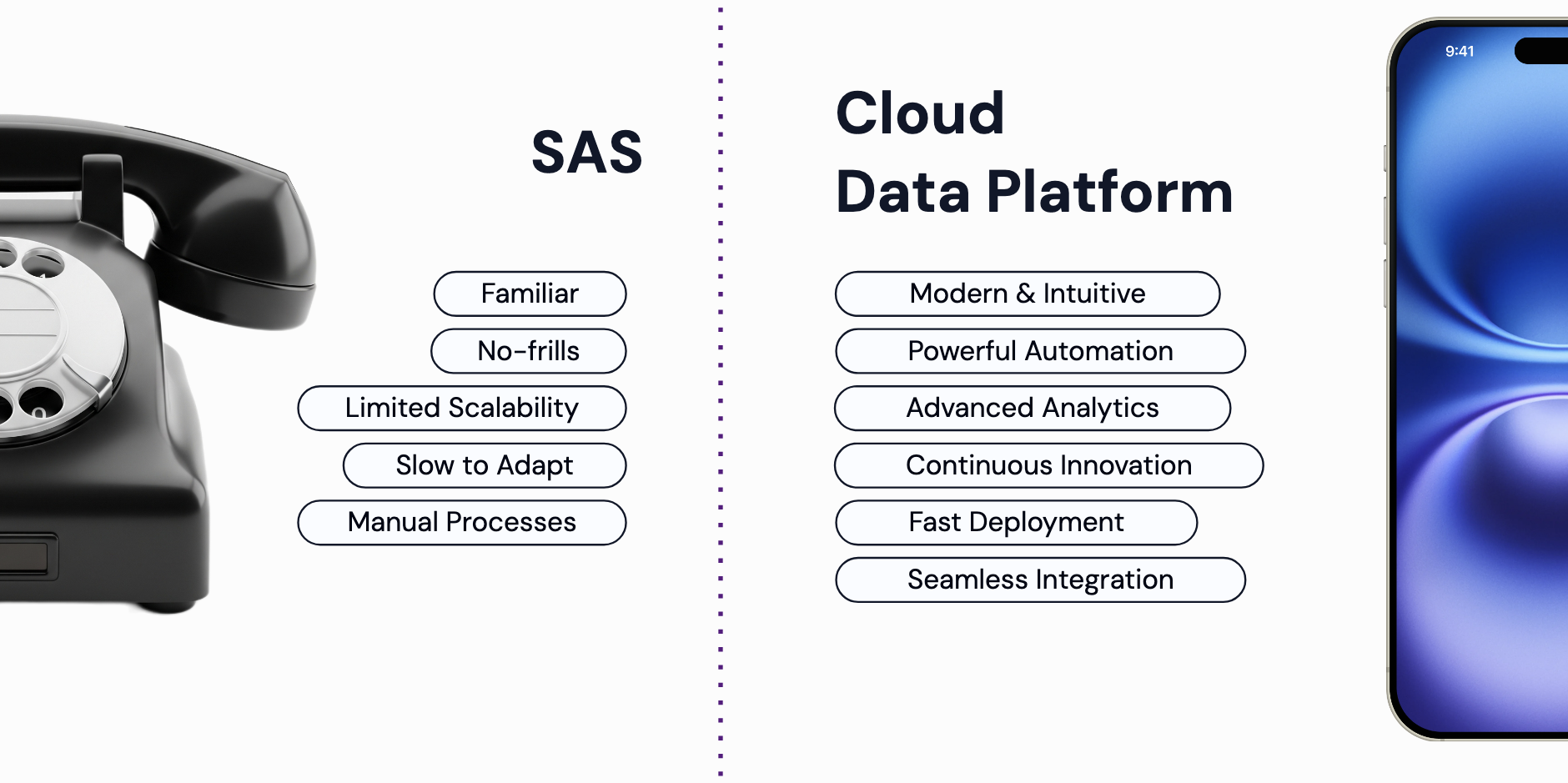
A useful mental model: SAS is the rotary telephone of the analytics world. Familiar, no-frills, slow to adapt, with limited scalability and manual processes. A modern cloud data platform, by contrast, is modern and intuitive, with powerful automation, advanced analytics, continuous innovation, fast deployment, and seamless integration with the broader data and AI ecosystem.
Six Reasons Public Sector Organizations are Moving
Lower Total Cost of Ownership (TCO). Cloud data platforms are significantly less expensive than on-premises SAS environments - once licensing, hardware refresh, infrastructure, and specialized administration are added together. In our experience, as an example, organizations see up to 60% reduction in TCO compared to on-premises SAS after migrating to Databricks.
Elastic scalability. On-premises SAS clusters require capacity planning months and years in advance. Cloud platforms grow or shrink to fit workload demand, which is an enormous advantage for organizations that face cyclical peaks (tax season, census processing, benefits administration, year-end reporting).
Faster, broader insights. Modern architectures process the same workloads orders of magnitude faster. For the public sector, for instance, this translates directly to faster fraud detection, quicker benefits adjudication, and more responsive policy analysis.
A larger, more accessible talent pool. Modern platforms are built on popular, open-source technology with wide talent availability (Python, SQL, Apache Spark) - versus a shrinking pool of SAS specialists. This is critical for hiring and retention - recruiting from a niche, premium-priced talent market is increasingly difficult.
Continuous innovation and AI-readiness. Cloud platforms receive constant updates with new features, including ones leveraging Generative AI, LLMs, agentic capabilities and machine learning, much more often and without the disruptive upgrade cycles of on-premises software.
Future-proofing. Modernizing aligns analytics with broader cloud-first IT strategies, government digital transformation mandates, and the trajectory of growth.
You Are not Alone
Public and private sector organizations alike are making this move. Many Canadian public sector organizations are already utilizing the benefits of modern data platforms such as Databricks, Snowflake, and Microsoft Fabric, and successfully migrating to these new platforms from SAS.
When to Migrate: Reading the Signals
The right moment for when to start planning the migration usually presents itself through a combination of signals:
- A SAS contract renewal is approaching - the natural decision point. For organizations with a large footprint, we recommend starting the migration planning process at least 1 to 2 years before the next license renewal date.
- Growing backlog of analytics requests that the current platform cannot satisfy at the speed business demands.
- AI/ML use cases come up that SAS cannot natively support.
- Workforce transitions: senior SAS experts retiring, and difficulty recruiting replacements.
- Cloud-first mandates that require alignment of all major workloads.
Waiting for too long compounds risk: institutional knowledge leaves with retiring staff, code complexity compounds, and the eventual migration becomes harder, not easier.
How to Migrate: The Three Pillars
Contrary to the popular opinion, a successful migration is never just a code conversion exercise. In our experience, three interlocking workstreams must move together: Data, Code and Users.
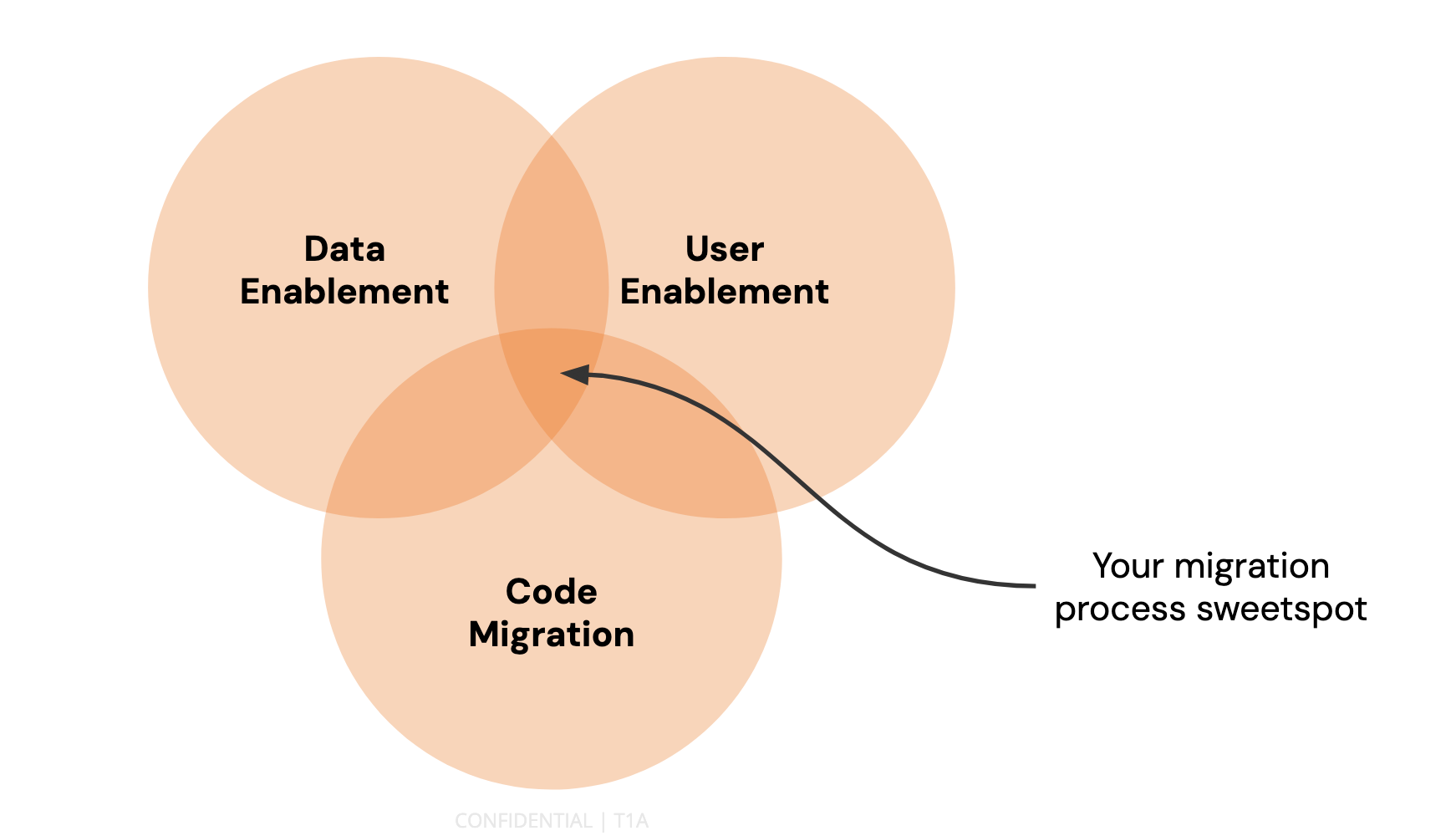
Neglect any one pillar and the migration stalls: a code-only migration leaves users disenfranchised; a data-only migration leaves business logic stranded; user training without working code wastes everyone's time.
Beware the SAS Iceberg
One of the most common reasons SAS migrations overrun budget and timeline is that organizations underestimate what's actually running on the platform. We use the SAS Iceberg model to frame the discovery challenge:
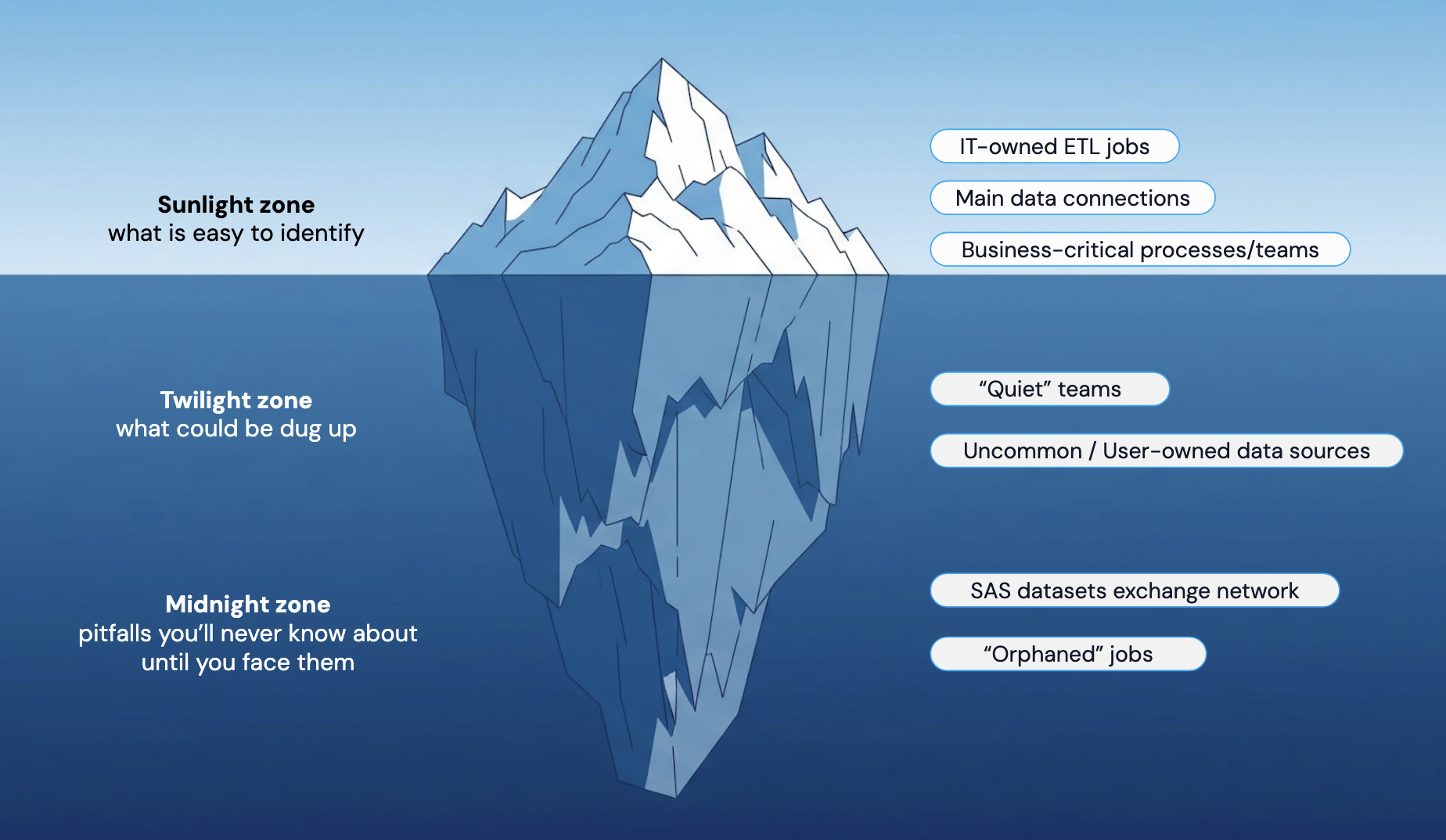
- Sunlight zone (easy to identify): IT-owned ETL jobs, main data connections, business-critical processes.
- Twilight zone (can be uncovered with effort): "Quiet" teams, uncommon or user-owned data sources.
- Midnight zone (hidden until you hit it): SAS dataset exchange networks between users, "orphaned" jobs that no one owns but that someone, somewhere, still depends on.
A detailed discovery of the SAS landscape is crucial before starting a migration to uncover all the potentially obscured use cases and define a clear migration path.
A Phased Journey, Not a Big Bang
A "big bang" migration is the wrong approach for organizations that cannot afford disruption of their workflows.
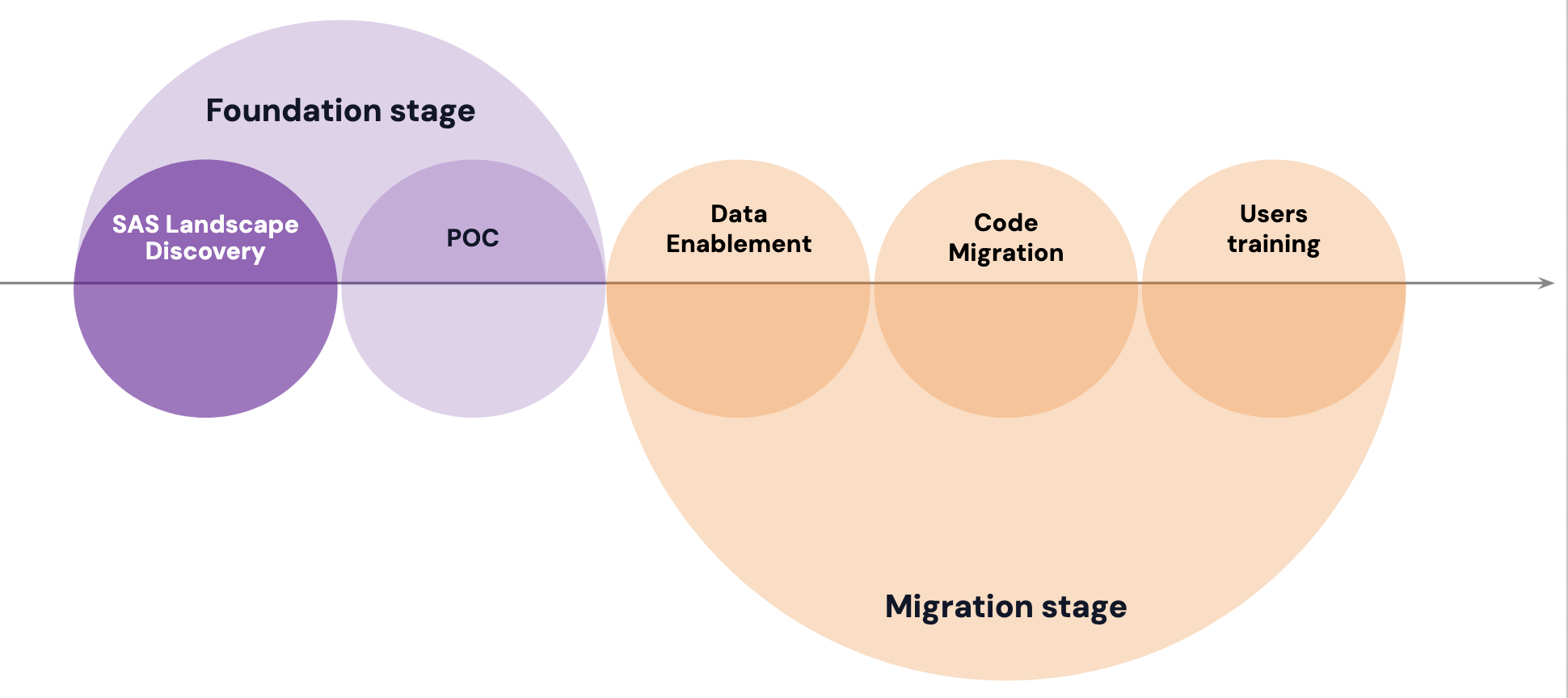
T1A's recommended journey has two core stages:
Foundation Stage
- SAS Landscape Discovery: Quick wins include transparent budgeting, a clear delivery road map, comprehensive inventory, and cleaning/migration cost reduction. Discovery typically combines a ~1 month Technical Assessment (IT stakeholders, SAS admins, log/script/metadata analysis) with a 1–3 month Business Discovery (interviews with each business unit to understand working processes and dependencies).
- Proof of Concept: Initial cloud environment setup, showcase migration of a few SAS processes, and demos for stakeholders. Followed by Early Adoption: a complete migration of one or two proactive teams to validate the approach.
Migration Stage
For each phase, spanning one or several business teams, we recommend going through a full a five-step span:
- Data Enablement: Make sure that all source data used by SAS is enabled in the target platform, as well as data destinations, such as APIs, external storage locations, etc.
- Code Conversion: Convert SAS artifacts into Databricks code (PySpark, SQL, Prophecy).
- People Enablement: Customized training, typically ~30% on the new platform and ~70% on the team's specific re-engineered processes.
- UAT: Validate converted code, validate result datasets, perform user acceptance.
- Go-Live: Cut over migrated jobs, enable BI/MLOps artifacts, enable CI/CD on the new platform.
Phases let proactive teams migrate first while later phases benefit from lessons learned - iterative learning and risk mitigation are the goal.
Striking the Right Engagement Balance
Different teams have different appetites and capabilities. Our model spans a spectrum from DIY (Self-Migration) Business Users-Driven with our enablement and support, to 100% Partner Engagement "White-Gloves" Workloads Migration. Most sector clients land somewhere in between, with varying engagement levels by business unit.
How T1A Accelerates Public Sector Migrations
T1A specializes in SAS migrations, with over 14 years of experience and numerous successful migrations:
- Migration heritage: 50+ SAS environments analyzed and migrated, 150M+ lines of code converted, 10K+ SAS users migrated, and 100+ customers across North America and Europe.
- Deep SAS DNA: Former SAS Platinum Partner (5 years) and Gold Partner (10 years) - meaning we know SAS from inside out.
- Modern data platform expertise: Partnerships with major vendors of modern data platforms, including Databricks, Microsoft, and Snowflake.
- Public sector vehicle: As an ECIF-enabled Solutions Partner, DCIF- and DPP-enabled with Databricks, and partnered with Donna Cona, T1A is positioned to engage Canadian federal and provincial buyers through the right contracting channels.
Alchemist SAS Migration Suite
We complement people with proprietary accelerators at every stage of the migration journey:
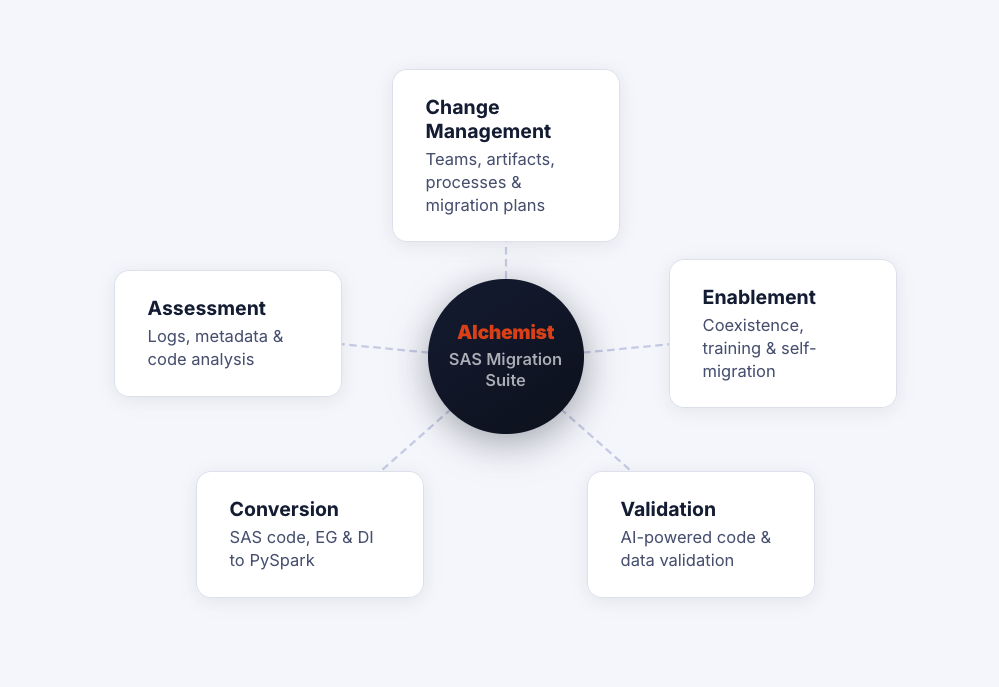
You can try Alchemist Live for free to see code conversion in action.
Closing: The Public Sector Imperative
Canadian public sector organizations have a unique modernization mandate: deliver better citizen outcomes, demonstrate fiscal responsibility, comply with cloud-first policies, and prepare for an AI-enabled future. Legacy SAS platforms can keep the lights on, but they increasingly hold organizations back from delivering on all four.
A well-planned, rooted in deep discovery, executed with proven accelerators, and balanced between partner-led and self-driven streams, typically delivers:
- 30–40%+ reduction in TCO within 18–24 months
- Order-of-magnitude faster insight-to-decision cycles
- Access to the full modern AI/ML toolchain without proprietary lock-in
- A larger, more sustainable talent pool of Python, SQL, and Spark practitioners
The window for orderly modernization is open today. Organizations that move now will set the analytics standard for Canadian public service over the next decade. Those that wait will eventually migrate under duress - at higher cost, with less time, and with diminished institutional knowledge.

Published by
About our partner
Tier One Analytics
We are a full-service consulting company. We engineer, analyze, and deliver strategic services for businesses. Our home base is in the U.S., pushing the boundaries of innovation, while our arms stretch out to Canada and Europe, embracing a world of possibilities.We're all about knocking down barriers, making sure that no matter where you find yourself, our expertise and support are just a whisper away. Think of the world as your playground for business, and us as your playmates, ready to explore it with you.We offer comprehensive Data Engineering, Customer Relationship Management, Customer Lifecycle Management and Process Intelligence services.
Learn more



Help your peers
Share what you've learned with fellow public servants