
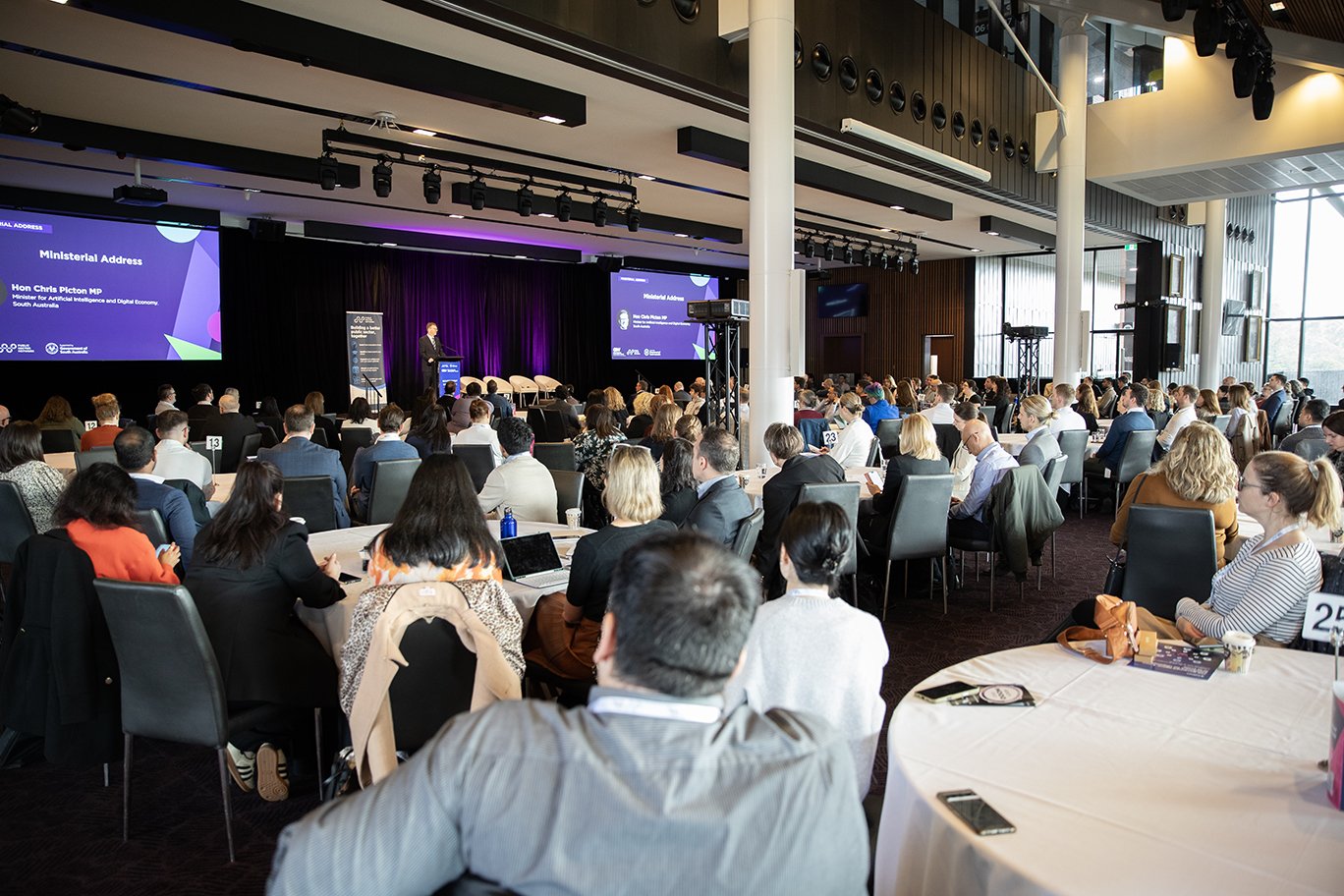
Minister Picton presents at Government Innovation Week South Australia 2026
Opening Remarks
Judy Hurditch — Managing Director and Principal Analyst, Intermedium
- AI is the headline issue for government
- Roughly 50% of delegates worked in digital, data or technology roles and a further 25% in policy and strategy, and all four opening live-poll questions focused squarely on AI.
- AI has moved from a niche IT conversation into a whole-of-organisation agenda for policy, operations and tech leaders alike.
- Productivity is the prize — but capability is still "emerging"
- Delegates ranked productivity and cost reduction as the greatest value of AI, closely followed by workforce enablement.
- Most placed their organisation's own AI capability at "emerging," signalling they are not yet ready to scale beyond pilots.
- What agencies are asking for is practical scaffolding
- The top unlocks named by the room were assurance frameworks, approved tools and platforms, and training — not more strategy documents.
- Vendor-vetted platforms, clear assurance pathways and role-based AI uplift are the enabling layer that lets frontline teams move from experimentation to safe, repeatable adoption.
Ministerial Address
Hon Chris Picton MP — Minister for Artificial Intelligence and Digital Economy, South Australia
- Digital and cyber are frontline service delivery
- Drawing on time as Health Minister, where SA's electronic medical record scaled from 6 to 70 hospitals, the Minister argued IT downtime now translates directly into frontline impact across health, child protection and policing.
- The bar SA government has to clear on resilience and information protection is deliberately higher than the private sector.
- A permissive but governed AI posture
- SA already allows public servants to use ChatGPT, Claude and Copilot at the desktop, with Copilot trusted for more sensitive workloads.
- The Office for AI has been tasked with moving AI from trials into business as usual, with "few future IT projects without an AI feature embedded."
- Innovation comes bottom-up
- The political narrative is broader than productivity — the AI scribe trials are the clearest example of giving frontline staff their time back with patients, students and clients.
- The vast majority of useful innovation will come ground-up from agencies, not top-down from the State Administration Centre.
Chair Opening
Harsh Mishra — Head of Transformation and Architecture, Cloudwerx
- SA's edge is innovating with purpose and trust
- South Australia consistently punches above its weight despite less resourcing than larger jurisdictions — evidenced by a string of national firsts: the first Office for AI, the first Minister for AI, and the true operationalisation of the Digital Investment Fund.
- SA's competitive advantage is policy clarity, speed of decision-making and a culture that treats innovation as a discipline — not a budget line.
- From digital transformation to intelligent transformation
- Transformation can no longer be scoped as application modernisation or process automation; the real shift is to an operating model where humans and AI work alongside each other as two intelligent actors.
- That demands a new operating model — not just new tools — with role design, decision rights, assurance and the human/AI interaction model redesigned together.
- The yardstick is value to people
- "The outcome is not always the best technical outcome — it should always be what gives the best value to the people."
- Lead with the community outcome the investment unlocks, then defend the architecture.
Opening Keynote: Digital Investment in South Australia — Driving Improved Outcomes
Steve Eatts — Director, Digital Investment Fund, Department of Treasury and Finance
- The DIF exists because the delivery track record is poor
- 70% of large ICT projects fail nationally, and fewer than half of those that deliver meet their expected outcomes.
- SA's traditional pattern compounded the problem: each agency solving its digital problems in isolation, a bias toward custom builds over configured platforms, lengthy procurement cycles, intense talent competition, and tactical-not-strategic investment.
- A ~$350m vehicle with digital and AI streams
- Established three years ago with an initial $200m over five years, the DIF has grown to roughly $350m with two dedicated streams.
- 22 initiatives (~$200m) are already approved, including the Stronger Cyber program, final mainframe transitions, a reusable grants management platform now live across three agencies, and the funding that stood up Australia's first dedicated Office for AI.
- From funding projects to delivering outcomes
- Submissions are assessed against four principles: value for money, long-term benefits, repeatability and feasibility of delivery.
- Funding is stage-gated, a regimented assurance regime applies, and a senior digital executive advisory group sits on steering committees as independent contributors.
- Improved commercial outcomes have already delivered savings of more than $1m on individual initiatives.
- The ask: engage the DIF team early, lead with reusability and statewide value, and submit an outcome — not a project.
Innovation Spotlight — Celebrating the Impact and Benefits of Innovation in South Australia
Scott Bayliss — Chief Services Officer, Department of Treasury and Finance · Shikha Sharma — Chief Digital and Information Officer, Department of Human Services · Jason Foster — Director, Information, Digital and Technology, Department for Mining and Energy · Steve Eatts (Facilitator) — Director, Digital Investment Fund, Department of Treasury and Finance
- "Platforms not solutions" as the operating norm
- DHS's new grants management platform replaced a manual process across 600+ community organisations, with a multi-agency reference group already driving uptake by PIRSA and others.
- The Department for Energy and Mining built its new tenement management system as a platform deliberately designed to extend into oil and gas, renewables and other regulators.
- The headline innovation is governance and culture, not a project
- The biggest shift in SA is the new operating model — a Minister for AI, the Office for AI, the Digital Investment Fund, and cross-agency governance forums that bring senior digital leaders together to look "up and out."
- A dedicated Treasury unit walks into business units to challenge low-value work and stop it where the value to community is not compelling.
- AI compresses delivery — but change management is the real bottleneck
- The tenement system targets a reduction from three years to 18 months for standard mine startup, and a redesigned national-park boundary check moved from a multi-month back-office process to a two-minute self-service answer.
- AI-driven smart traffic lights and SA Ambulance Service in-truck patient information were named as proof-of-value examples.
- AI is the enabler, not the source of innovation — and whether IT is the right home for driving AI adoption is now an open question.
Context is Key: From Fragmentation to Trusted Data Foundations
Con Yannakena — Integration & Automation Lead, Public Sector, Salesforce · Trent McGee — Director of Digital Strategy, Technology and Architecture, Department of Treasury and Finance
- The AI conversation is a data conversation: Unlock, Trust, Activate
- The framework for moving from fragmentation to trusted foundations is three steps — unlock the data (connect, integrate, access), trust it (cleanse, drive quality), then activate it for richer community engagement.
- The litmus test: "can you get the right data to the right person at the right time with the quality to support the right AI you can trust?"
- A whole-of-government integration spine — iPaaS
- Originally stood up to migrate data out of the Masterpiece mainframe into a modern cloud finance platform as part of the Finance Reform Program, the iPaaS is now in active use across Skills SA, the Department of State Development and DHS (notably the screening unit), with Housing now starting.
- It runs as hub-and-spoke — each agency operates its own spoke autonomously, wrapped by enterprise support and an emerging AI Gateway capability.
- Opportunity fatigue is the strategic risk OCIO is set up to manage
- Too many AI and digital opportunities, constantly shifting priorities, and constant cybersecurity pressure are the real strategic risk.
- OCIO's role is to spot cross-agency patterns, provide shared services where it makes sense, and act as a single front door — with Will Luker's monthly stakeholder updates the simplest way for any agency to plug in.
- The DTF graduate program was flagged as a quiet but successful pipeline for capability uplift.
AI State Briefing: AI Proof of Value & Government Service Innovation
Peter Meere — Director, Office for Artificial Intelligence, Department of Treasury and Finance
- A flagship, in-production case study setting the SA benchmark
- The Department for Education's English language proficiency assessment tool compresses a 30-minute teacher assessment to under five minutes.
- With roughly 30,000 assessments per year and the tool scaled to support every one, that's 29,000 teaching hours returned to teachers annually — freeing them to do higher-value work with students.
- This is the operational definition of public value being used across SA: less admin, more time with people, better decisions faster.
- Responsible, effective, strategic — and already operating at real scale
- Three pillars: do AI responsibly to protect public trust, effectively against real business problems rather than "AI for AI's sake," and strategically so SA doesn't solve the same problem fifty different times.
- Three mechanisms: test safely via the $28m AI Proof of Value program (nine initiatives approved in six to eight months); scale consistently via an emerging whole-of-government AI platform; govern continuouslywith central AI policy and proportionate risk treatments.
- The first PoV cohort is weighted to frontline impact
- Approved initiatives include three AI-scribe transcription trials (two in health, one in policing — with child protection, education and allied health next-logical extensions), a Department of Housing and Urban Development chatbot for property regulations, DIT traffic safety work, and CFS AI to speed up public fire warnings.
- The ask back to the room: start with a real bottleneck in your business unit, ask whether AI can help, and if yes, run an experiment.
AI Case Studies — Unpacking Successful South Australian Initiatives to Date
Dan Hughes — Chief Information Officer, Department for Education · Michael Southern — Manager, Traffic Management Centre, Department of Infrastructure and Transport · Lyn Corcoran — Manager, Data Platforms, SA Water · Peter Meere (Facilitator) — Director, Office for Artificial Intelligence, Department of Treasury and Finance
- Co-design in a safe walled garden is the SA pattern that scales
- DfE's response to ChatGPT was not to ban it: EdChat was built as a walled-garden version, co-designed with educators, and used to test guardrails alongside drafting policy. It is now a SaaS platform shared with other jurisdictions, where educators create and share their own agents — and once an agent is picked up by ~15+ schools, the department systematises it.
- SA Water's two most-used agents (an unstructured-data agent for PDFs/images/emails, and an enterprise-data chatbot) were both built with the people closest to the problem, not designed top-down.
- Governance is the enabler, not the blocker
- SA Water can't deliver water to the tap unless it has been treated and tested — that invisible step is precisely what makes the public trust the tap, and the same logic applies to AI.
- "AI ops availability" — governing and wrangling AI platforms at enterprise scale — was named as the next discipline agencies need to be building now.
- Proper risk management speeds you up, because it builds the trust that lets you scale.
- Already-in-production AI is delivering hard outcomes
- DIT's AI cameras at the Heaslip Road off-ramp on the Northern Expressway have produced zero collisions since the trial went live, with rollout extending to two more interchanges.
- A DIF-backed AI crash-detection trial uses cameras at roughly one-tenth the cost of thermal cameras with around three times the detection distance.
- "AI won't replace an educator, but an educator using AI will then augment the profession" — the pattern is start small, prove it end-to-end, then scale.
A Blueprint for Public Sector AI Adoption
Paul Hyland — Director, Data and Analytics, Datacom
- The honest scoreboard on AI in government
- Shadow AI is already in most workplaces (staff using ChatGPT at home with work content).
- Fewer than 30% of organisations have CEO-level sponsorship to scale beyond basic tools.
- ~95% of AI projects fail — almost always at scale, not at proof of concept.
- ~80% of organisations report no material impact from their AI investment.
- Citizens now expect the same conversational, context-aware experience from government that they get from their bank or Google.
- A four-layer blueprint as a shared language
- The blueprint stacks as Foundation → Enterprise IT → Front Office → Back Office — deliberately ordinary so different parts of an organisation can talk to each other at different points of the journey.
- Inside Foundation, the order matters: process (AI charter, strategy, regulatory alignment, ethics, governance) is the most-overlooked keystone; people (organisation-wide AI literacy, culture, change management, safe sandboxes) is where adoption actually lives — "culture eats everything for breakfast"; technology is the easiest layer because vendors have largely closed the gap.
- FinOps and back-office collaboration are the urgent unmet disciplines
- Vendors are shifting from license-based to token-based billing, with early adopters already seeing cloud-style bill shock — agencies need to design in cost-balanced AI and "does the user pay" models now.
- Agencies need a new agentic AI architect discipline alongside data, enterprise and solution architects, designing an evergreen, component-based architecture.
- On back-office collaboration: "I've yet to see it done successfully by any government." Agencies share most of the same HR, finance and regulatory comms problems but consistently solve them alone.
Industry Growth, Collaboration and State-Wide Innovation — Enhancing Global Competitiveness
Nicola Phillips — Vice Chancellor and President, Adelaide University · Dr Judy Halliday — Executive Director, Innovation & Entrepreneurship, Department of State Development · Will Luker (Facilitator) — SA Government Chief Information Officer, Department of Treasury and Finance
- A deliberately tighter university–industry–government weave
- SA's industry-growth strategy spans defence, space, energy transition, advanced manufacturing and health, with a powerhouse university — the explicit logic behind the creation of Adelaide University — at the heart of every successful transformation ecosystem.
- The university plays three roles: workforce and skills, partnership across public and private sectors, and being a magnet for talent at sufficient scale to attract scientists, innovators and students from around the world.
- SA is "small enough but big enough" — a hyper-connected system with fast decision cycles, growing at roughly 36% benchmarked against other global innovation systems.
- Government's job: lily pads across the "Pond of Peril"
- Government's role is to lay lily pads — bridges, programs, grants, capital touchpoints — that transformational businesses can step on at the level they need, when they need them.
- The three constraints those businesses keep flagging are capability/skills/talent, customers, and access to capital.
- The canonical SA case study is Fivecast — spun out of the Data to Decisions Cooperative Research Centre, with a journey measured in decades, not years — alongside a portfolio of 10–100-person SA companies that started as research collaborations.
- Preparing graduates for a future no one can yet imagine
- The new Adelaide University curriculum embeds work-integrated learning for every student, across every discipline — including creative and cultural industries.
- The human-skills layer — creativity, imagination, adaptability, and the relationship between technology and what it means to be human — cuts across every technical specialism.
- The most interesting innovation happens at the collision of different disciplines.
- The retention question reframed: the goal isn't to lock graduates into staying, it's to ensure they can choose to stay because the opportunities are genuinely compelling.
Skilled and Adaptable — Fostering a "Future-Ready" Workforce in the AI Era
Kim Eldridge — Executive Director, Skills SA, Department of State Development · Commissioner Cameron Baker — Chair, South Australian Skills Commission · Callan Markwick — Executive Director, Workforce Population and Migration, Department of State Development · Judy Hurditch (Facilitator) — Managing Director and Principal Analyst, Intermedium
- SA's workforce paradox: "a job for life" and unmet trade demand
- Thanks to defence and advanced manufacturing, apprentices entering the SA pipeline today may still be working for BAE Systems and ASC in 30 years — against an Eastern Seaboard assumption of five career changes.
- Construction, critical construction trades and automotive engineering are all in unmet demand right now.
- SA was the first jurisdiction to adopt dual trades — auto-electrician qualifications coupled with light-vehicle, heavy-vehicle or ag-machinery — letting trades work across internal combustion through to high-voltage EV.
- SA's electrotechnology cohort has been on e-profiling for 16 years, and apprentices are independently using AI to navigate paywalled Australian Standards.
- Foundational AI literacy is the urgent system bet
- Skills SA's leverage point is data — RTO funding data on demand and outcomes, plus pre-training data on student readiness including digital literacy.
- Two skills agendas need to be separated: specialist AI roles (industry mostly trains in-house because the field moves faster than formal qualifications) and the foundational floor every student leaving school and every worker leaving training needs.
- TAFE SA already has a "basics of using AI" course available; a federal-style public-sector academy was raised as a scaled uplift play SA could consider.
- AI is augmentation — and the new roles are already in SA job ads
- Workforce modelling suggests total jobs dip in the late 2030s/early 2040s, then flip back up as AI-related roles emerge.
- Live SA listings already include AI ethics and privacy specialists, AI governance leads, AI content creators and trainers, and transformation leads, with the heaviest growth in technical content creation and the responsible-AI / governance cluster.
- International-student-to-permanent-residency pathways remain a central plank of SA's workforce pipeline.




Help your peers
Share what you've learned with fellow public servants