
Emerging technologies are developing quickly, but speed alone is not a measure of successful innovation.
For government leaders, the challenge is deciding where new technologies can deliver genuine value, creating space to experiment, and putting the right safeguards around that experimentation without making useful innovation unnecessarily difficult.
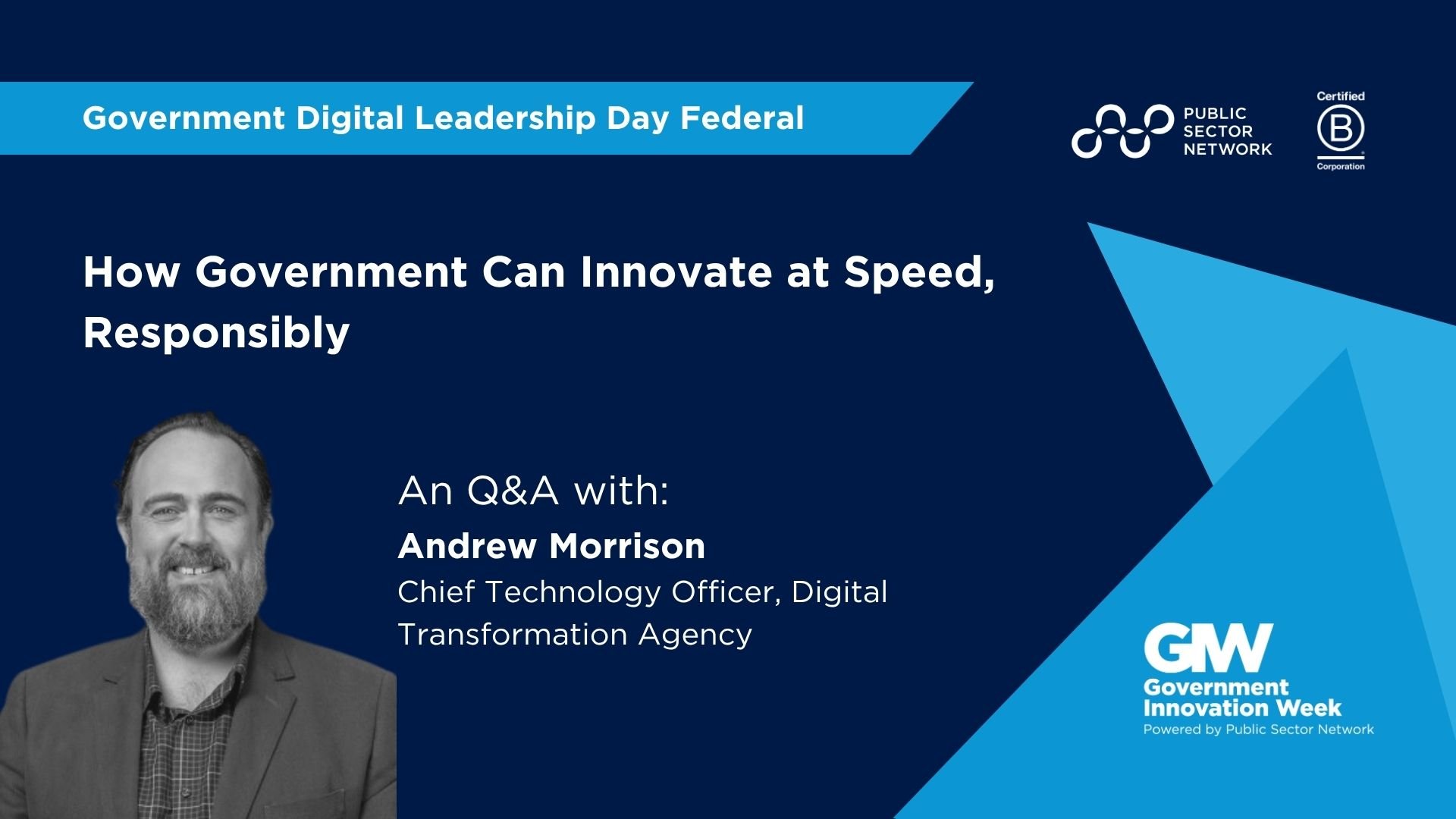
Ahead of Digital Leadership Day Federal 2026, Public Sector Network spoke with Andrew Morrison, Chief Technology Officer, Digital Transformation Agency, about responsible innovation, proportionate governance, moving beyond proofs of concept and the leadership capabilities government will need as technology continues to evolve.
Andrew will continue the conversation at Digital Leadership Day in Roundtable 3: “Responsible Innovation: How do we move fast with emerging technologies without compromising ethics and safeguards?”
The one-hour roundtable, facilitated by Automation Anywhere, will give senior government leaders an opportunity to discuss the practical balance between experimentation, governance, risk and delivery. It runs from 12:25 PM to 1:25 PM on Wednesday, 21 October.
Explore the event: Digital Leadership Day overview | View the agenda
Q&A with Andrew Morrison
Public Sector Network: Emerging technologies are developing at an extraordinary pace. How should government leaders distinguish between innovations worth pursuing now and those that require more time, evidence or maturity?
Andrew Morrison:
Government leaders have made a deep commitment to ensure people and businesses are supported with services and solutions that provide real value.
This means they should focus less on hype cycles and more on evidence-based innovation.
The technologies worth pursuing now are those that solve real problems, improve services and can scale securely, ethically and responsibly.
For emerging technologies that show promise but lack maturity, leaders should experiment through targeted proofs of concept. This minimises risk while building the evidence needed for broader adoption.
Public Sector Network: How can agencies create the conditions to experiment and move quickly with emerging technologies while still maintaining appropriate safeguards around security, privacy, ethics and accountability?
Andrew Morrison:
To move quickly without compromising trust, agencies need to make security, privacy, ethics and accountability central parts of innovation, not later add-ons.
The DTA has consistently emphasised responsible AI, clear governance, cross-functional collaboration, technical literacy and evidence-based decision-making as enablers of faster adoption, not barriers to it.
Agencies that create safe environments to test ideas, learn from results and apply consistent safeguards are better placed to scale successful innovations and build public confidence in emerging technologies.
Public Sector Network: What does proportionate governance look like in practice, where controls are strong enough to manage risk but not so burdensome that they prevent useful experimentation and innovation?
Andrew Morrison:
Proportionate governance starts with matching oversight to risk.
Low-risk experiments should be able to proceed quickly with clear guardrails. High-impact uses involving sensitive data, public-facing decisions or significant consequences warrant much greater scrutiny.
The goal is not to apply the same process to every project, but to create clear pathways for innovation that scale controls as risk increases.
In practice, that means setting expectations early, empowering accountable decision-makers and using evidence from testing to determine whether an initiative should stop, adapt or move forward.
This approach helps agencies innovate with confidence while maintaining public trust.
Public Sector Network: The DTA has strengthened its approach to responsible AI through clearer governance, impact assessment and accountability requirements. What is most important in translating those safeguards from policy into everyday technology and leadership decisions?
Andrew Morrison:
The most important step is making responsible AI everyone’s responsibility, not just a policy requirement.
Governance frameworks and accountability mechanisms are only effective when they are built into everyday decisions and oversight.
Leaders need to create a culture where teams understand both the opportunities and risks. This ensures they are comfortable asking the right questions early and using data to guide decisions.
When responsible use becomes part of how agencies deliver outcomes, we’re no longer working with safeguards. Instead, safety becomes second nature.
Public Sector Network: When an emerging technology shows promise, what should leaders be looking for before moving from experimentation or proof of concept to broader adoption across an organisation?
Andrew Morrison:
Before moving beyond experimentation, leaders should look for proof that the technology delivers a meaningful outcome.
This is very different to just a successful demo.
That includes a clear business case, measurable benefits, user acceptance and confidence that the solution can integrate with existing processes, data and systems.
The strongest candidates for broader adoption are those that have demonstrated value through practices that can be sustained, maintained and trusted over time, as opposed to simply demonstrating that a technology functions.
Public Sector Network: How can common standards, architecture and whole-of-government approaches help agencies innovate faster while still giving them enough flexibility to respond to their own operating environments?
Andrew Morrison:
Common standards and shared architecture help agencies avoid solving the same problems repeatedly.
By providing trusted building blocks and fostering reusable capabilities, government as a whole can spend less time creating foundations and more time focusing on service delivery and policy outcomes.
At the same time, flexibility is essential.
A whole-of-government approach works best when agencies can adapt shared standards to their own operating environments, risk profiles and user needs.
The balance is consistency where it creates value, and autonomy where it enables better outcomes and innovation.
Public Sector Network: Events like Digital Leadership Day bring together senior leaders from across government to share experiences, challenges and practical lessons. Why is that kind of cross-government dialogue so important as agencies navigate emerging technologies and digital transformation?
Andrew Morrison:
Cross-government dialogue helps agencies learn from real-world experience rather than starting from scratch.
As emerging technologies evolve, many organisations face similar questions, from adoption, governance and capability through to delivery and potentially end-of-life.
Sharing lessons helps reduce duplication and build confidence. It also helps identify approaches that can be reused across government.
This dialogue strengthens collaboration on common challenges and supports more consistent, citizen-centred outcomes.
Digital transformation is rarely achieved by a single agency alone. Progress is faster when leaders can learn from one another and apply those insights within their own operating environments.
Public Sector Network: Looking ahead, what capabilities and mindsets will senior public sector leaders need to build if responsible innovation is to become an ongoing organisational capability rather than something managed technology by technology?
Andrew Morrison:
Senior leaders will need to build cultures that are adaptable, evidence-driven and comfortable with continuous learning.
As technology evolves, success will depend less on expertise in any single tool and more on amalgamating a workflow. Leaders will be expected to hone their capacity to evaluate opportunities, manage risk, foster collaboration and make informed decisions in uncertain environments.
Leaders will need enough AI literacy to understand practical risks and opportunities.
Strong governance will remain essential because it gives teams confidence to innovate within clear boundaries.
Curiosity will matter more than ever before. So will openness to experimentation.
Leaders should be willing to learn from what works and from what does not.
The organisations that thrive will embed responsible innovation into the way they work. They will not treat it as a separate response to each new technology.
Responsible innovation without unnecessary friction
A consistent theme throughout Andrew’s responses is that governance and innovation do not need to sit in opposition.
When risk is understood early, safeguards are proportionate and accountability is clear, governance can give teams greater confidence to experiment and move quickly.
That idea will sit at the centre of Andrew’s roundtable at Digital Leadership Day Federal 2026:
Responsible Innovation: How do we move fast with emerging technologies without compromising ethics and safeguards?
Facilitated by Automation Anywhere, the roundtable will provide an interactive setting for senior leaders to examine questions including:
- which emerging technologies are mature enough to pursue now
- how to create safe environments for experimentation
- where stronger controls are warranted
- how governance can scale with risk
- what separates a promising proof of concept from something ready for broader adoption
- how common standards and reusable capabilities can accelerate delivery across government
The roundtable takes place from 12:25 PM to 1:25 PM on Wednesday, 21 October 2026.
Building responsible innovation into leadership
Andrew’s roundtable forms part of a broader Digital Leadership Day program examining the leadership, operating models and capabilities needed as government becomes more connected and technology-enabled.
Across the day, senior government leaders will consider challenges spanning connected government, AI-driven productivity, workforce capability, responsible AI, cross-agency collaboration and leadership through uncertainty.
The program also includes eight interactive roundtables, giving attendees an opportunity to move beyond presentations and discuss practical challenges directly with peers from across government.
For Andrew, that cross-government dialogue matters because agencies are frequently navigating similar problems. Sharing what has worked, and what has not, can help reduce duplication and build a stronger foundation for responsible adoption across the public sector.
Digital Leadership Day Federal 2026 takes place on Wednesday, 21 October 2026 in Canberra and is designed for senior government executives. Attendance is by invitation, with expressions of interest subject to approval.
Explore the event: Digital Leadership Day overview | View the agenda

![Charting the future: The impact of DTA's work agenda on agencies and suppliers in the near and mid term [Webinar]](https://cdn.publicsectornetwork.com/thumbnails/insight/feature_images/LI_Event_Banner_2_6bd9e9.jpg.640x360_q85_autocrop_crop-center.jpg)
![The Public Sector in the Age of AI: Leadership, Governance and Impact [Webinar]](https://cdn.publicsectornetwork.com/thumbnails/insight/feature_images/LI_Event_Banner_1_6e80b0.jpg.640x360_q85_autocrop_crop-center.jpg)







Help your peers
Share what you've learned with fellow public servants