
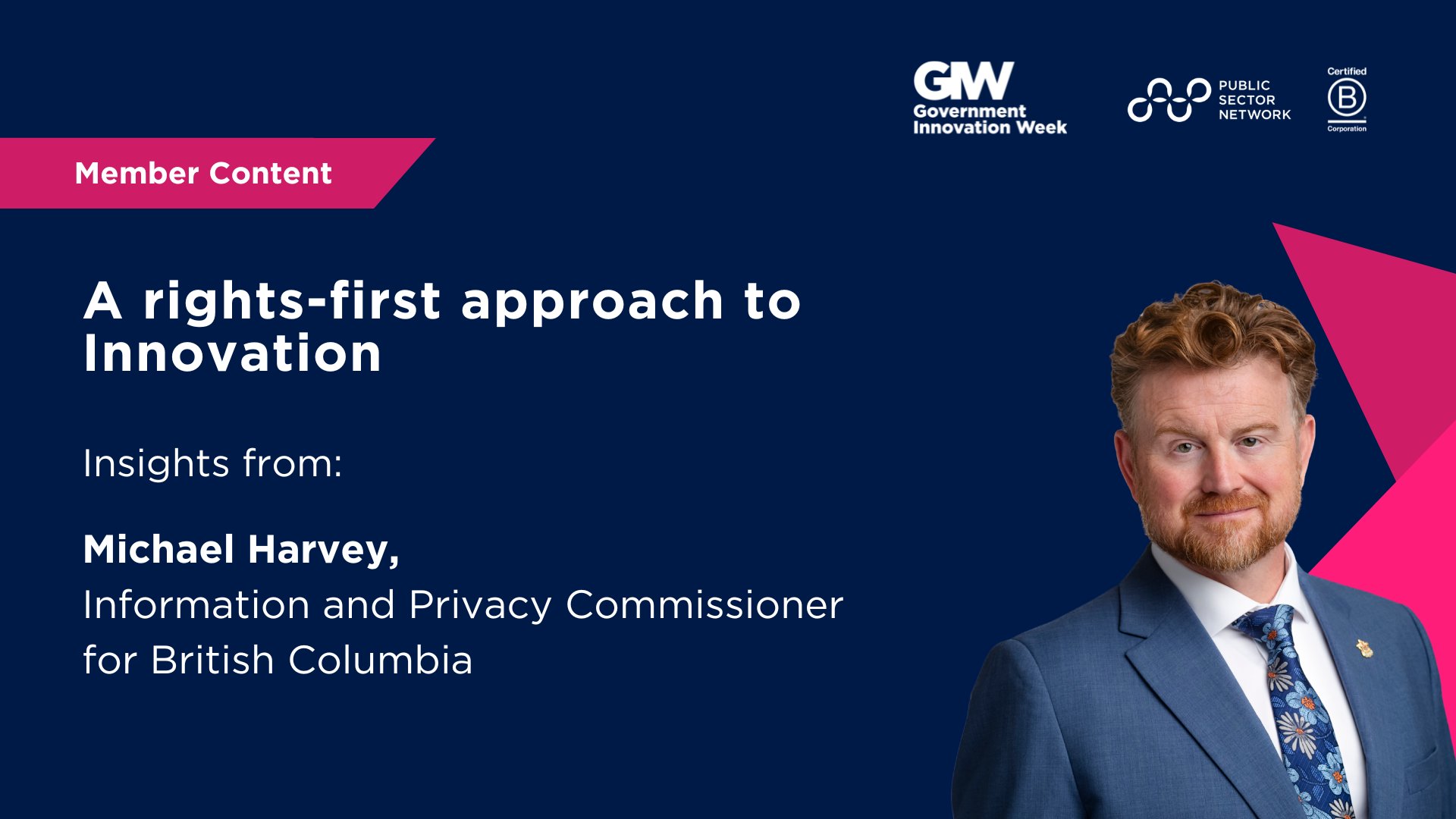
As part of our upcoming Government Innovation Showcase in Victoria, we invited Michael Harvey, Information and Privacy Commissioner, Government of British Columbia to share his insights on a Rights-First Approach to Innovation. As one of our featured speakers, the Commissioner will be delivering a powerful session titled " Embedding privacy, building trust: A rights-first approach to innovation," where he shares an approach to innovation and how embedding privacy principles from the outset of initiatives can not only avoid problems in the future, but build better solutions that earn the public trust now.
Learn more about the Commissioner's role, his 'right-first' approach to privacy, and how it can be a catalyst for innovation. Enjoy!
1. Please share with us a bit about your role and focus areas.
As BC’s Information and Privacy Commissioner, I provide independent oversight and enforcement of our privacy and access to information laws, the Freedom of Information and Protection of Privacy Act and the Personal Information Protection Act. My office protects and promotes the privacy and access rights of people in BC, including through mediating access and privacy complaints, issuing legally binding orders, conducting investigations, and commenting on the privacy implications of new technologies. Our office’s recently released three-year strategic plan, “Trust in the Age of Information,” details our immediate priority areas of focus around building trust through transparency, supporting trusted innovation, and enhancing rights equity.
2. In an era of rapid technological change, why is a "rights-first approach" the necessary foundation for public sector innovation?
People’s rights – to privacy, security, access to information, and others – are embedded in the laws of this province. They can’t be separated from the services provided in the public sector. A rights-first approach means recognizing these rights and designing programs and services with them foremost in mind from day one – not treating them as afterthoughts.
Of course, we understand that providing excellent and innovative goods and services – public or private – means that personal information is going to have to be collected, used and disclosed. Similarly, perfect transparency is often not going to be possible and certain confidences must be maintained for the proper operation of a democratic government. But taking a rights-based approach means that the starting point must be the right. In this sense, our access and privacy rights might not be absolute, but they must be fundamental. Consider privacy rights: personal information is at the core of our identities in our Information Society.
When we respect people’s control over their personal information – their privacy rights – we build the trust necessary for innovations to be accepted. Similarly, when our starting point is that people have the right to know what their public bodies know, then we can say that we are in a democracy – rule by the people.
3. What are the key elements of an organizational culture that successfully balances innovation with its responsibility to protect citizen rights and data?
Successful organizational cultures recognize that privacy and innovation are not mutually exclusive, or traded off against each other, but rather that privacy can enhance innovation by earning the public’s trust. It starts with buy-in from the top – leadership that takes a rights-first approach. This means asking not only how we can innovate in our service delivery, but how we can do so in ways that respect people’s rights and build trust. In the Information Society, a successful organization will not see respect for people’s privacy rights as a necessary impediment to delivering their core purpose, but a fundamental part of their core purpose. In the Information Society, our information is our autonomy, and our destiny and success will come in putting control of it into the hands of those to whom it belongs.
4. Could you provide an example of how embedding privacy principles at the design stage leads to a more trustworthy and effective public service?
British Columbia has been a leader in rights-first innovation in the public sector. An example of this is the BC Wallet/BC ID. It provides people with transparency and control over their data. Users decide what information to share and when, making government services more accessible, while reducing requirements for documents. This is a precedent that shows this province’s potential to lead when it comes to rights-first innovation as we move forward in the AI era.
5. Any advice you would give other agencies as they leverage digital technologies to improve service delivery and citizen engagement while upholding their fundamental responsibility to protect privacy and build public trust?
Privacy and innovation are not competing priorities – they can and should be mutually reinforcing. At both the leadership and front-line levels, public bodies need to think about privacy by design principles at the earliest stages of their project or initiative. This means asking whether simpler, less data-intensive approaches could achieve the same goal, minimizing the collection of information, putting security safeguards in place, and many other factors. Privacy impact assessments are an invaluable tool that put privacy by design principles into practice. We have a great team at the OIPC that can help you work your way through those assessments.
Commissioner Harvey's insights provide a clear path forward. By championing a rights-first approach, we can ensure that innovation in British Columbia is not only technologically advanced but also fundamentally trustworthy and equitable for all citizens. We are thrilled that he will be delivering this vital message as a keynote speaker at the upcoming Government Innovation Showcase next month. His leadership on this issue is essential as we work collectively to shape a more trustworthy and innovative future for British Columbia.
















Help your peers
Share what you've learned with fellow public servants