

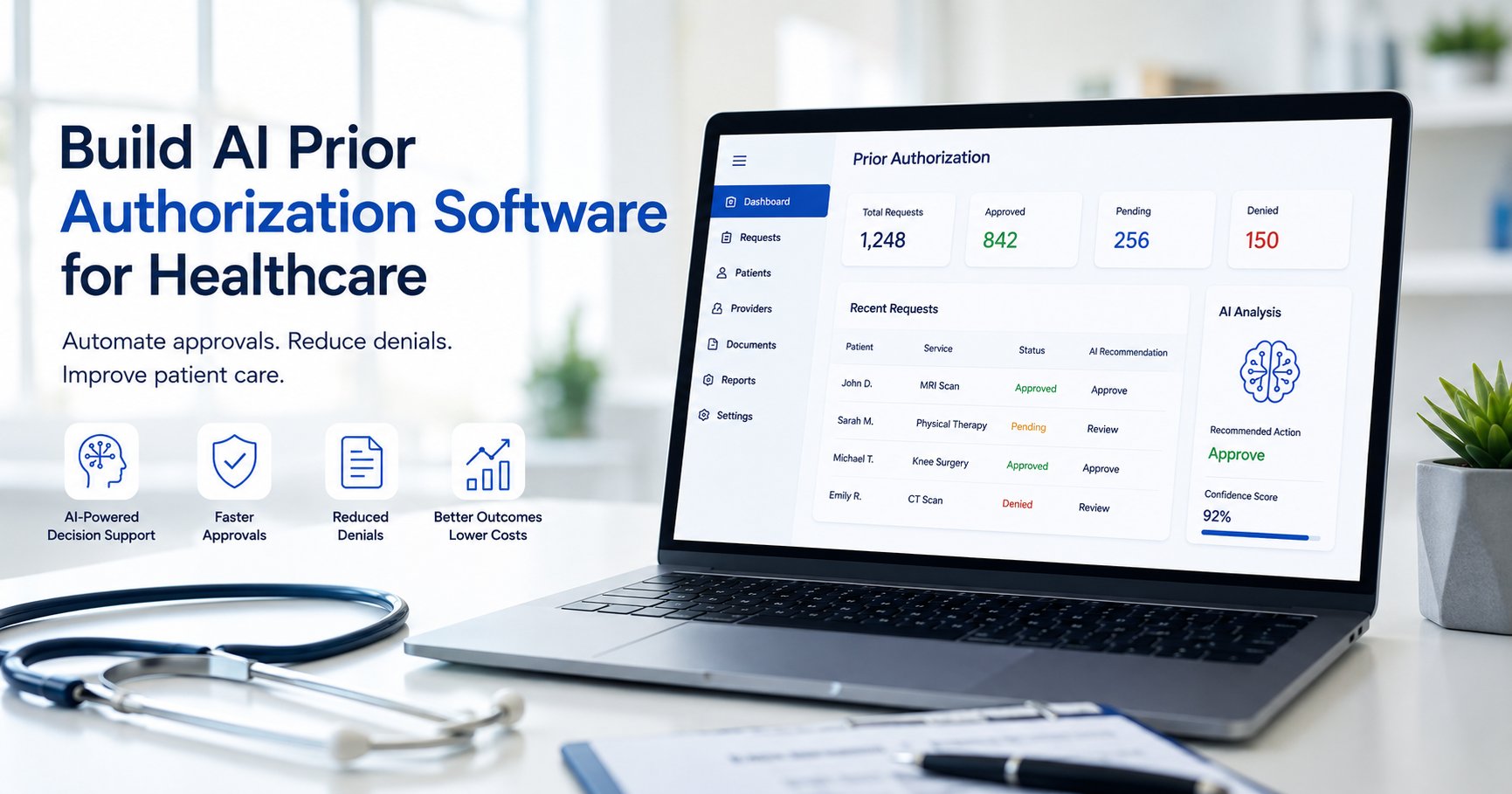
Prior authorization remains one of the most time-consuming and expensive administrative processes in healthcare. Providers often spend countless hours collecting clinical records, validating payer requirements, submitting documentation, and tracking approvals manually. These delays impact patient care, increase operational costs, and contribute significantly to physician burnout. As healthcare organizations continue embracing intelligent automation, AI-powered prior authorization software has emerged as a transformative solution for streamlining utilization management.
Building AI prior authorization software requires much more than digitizing traditional forms. Modern healthcare organizations need intelligent platforms capable of understanding clinical narratives, interpreting payer-specific policies, integrating with Electronic Health Records (EHRs), and automating repetitive administrative tasks while maintaining strict compliance with healthcare regulations. By leveraging Artificial Intelligence, Natural Language Processing (NLP), Large Language Models (LLMs), and secure interoperability standards like FHIR, organizations can drastically reduce authorization turnaround times and improve approval accuracy.
A successful AI prior authorization platform typically begins with secure EHR integration. The software must retrieve patient demographics, insurance information, diagnostic codes, treatment histories, physician notes, and laboratory results from multiple healthcare systems. Because providers often use different EHR vendors, implementing standardized healthcare data formats and FHIR-based APIs is critical for interoperability and scalability.
Once clinical data is collected, NLP and LLM technologies play a vital role in extracting meaningful medical information from unstructured documents. AI models can analyze physician notes, identify relevant diagnoses, detect comorbidities, summarize treatment histories, and compare patient information against payer-specific medical necessity requirements. This enables the system to automatically identify missing documentation before submission, reducing denials and resubmissions.
An intelligent orchestration engine serves as the decision-making layer of the platform. It continuously evaluates clinical information against changing payer policies, determines eligibility requirements, routes requests to the appropriate workflow, and triggers human review whenever confidence scores fall below predefined thresholds. Human-in-the-loop validation remains essential to ensure clinical accuracy, regulatory compliance, and patient safety.
Another critical component is automated submission and status tracking. The platform should securely communicate with payer systems through APIs, electronic transactions, or portal automation when direct integrations are unavailable. Automated status monitoring allows healthcare teams to receive real-time updates, approval notifications, and authorization codes directly within the EHR workflow.
Because healthcare data is highly sensitive, security and compliance must remain foundational throughout development. Organizations should implement HIPAA-compliant infrastructure, role-based access controls, audit trails, encryption, secure authentication mechanisms, and continuous monitoring to protect patient information and maintain regulatory compliance.
The future of healthcare administration is increasingly driven by intelligent automation. AI-powered prior authorization software not only reduces administrative burdens and operational costs but also accelerates patient access to treatment and allows clinical teams to focus more on delivering quality care. Healthcare organizations investing in AI-enabled authorization systems today are positioning themselves for greater efficiency, scalability, and improved patient outcomes in the years ahead.


Published by
About our partner
Seasia Infotech
Seasia Infotech is a CMMI Level 5 certified global technology company specializing in custom software development, AI and machine learning, web and mobile application development, cloud solutions, enterprise software, QA and testing, DevOps, UI/UX design, and digital transformation. With over 25 years of industry experience, we help startups, SMEs, and enterprises build secure, scalable, and innovative technology solutions. Our experienced team has successfully delivered thousands of projects across industries including healthcare, fintech, retail, logistics, real estate, manufacturing, and education. We are committed to delivering high-quality solutions, agile development, and long-term client partnerships.
Learn more





Help your peers
Share what you've learned with fellow public servants