
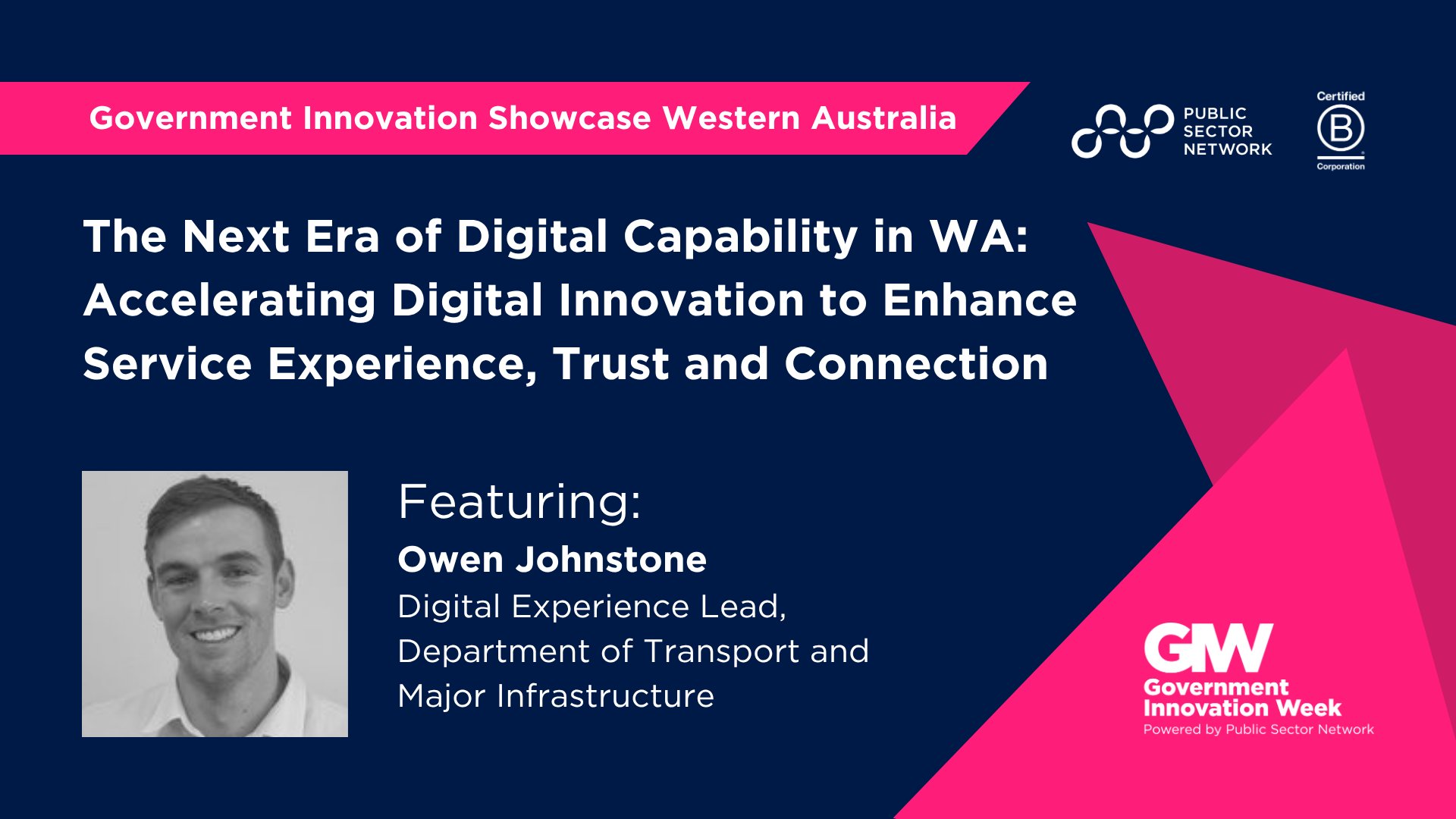
Benji Crooks, Marketing Director at Public Sector Network, spoke with Owen Johnstone, Digital Experience Lead at the Department of Transport and Major Infrastructure, about what will shape digital capability through 2027–28, how government can build trust in AI, and why customer experience must stay at the centre of service design ahead of his appearance at Government Innovation Showcase Western Australia 2026 as part of Government Innovation Week Western Australia on Tuesday, 25 August 2026, where he will join the session "The Next Era of Digital Capability in WA: Accelerating Digital Innovation to Enhance Service Experience, Trust and Connection".
Benji Crooks: So first of all, if you could just introduce yourself, your role and your department.
Owen Johnstone: My name is Owen Johnstone. I work for the Department of Transport and Major Infrastructure. My role at the department is Digital Experience Lead. It involves heading up UX—user experience and user interface design—across the department’s digital service platforms (mainly DotDirect), as well as some internal, staff-facing systems.
Benji Crooks: Aligning the questions a little bit to what you’re going to be talking about: what do you see as the next era for digital capability? What is changing, and what matters most through 2027 to 2028?
Owen Johnstone: I think what matters most is a range of factors. A major one right now is public confidence and public safety around information. The WA Government is going through a huge change with the PRIS guidelines, which we’re working to implement.
Another key issue is people’s confidence—and willingness—to use online services. We’ve seen online service usage steadily grow year on year, and DotDirect is a good example: sign-ups continue to increase. Looking towards 2027–28, I think we’ll see the last major push where even people who have been hesitant round the corner, and a clear majority—maybe 80–90%—use digital platforms first. In-person channels will still exist, but more as a backup.
The third hot topic is AI. It’s a big conversation point at this upcoming showcase. AI has advantages, but for government the key question is: how do we use it smartly and with good purpose, rather than using it just because it’s available? There’s no point applying a powerful technology without a suitable use case.
Benji Crooks: You spoke about public confidence in new innovation. How do you build that public confidence with the introduction of AI and different systems?
Owen Johnstone: Government is a bit different to the private sector. We’ve seen private industry implement AI at scale, but I don’t see government using it as widely in the immediate future—even by 2027–28.
That said, there are resources being made available to support AI adoption. For government, the pace can sometimes be a hindrance—but in this situation it can be a benefit. It gives us time to think, look at the research, and analyse how AI can be implemented properly and safely. By the time it’s implemented, we’ll have spent a long time working through the right approach, so the public can be confident it’s being introduced responsibly.
Benji Crooks: I completely agree—if you rush ahead, you can get benefits sooner, but you’re not building the governance or doing it safely.
Owen Johnstone: That’s the major risk: people move too quickly and try to implement AI too widely. I’m not in charge of how AI is rolled out, but I think the safest option is to introduce it in small, controlled situations where people are still heavily involved—and then expand from there.
People worry about job losses, but I don’t think that’s how we should approach it. It should start as a small assistance to someone’s role. Once it’s been used for a long time and we’re confident it’s working, you can increase it gradually. That’s how government workers—and the WA community—can build confidence that it works and has been implemented correctly.
Benji Crooks: Talking again about confidence in new innovations: what would you say is one of the better innovations introduced over the last couple of years? Is it something like DotDirect, or another one?
Owen Johnstone: One important thing is to look wider at what other governments are doing—interstate and overseas.
The UK Government website (GOV.UK) is held up as a gold standard for accessibility. It’s something I—and others at the Department of Transport—look at a lot for how they’ve implemented advances in accessibility. I’m not a UK citizen, so I can’t access their services, but the website itself is excellent: easy to use, with lots of ideas we can adapt for WA.
Another example is the New South Wales services. They have a substantial online library or hub that outlines what they’re doing with digital services. They publish guides on how they design services, including style guides and design files in one place. I think it’s a great way to build public confidence because it shows: this is how we design services, this is our methodology. There’s no smoke and mirrors. It also helps staff because they can find the rules easily. We don’t have the population to justify a hub like that, but we look to NSW for inspiration when we’re shaping our own style guides.
Benji Crooks: That’s why an event like Government Innovation Week is so important—learning from different governments and experiences. What’s your hope attendees take away, and what will they learn from your session?
Owen Johnstone: I’m coming at this from a customer experience and customer service standpoint. Many others are speaking from a more technological angle.
If someone takes one thing away from what I talk about, it’s this: put the customer—the person you’re trying to help—at the centre of the problem. Don’t start with the department’s problem or the business unit’s problem. Start with the person’s problem, then frame the solution around solving that. If you keep the customer at the centre, you’re much less likely to build a service they don’t want.
Benji Crooks: To close: we’ve talked about trust, innovation and customer-centred design. How do you measure trust with a customer, and whether their experience has worked?
Owen Johnstone: There’s no one way—it’s a range of methods that you use together.
With online services, you have analytics. You can see how many times a transaction was completed, or how often someone updated their email, for example. But it’s also very important to get feedback directly from people, because the experience isn’t only about what happened—it’s also about how it felt. Just because someone can complete an online form doesn’t mean the experience is good.
You can collect reactive feedback through complaints or forms, but you also need to proactively go out to your target audience—through consultation groups and other engagement—and ask: “What do you think? What could we do better?” You can’t implement everything, but most of the time there are at least one or two things you didn’t realise, even as an expert. Nothing trumps asking the people who actually use the service.
Hear Owen Johnstone at Government Innovation Showcase Western Australia 2026 as part of Government Innovation Week Western Australia on Tuesday, 25 August 2026. Owen will share a customer-experience lens on designing digital services that build trust and confidence as government moves towards digital-first delivery.





Help your peers
Share what you've learned with fellow public servants