
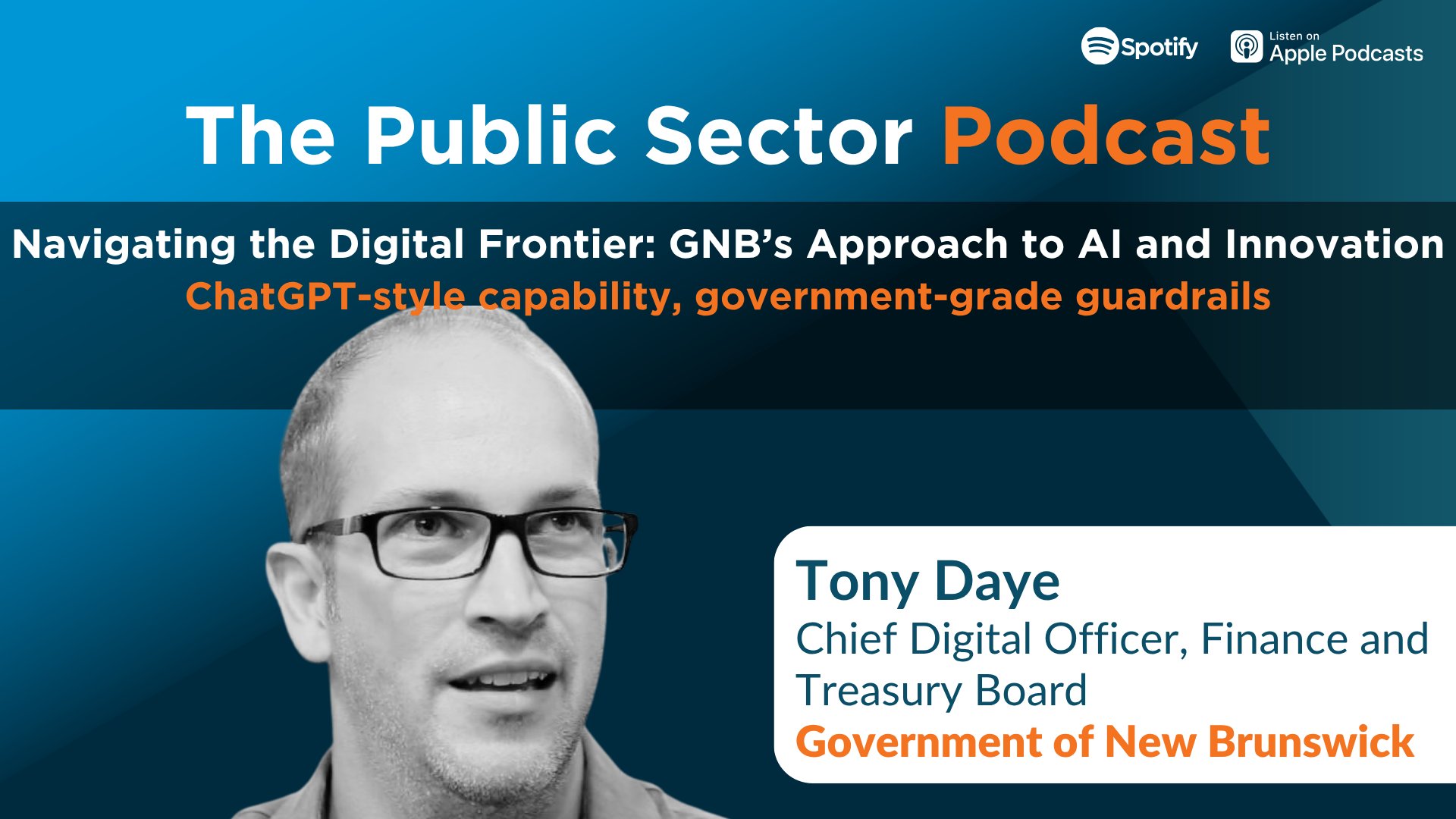
Episode Overview
In this episode, Tony Daye, Chief Digital Officer, Finance and Treasury Board for the Government of New Brunswick, shares how New Brunswick is approaching AI-enabled digital transformation with a clear focus on trust, privacy, and governance. Tony outlines the breadth of his mandate across digital transformation, strategy, procurement, and close partnership with cybersecurity, then walks through how the province is leveraging global best practices while embedding guardrails into technology deployment.
The conversation covers New Brunswick’s early R&D into large language models (LLMs), the opportunities they see for improving government operations, and the reality of risks like bias, black-box decisioning, and data privacy. A key highlight is Chat GNB/Chat GMB—a secure, government-hosted generative AI tool designed specifically for public sector use—alongside a broader push for simpler, more consistent citizen services through design systems, form standardisation, and journey mapping.
Key Themes
A central theme is that AI adoption in government must be trust-by-design. Tony explains why external AI platforms can be a non-starter for sensitive public sector use cases, and how controlled, tenant-based deployment creates the conditions for safer experimentation and scale.
The episode also emphasises that AI is only one part of transformation. Real service improvement comes from combining AI with strong foundations: standardised forms, consistent design, clearer citizen journeys, and better data quality—so innovation improves people’s lives, not just systems.
What You’ll Learn
1) New Brunswick’s Approach to AI and Digital Transformation
How the CDO function is set up, and what it means to balance innovation with policy, privacy, and security requirements.
2) What LLMs Can Do for Government Operations
Where LLMs can add value quickly—context-aware Q&A, summarisation, drafting documents and reports, and streamlining language-based tasks.
3) The Key Risks Governments Must Design Around
How bias, lack of transparency (“black box” models), and data privacy concerns shape responsible implementation decisions.
4) Why “Secure-by-Default” Matters for Generative AI
Why controlling where data goes (and where it stays) is critical when deploying AI in a government environment.
5) What Chat GNB/Chat GMB Is (and Why It Was Built)
How a government-hosted tool can provide ChatGPT-like functionality while keeping prompts and outputs inside the government tenant with access controls like SSO.
6) Scaling from Pilot to Enterprise Use
What it looks like to move from early testing to broader rollout across the workforce, and why training, communication, and change management matter.
7) Drafting an AI Strategy That Survives Technology Change
Why New Brunswick is focusing on standards and principles (privacy, security, transparency, accountability) rather than prescribing specific tools.
8) AI as Part of a Citizen-Centred “Life Events” Model
How life events and journey mapping can guide priorities so AI supports services people actually need—like benefits, licensing, healthcare navigation, or student loans.
9) The Foundations: Design Systems, Form Standardisation, Journey Mapping
How consistent user experience, reduced friction, and improved data quality build trust and unlock better digital service delivery.
Key Takeaways
- Trust is the core requirement for AI adoption in government—privacy, security, transparency, and accountability must be built in from the start
- LLMs can improve productivity, but they bring real risks (bias, opacity, privacy) that require guardrails
- A secure, in-tenant tool like Chat GNB/Chat GMB enables safer experimentation and broader workforce enablement
- Digital transformation works best when AI is paired with strong service design foundations (design systems, standardised forms, journey mapping)
- Better services are driven by citizen needs and “life events,” not by technology alone
- Communities of practice and internal champions help scale capability in large organisations
Why You Should Listen
This episode is for public sector digital leaders, CIO/CDO teams, service designers, cybersecurity and privacy leaders, and transformation practitioners who want a practical look at how to adopt generative AI responsibly—without losing control of data or citizen trust. It’s a clear example of how governments can move forward with AI while strengthening the foundations that make digital services simpler and more consistent.
Memorable Line of Thinking
AI can unlock “previous impossibilities”—but only if it’s deployed with the guardrails, service design foundations, and trust that citizens expect from government.







Help your peers
Share what you've learned with fellow public servants