
Federal agencies are being asked to modernise services, adopt AI and improve digital experiences at a time when cyber threats are becoming more complex and public confidence can be difficult to earn and easy to lose.
For Dimitar Dimitrovski, Chief Information Officer at the Fair Work Ombudsman, those pressures cannot be treated as separate conversations.
Cyber resilience, digital transformation, AI adoption and public trust all come back to how government designs and delivers services that people can rely on.
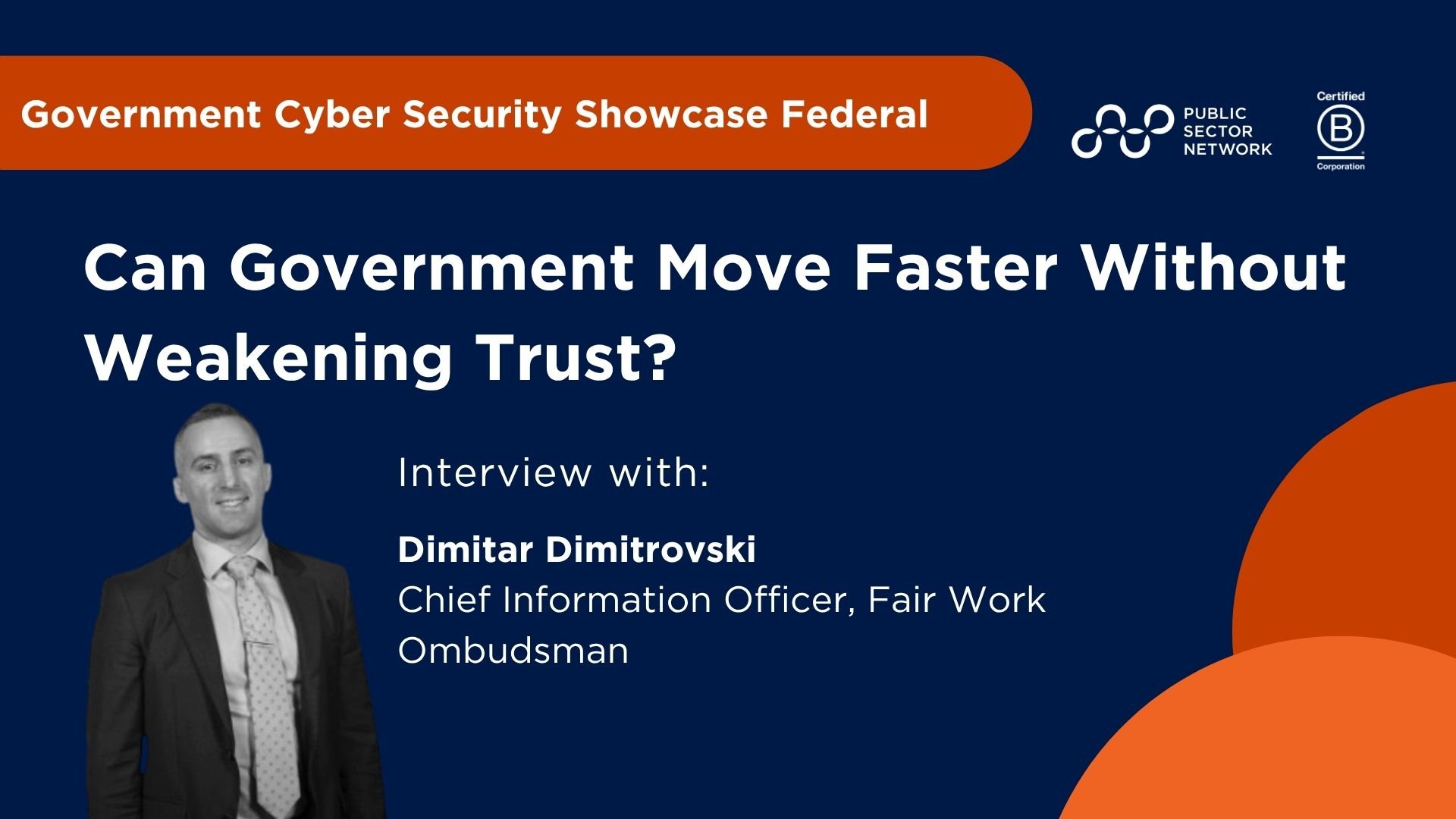
Ahead of his appearance at Government Cyber Security Showcase Federal 2026, Public Sector Network spoke with Dimitar about the technology priorities shaping his work, where AI can create practical value, why cyber risk needs to be treated as an agency-wide issue and what a more connected digital government could look like by 2030.
Dimitar will join Chris Zhang, A/Manager, Internal Audit, Department of Industry, Science and Resources, and Sajid Hassan, Chief Information Officer, Australian National University, for the panel discussion “Can Government Move Faster Without Weakening Trust?”
The session will examine how government can accelerate transformation without introducing greater systemic risk, where public trust is most vulnerable in AI-enabled services and what responsible innovation should look like across the Commonwealth.
Explore the event: Event overview | Register for the Showcase
Q&A with Dimitar Dimitrovski
Public Sector Network: What are the biggest cyber and technology priorities you are focused on right now, and what is driving them?
Dimitar Dimitrovski:
There are three key areas for us: strengthening cyber resilience, responsibly adopting AI and modernising our core digital platforms.
Those priorities are being driven by rising cyber threats, growing public expectations around digital services and the need to make sure the technology we deliver continues to support effective regulatory outcomes.
They are all interconnected. We need technology that enables us to work more effectively, but it also needs to be resilient and trusted.
Public Sector Network: As CIO, you operate in an environment where digital services need to be accessible, reliable and trusted. What does trust mean in the context of the services your agency delivers?
Dimitar Dimitrovski:
For a government agency, trust means people can rely on our services to be secure, available, accurate and transparent.
It means protecting sensitive information, maintaining service continuity and making sure our technology decisions support confidence in the advice and regulatory functions we provide.
Technology moves fast, but trust moves really slowly.
That is something you have to balance. Technology will continue to evolve quickly, but we need to make sure the way we adopt it does not get ahead of the trust people place in government.
Public Sector Network: Federal agencies are under pressure to modernise faster, particularly as AI and automation become more prominent. Where do you see the biggest opportunities to move faster without compromising security or public confidence?
Dimitar Dimitrovski:
Some of the greatest opportunities are in automation, data-driven services, AI-assisted workflows and cloud platforms.
But success depends on embedding governance, transparency and security from the start rather than treating them as compliance activities that get added later.
If those elements are built into the design and development of a platform from the beginning, you are in a much better position to move quickly and responsibly.
That is where I think the real opportunity is.
Public Sector Network: The Fair Work Ombudsman interacts directly with employers, employees and the broader public. How does that frontline environment shape your approach to digital transformation and cyber resilience?
Dimitar Dimitrovski:
It keeps us focused on outcomes for the people who actually use our services.
Any technology change needs to improve accessibility, reliability and user experience from the outset, while also making sure our systems remain resilient and information stays protected.
We need to make sure people can access services regardless of where they are or what their needs are. That is why things such as multiple languages, translation services and strong accessibility standards are important.
At the same time, we need confidence that the systems themselves are secure. We regularly undertake penetration testing and other exercises to make sure our information and services remain protected.
Ultimately, working in a frontline environment keeps bringing the focus back to the user. The technology needs to make the experience better without compromising resilience.
Public Sector Network: As AI-enabled services become more common across government, where do you think public trust is most vulnerable?
Dimitar Dimitrovski:
Transparency is critical.
People need confidence that AI is being used responsibly, that decisions remain accountable and, first and foremost, that their personal information is protected.
Trust starts to disappear when people do not understand how AI is being used or where accountability sits.
You cannot implement a system and then say that the accountability now belongs to the system. Ultimately, a person still needs to be responsible. When we build these systems, we need to make sure there is clear ownership and responsibility around decision-making.
At the Fair Work Ombudsman, our immediate focus is more on using AI to improve productivity internally and support how we develop and deliver applications rather than putting AI directly in front of citizens.
For us, improving the way our people work and improving the services themselves comes first. That experience can then help shape what a future phase of AI-enabled public interaction could look like.
Public Sector Network: Cyber incidents are becoming increasingly visible and disruptive. How can agencies build resilience in a way that goes beyond technology and becomes part of organisational culture?
Dimitar Dimitrovski:
Resilience comes from shared responsibility.
Technology matters, but so do leadership, governance, workforce capability, clear processes and regular practice.
The strongest organisations treat cyber risk as a business issue, not simply an IT issue.
The same applies to AI risk. Ultimately, it is risk to the organisation.
If there is a risk to my technology stack, that is a risk to the agency and its ability to do its job. Once you start looking at it in those terms, cyber resilience becomes much broader than the technology team.
That is how you begin to build resilience across the organisation.
Public Sector Network: Looking ahead to 2030, what should trusted and resilient digital government look like, and what needs to change now to get there?
Dimitar Dimitrovski:
We need to invest now in cyber fundamentals, AI upskilling, digital capability, modern platforms, AI governance and cross-government collaboration.
By 2030, government services should be secure by design, highly accessible, data-informed and supported by trusted AI capabilities.
But I also think digital government needs to become more connected.
Citizens do not necessarily care which agency owns a particular service. They see government as government.
When somebody contacts a service and gets told, “That is with another agency,” that distinction may make sense internally, but it does not necessarily make sense to the person trying to get something done. From their perspective, it can simply feel like government is not joined up.
That is the narrative we need to shift.
Where legislation and policy allow it, services should be interconnected around the needs of the citizen rather than the organisational structure behind them.
Digital identity is a good example. People should not have to introduce and verify themselves separately with dozens of different agencies throughout their lives. There is an opportunity to create trusted capabilities that can be used across government and make those interactions much simpler.
That is what a more cohesive digital government should ultimately be working towards.
Can Government Move Faster Without Weakening Trust?
Many of the themes Dimitar raises will continue at Government Cyber Security Showcase Federal 2026 on Thursday, 22 October in Canberra.
His panel, “Can Government Move Faster Without Weakening Trust?”, will consider one of the central challenges facing the Commonwealth: how to modernise at greater speed while maintaining resilience, accountability and public confidence.
Discussion will include:
- accelerating transformation without increasing systemic risk
- understanding where trust is most vulnerable in AI-enabled digital government
- defining responsible innovation across the Commonwealth
- what resilient and trusted government should look like by 2030
The conversation forms part of the Governance, Strategy and Risk track, one of two dedicated streams at this year’s Showcase.
Across the broader program, attendees will hear from cyber security, digital, national security, risk and technology leaders on AI-enabled threats, critical infrastructure, cybercrime, identity, supply chain exposure, secure innovation, incident response and the changing nature of government resilience.
For Federal Government teams responsible for protecting services while enabling transformation, the Showcase provides a practical opportunity to hear how peers are approaching the same challenges and discuss what stronger resilience looks like in practice.
Government Cyber Security Showcase Federal 2026
Thursday, 22 October 2026
National Convention Centre Canberra
Complimentary for government attendees
Explore the event: Event overview | Register for the Showcase

![Charting the future: The impact of DTA's work agenda on agencies and suppliers in the near and mid term [Webinar]](https://cdn.publicsectornetwork.com/thumbnails/insight/feature_images/LI_Event_Banner_2_6bd9e9.jpg.640x360_q85_autocrop_crop-center.jpg)




Help your peers
Share what you've learned with fellow public servants