


Written and edited by Tech Editor Lauren Attana, Technical Consultants; Marcelo Farinelli and Andrei Ciobani and Chief Technology Architect Daniel Cox.
The first organisation to feel the impact of quantum computing will not be the one building it. It will be the one still relying on cryptography that no longer protects its data.
Quantum computing is steadily moving from theoretical research into practical engineering. While large-scale quantum machines capable of breaking modern encryption are not yet operational, global technology providers and cybersecurity agencies are already preparing for the transition.
Sensitive data captured today may be decrypted in the future. This is the “harvest now, decrypt later” risk model increasingly discussed by security leaders. For Government Agencies responsible for long-lived data such as health records, citizen services, legal archives, utilities infrastructure, and intellectual property, the exposure window is already open.
It’s important to note that Post-quantum cryptography (PQC) is not hype organisations need to react to. It’s real and needs structured preparation and the time to begin that preparation is now.
Government Agencies that start early can integrate post-quantum readiness into existing upgrade cycles, cloud migrations and modernisation programs—those who delay risk compressing multi-year transition efforts into reactive remediation under regulatory or security pressure.
Post Quantum Cryptography Vs Post Quantum Computing
Before examining timelines and vendor readiness, it is important to understand the distinction between these two closely related terms
Post-quantum Computing is the broader concept. It describes the future landscape where quantum computers exist and have the capability to break many of today’s cryptographic systems. It is about the impact of quantum technology on computing, security aand data protection overall.
Post-quantum Cryptography is the response to that challenge. It focuses specifically on developing new encryption algorithms that can run on today’s classical computers but remain secure against attacks from future quantum computers.
In simple terms:
- Post-quantum computing = the problem (quantum threat)
- Post-quantum cryptography = the solution (quantum-resistant security)
For Government Agencies, the key takeaway is that you should not wait until quantum computing matures to start preparing. The shift to post-quantum cryptography can begin now to protect long-term data.
PQC represents a transition in the cryptographic algorithms used to protect data at rest, in transit and across applications and infrastructure. It is not a patch. It is not a product. It is an architectural evolution.
Modern digital environments rely heavily on public-key cryptography, including RSA and elliptic curve cryptography, which underpin secure web traffic, VPN connections, digital certificates, database encryption, API authentication, email security and code signing. Post-quantum cryptography involves replacing or augmenting these algorithms with alternatives resistant to quantum attack models. This transition touches legacy systems, cloud platforms, application code, operating systems and vendor dependencies.
Source: https://cryptomator.org/blog/2025/07/24/post-quantum-roadmap/
Understanding the Quantum Risk in Business Terms
The “Harvest Now, Decrypt Later” Threat Model
The most frequently referenced risk scenario is “harvest now, decrypt later.” Malicious actors can capture encrypted data today and store it. If future quantum computers become capable of breaking current public-key cryptographic standards, that stored data may be decrypted.
For Government Agencies retaining data for decades, this is not theoretical.
Encryption is the Second Line of Defence
Encryption is critical, but it is the second line of defence. Identity controls, monitoring, segmentation and patching exist to prevent data theft. If those controls fail, encryption determines whether the breach becomes catastrophic.
Security improvements that prevent data theft reduce quantum exposure risk today.
For the Australian Government, the practical implication is this: post-quantum cryptography should be treated as a strategic risk management issue, not a distant technology curiosity.
ASD Post-Quantum Transition Timeline
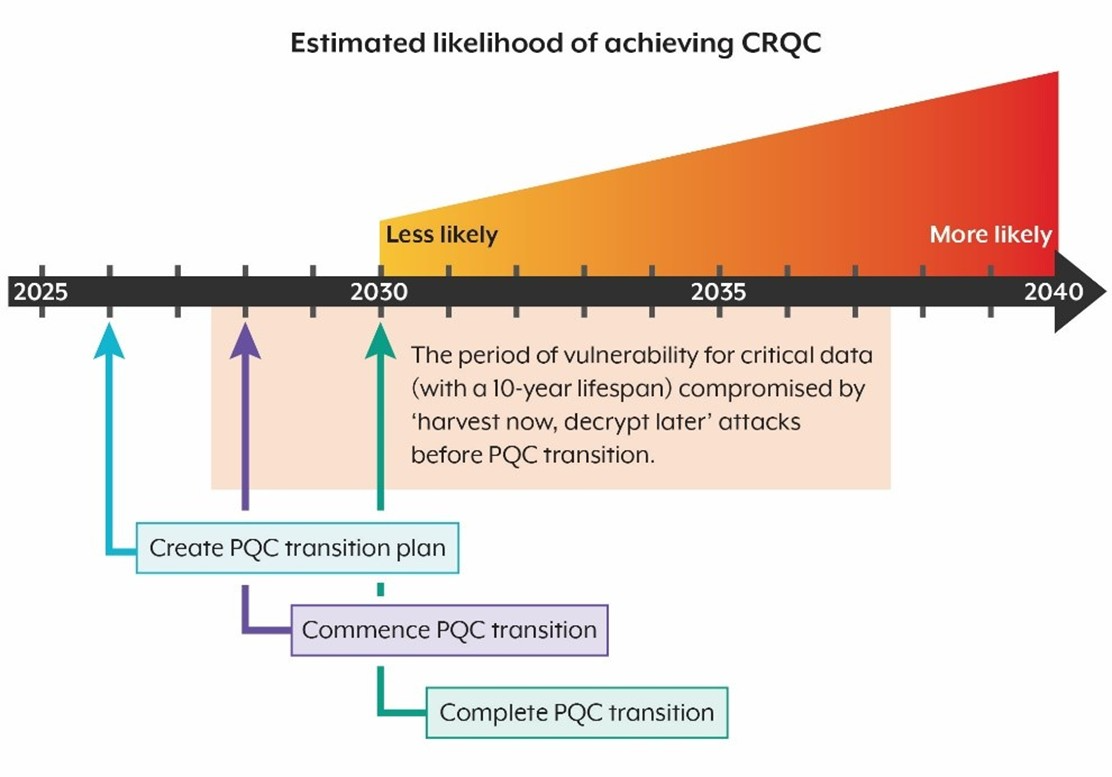
The Australian Signals Directorate (ASD) suggests that organisations should have a refined plan by the end of 2026 and cease the use of traditional asymmetric cryptography by the end of 2030. This includes cryptographic algorithms such as the Rivest-Shamir-Adleman (RSA), Diffie-Hellman (DH), Elliptic Curve Diffie-Hellman (ECDH) and Elliptic Curve Digital Signature Algorithm (ECDSA) primitives. Instead, ASD recommends using post-quantum ASD-approved cryptographic algorithms as described in the ISM’s Guidelines for cryptography PQC – Awareness Article.docx.
Adoption of PQC by the end of 2030 includes contingencies for disruptive technology breakthroughs and other external factors. Government Agencies should also include additional contingencies to allow for internal factors that may delay their PQC transition.
The diagram below shows ASD’s recommended PQC transition timeline against the increasing risk of a cryptographically relevant quantum computer (CRQC) becoming available each year.
Source: ASD Planning for Post-Quantum Cryptography
How the technology vendors have been preparing
Quantum computers do exist today, but they are still in an early, experimental stage – often referred to as the NISQ era (Noisy Intermediate-Scale Quantum). They are powerful for research and specialised problems, but not yet capable of breaking modern encryption or replacing classical systems. This is why major technology vendors have not been waiting for quantum computing to mature before building post-quantum cryptographic capabilities into their platforms.
Oracle
Oracle has published detailed guidance on post-quantum cryptography and its integration into enterprise systems, highlighting the importance of cryptographic agility and forward planning.
Oracle’s messaging focuses on preparing infrastructure, databases, and enterprise applications for quantum-resistant algorithms as standards mature. For Government Agencies running Oracle database estates or Oracle-based applications, this signals that upgrade pathways will increasingly incorporate post-quantum readiness considerations.
This reinforces the importance of keeping platforms current. Delayed upgrades increase cryptographic risk exposure.
https://blogs.oracle.com/security/post-quantum-cryptography.
Microsoft
Microsoft has outlined its progress toward quantum-safe security and next-generation cryptography in its security blog.
Microsoft emphasises long-term cryptographic transition planning and integration into cloud services, operating systems, and identity infrastructure. This has direct implications for Government Agencies relying on Microsoft cloud platforms, Windows environments, and identity services.
Quantum-safe transition is becoming part of mainstream platform evolution.
AWS
Amazon Web Services provides detailed resources on post-quantum cryptography and quantum-safe security planning.
AWS frames quantum safety as a shared responsibility model consideration. While hyperscalers invest heavily in quantum-resistant capabilities, customers must understand how their workloads, encryption settings, and key management practices align with emerging standards.
For organisations migrating workloads or modernising applications in AWS, post-quantum considerations should be evaluated during architectural design.
Learn more: https://aws.amazon.com/security/post-quantum-cryptography/
PostgreSQL
The PostgreSQL community is also addressing quantum-safe cryptographic planning
The discussion highlights that open-source database platforms are not immune from quantum risk. Encryption libraries, TLS implementations, and extension ecosystems must evolve alongside formal standards.
For organisations considering Oracle to PostgreSQL migrations, or expanding PostgreSQL estates, now is the right time to evaluate long-term cryptographic resilience.
Learn more: https://www.postgresql.fastware.com/blog/why-quantum-safe-postgresql-is-critical-today
Why planning must begin now
Most enterprise environments cannot replace foundational cryptographic components in under 18 to 24 months. Cryptographic change affects applications, databases, identity, operating systems, networking and cloud configurations.
Building cryptographic agility now allows organisations to transition methodically rather than reactively.
Where organisations are most exposed
Cryptography is embedded across modern IT environments:
- Databases encrypting data at rest
- TLS certificates securing web services
- API authentication mechanisms
- Backup and archival storage
- VPN tunnels
- Identity systems
- Cloud storage services
Legacy environments are often the most vulnerable. Older Oracle versions, unsupported Java runtimes, outdated operating systems, and ageing application frameworks may rely on deprecated cryptographic libraries.
Keeping platforms current is not simply about vendor support. It is about security resilience.
A Practical 5 step Approach to Post-Quantum Readiness
Establish Cryptographic Visibility
Map where encryption is used across infrastructure, applications, and cloud environments. Identify algorithms, certificate authorities, key management systems, and vendor dependencies.
Without visibility, prioritisation is impossible.
Prioritise Long-Lived and High-Value Data
Focus on:
- Citizen records
- Health data
- Infrastructure blueprints
- Intellectual property
- Legal and financial archives
If confidentiality must be maintained for decades, quantum exposure risk increases.
Align with Vendor Roadmaps
Review Oracle, Microsoft, AWS, and PostgreSQL guidance to understand:
- Planned support for quantum-resistant algorithms
- Upgrade requirements
- Compatibility considerations
Vendor ecosystems are evolving. Alignment now prevents disruption later.
Integrate PQC into Modernisation and Cloud Programs
The most cost-effective moment to strengthen encryption is during change. Examples include:
- VMware exits and cloud migrations
- Database version upgrades
- Application modernisation initiatives
- Infrastructure refresh cycles
- Containerisation programs
Embedding post-quantum considerations into these programs reduces duplication and spreads cost across transformation budgets.
Develop a Staged Transition Plan
Not every system must change immediately. A staged roadmap aligned to business risk is sufficient. Document:
- Target standards
- Upgrade sequencing
- Governance controls
- Risk treatment rationale
This supports executive oversight and regulatory defensibility.
Post-Quantum Readiness and Secure AI
As organisations adopt modern data platforms and private AI capabilities, the sensitivity of centralised data environments increases.
If AI systems rely on aggregated internal knowledge, data protection requirements intensify. Ensuring long-term encryption resilience strengthens responsible AI adoption.
Post-quantum planning therefore intersects with:
This is not an isolated initiative. It is an architectural consideration spanning the entire technology environment.
How Blue Crystal Solutions Supports Practical Preparation
Post-quantum readiness is not achieved through theory. It requires structured execution.
Blue Crystal Solutions supports organisations by:
- Reviewing encryption posture across database, application, cloud and operating system layers.
- Embedding post-quantum considerations into upgrade and migration programs with staged cryptographic transition roadmaps.
- Delivering platform upgrades, including Oracle 26c, Java 24/27 and Red Hat Enterprise Linux 10, where post-quantum cryptographic library support is being progressively introduced by vendors.
- Strengthening security controls to reduce data theft risk, including improved monitoring with SIEM tools to expose issues such as plain text authentication, implementing CIS benchmarks for operating systems and databases, penetration testing, and endpoint detection and response deployment.
Our approach integrates security with operational architecture. Rather than creating standalone quantum projects, we align preparation with programs already underway.
Encryption remains the second line of defence. Preventing compromise remains the first. Strengthening both ensures long-term resilience.
Start with clarity, not complexity
Post-quantum cryptography does not require immediate wholesale replacement of your technology stack. It requires awareness, architectural visibility and a structured transition pathway.
If your organisation is planning cloud migration, upgrading databases, modernising applications or reviewing security posture ahead of 2026, now is the time to assess how post-quantum considerations fit into that roadmap.
The most effective first step is clarity. A structured cryptographic exposure review can identify vulnerable algorithms, long-term confidentiality risks, vendor alignment gaps and areas of technical debt.
Organisations that begin this process early maintain control over cost, sequencing and governance.
The goal is not urgency. It is preparedness.
If your organisation is reviewing cloud, security, or modernisation strategy in 2026, now is the time to assess how post-quantum considerations fit into that roadmap. We can guide you through. Talk to our experts today about preparing your environments for Post-Quantum Readiness.
Resources
- ASD Planning for Post-Quantum Cryptography
- Oracle Post-Quantum Cryptography
- Microsoft Quantum-Safe Security
- AWS Post-Quantum Cryptography
- Why Quantum-Safe PostgreSQL Is Critical Today
- Cryptomator Post-Quantum Roadmap
Frequently Asked Questions

Published by
About our partner
Blue Crystal Solutions
Blue Crystal Solutions is a 100% Australian owned IT Managed Services and IT Consulting company specialising in cloud, database, applications, infrastructure and secure Private AI solutions. Headquartered in Adelaide, we support government, defence, healthcare, utilities, and regulated industries with sovereign delivery capability and a fully domestic workforce. We are ISO 9001 and ISO 27001 certified, with NV1 cleared personnel and a strong focus on quality, security, and modern engineering practices. We help customers build the technical and governance foundations needed to modernise operations, unlock value from data, and innovate with confidence. In IT, it’s all about the numbers, so Blue Crystal Solutions are: 1,000s of databases, servers, and applications under support 60+ contracts actively in management 30+ Cloud Projects delivered 50+ staff across 5 locations in Australia Excellent Customer Satisfaction NPS +67 3 Major Technology Partners 100% Australian owned & 100% Australian operated. ISO 27001 & ISO 9001 CertifiedNV1 ClearedMore info: https://www.bluecrystal.com.au/
Learn more




Help your peers
Share what you've learned with fellow public servants