

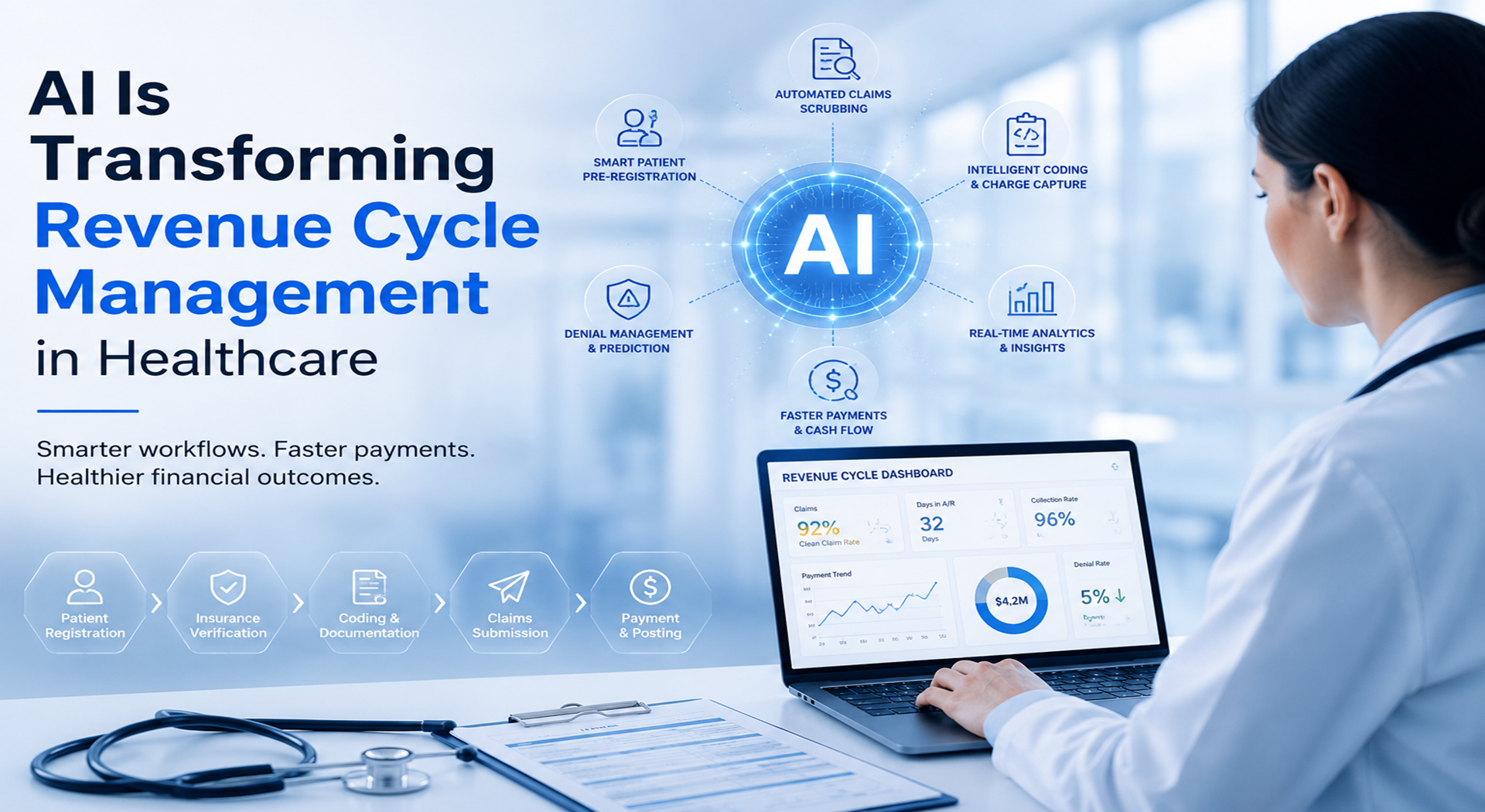
Medical billing departments have historically suffered from mountains of manual paperwork, slow claim processing, and increasing administrative overhead. Clinical attention suffers inevitably when hospital networks and private practices spend too much operational time chasing unpaid insurance claims. Friction between healthcare providers and payer networks has turned financial operations into a reactive defensive game.
Modern health systems are now revamping legacy workflows. Clinical businesses are moving from manual bill review to proactive revenue engineering by embedding machine learning algorithms and intelligent automation into the core of financial operations. AI in revenue cycle management can help health organizations identify coding errors, accelerate prior authorizations, and stabilize cash flow before claims leave the building.
Shifting From Reactive Appeals to Predictive Denial Prevention
Historically, revenue cycle teams addressed insurance denials after they happened. An improperly coded procedure or a missing modifier would trigger a rejection, initiating a multi-week appeal cycle that drained staff resources and delayed reimbursement.
Today, predictive algorithms scan clinical documentation in real time before claim generation. These systems compare patient records, provider notes, and specific payer rules against historical rejection patterns.
Here is what that looks like in practice-
- Autonomous Medical Coding: Generative natural language processing parses physician notes, assigns accurate ICD-10 and CPT codes, and flags vague documentation on the fly-moving farbeyond basic computer-assistedrules.
- Instant Eligibility Checks - Autonomous softwareagents hit insurance portals directly. They confirm coverage limits and match clinicalrequirements against payerpolicies in seconds. No faxes. No phone calls.
- Pre-Flight Claim Auditing - Continuousrule checks flag missing pre-authorization IDs and demographic mismatches beforeclaims everleave the building.
Through advanced ai healthcare software development, these automated systems reduce initial claim rejections by up to 30%, while cutting overall claims processing times from days to mere minutes.
Rethinking Patient Financial Touchpoints
Medical bills confuse people. Surprise charges, cryptic line items, and rigid collection notices generate frustration - and fuel bad debt across hospital systems.
Using ai in revenue cycle management changes how providers handle financial communication. Machine learning models analyze payment history alongside demographic data to generate transparent, upfront cost estimates before elective procedures even start.
These clearance workflows hook right into the patient’s healthcare app. Patients see exact out-of-pocket costs upfront. Instead of sending generic past-due notices, automated systems offer tailored payment plans based on real financial profiles, raising collection rates without alienating patients.
Integrating Intelligent Systems into Existing Infrastructure
Upgrading billing infrastructure is notoriously tricky. Older Electronic Health Records (EHR) systems were engineered as static databases - not nimble, real-time analytics engines.
Transitioning to an automated architecture requires addressing four core technical priorities-
- Unstructured EHR Extraction - Models must pull context from free-form doctornotes without introducing API lag orbreaking existing schemas.
- Real-Time Data Streams - Direct API connections bridge the gap between clinical notes and financial posting.
- HIPAA Guardrails - Patient data mustremain encrypted during model training and live inference. Zero exceptions.
- Payer Logic Updates - Models need continuous retraining to adapt as insurancerules andregional coverage policies change.
Partnering with an experienced software development company helps health systems bridge these legacy integration gaps. When vetting vendor capabilities, engineering leaders should prioritize specialized ai development services that train algorithms directly on localized payer datasets - ensuring predictive models scale cleanly without disrupting existing clinical workflows.
Concluding Thoughts
Adopting ai in revenue cycle management isn't an administrative luxury anymore - it's a survival metric. Payer rules are getting tighter, staffing shortages are mounting, and manual billing simply cannot keep up.
Health systems that adopt autonomous coding, predictive denial prevention, and clear patient billing will protect their margins, speed up collections, and keep their core focus on patient care.


Published by
About our partner
Seasia Infotech
Seasia Infotech is a CMMI Level 5 certified global technology company specializing in custom software development, AI and machine learning, web and mobile application development, cloud solutions, enterprise software, QA and testing, DevOps, UI/UX design, and digital transformation. With over 25 years of industry experience, we help startups, SMEs, and enterprises build secure, scalable, and innovative technology solutions. Our experienced team has successfully delivered thousands of projects across industries including healthcare, fintech, retail, logistics, real estate, manufacturing, and education. We are committed to delivering high-quality solutions, agile development, and long-term client partnerships.
Learn more








Help your peers
Share what you've learned with fellow public servants