
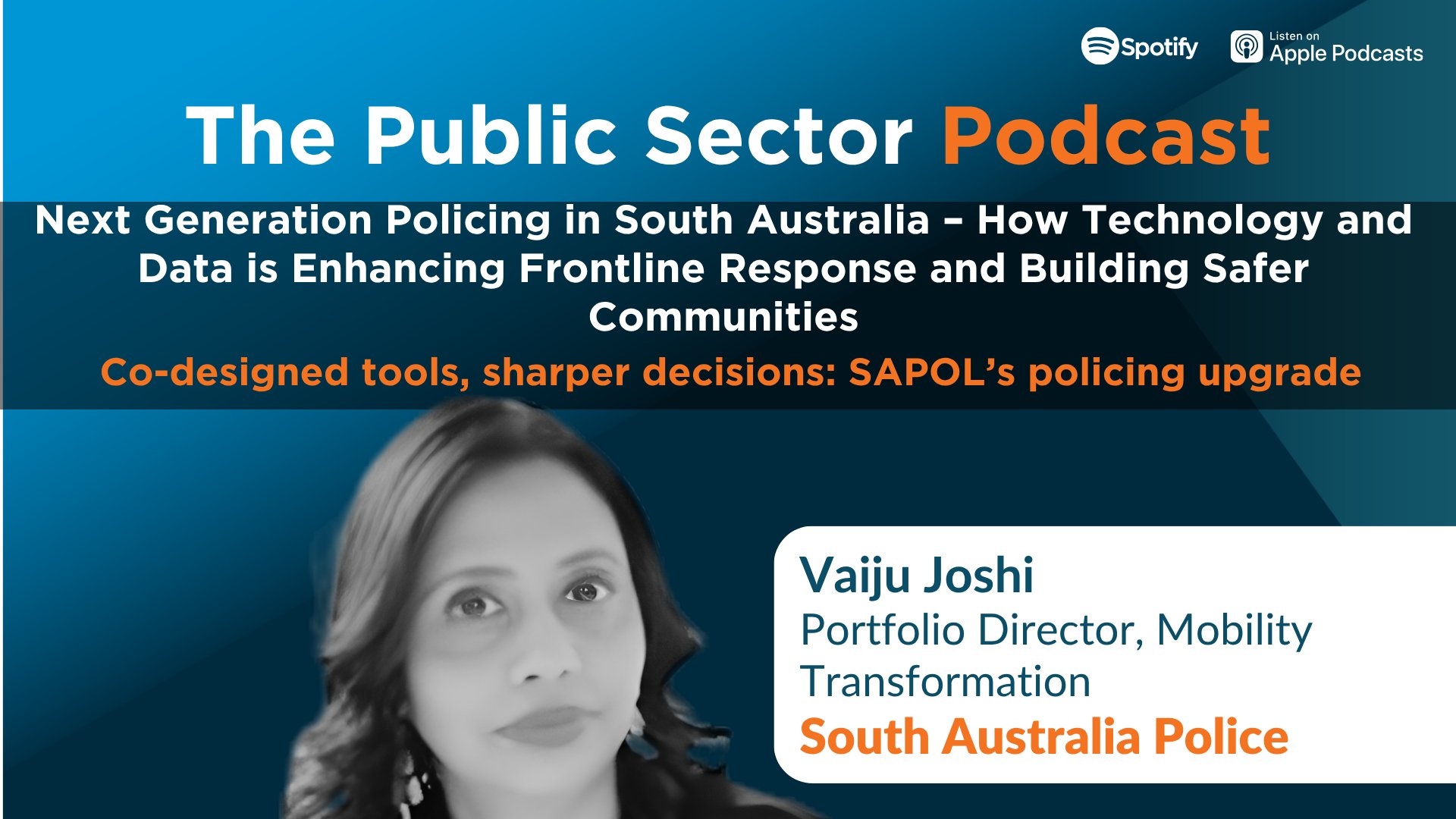
Episode Overview
Vaiju Joshi, Portfolio Director, Mobility Transformation, SA Police explores next-generation policing and how technology can better support frontline response — not as an end in itself, but as part of a broader vision for safer communities. Using SA Police (SAPOL) as the case study, the speaker outlines the operational realities officers face across metro and regional South Australia: long travel distances, volatile and fast-changing incidents, constant context switching, connectivity gaps, and heavy administrative load.
At the centre of the transformation is a bold shift: treating the mobile phone as the primary end-user computing device — a true “mobile office on the go.” The episode walks through the strategy, design principles, and rollout results behind SAPOL’s mobility program, including secure platforms, workflow automation, virtualisation for legacy systems, and Samsung DeX to turn a phone into a desktop-like experience in cars and stations. Real-world outcomes — from faster investigations to improved officer safety through location awareness — show what’s possible when solutions are co-designed with frontline officers and built to reduce cognitive load in high-pressure environments.
Key Themes
- Next-generation policing focused on safer communities
- Frontline realities: time pressure, distance, unpredictability, and context switching
- Mobile-first policing: the phone as the primary compute device
- Integrating legacy and modern systems via virtualisation
- Digital workflow automation and form digitisation (reducing return-to-base admin)
- UX for policing: reducing cognitive load and increasing situational awareness
- Officer safety enablement (including location awareness)
- Co-design “for frontline, by frontline” and adoption through champions
What You’ll Learn
- Why SAPOL prioritised community safety, officer safety, efficiency, and data-driven decisions
- The practical challenges of regional policing and why connectivity matters
- How a “mobile office” approach differs from simply issuing phones
- The five-part approach: secure mobile platform, connectivity, workflow automation, screen/peripheral augmentation, and virtualisation
- Why Samsung DeX enables laptop-like workflows without a laptop
- How consistent design patterns (signals, iconography, audio cues) support faster decision-making
- What the rollout looked like: pilot → learnings → rapid enterprise deployment
- Where measurable benefits are already appearing (time-and-motion studies, investigation speed, evidence handling)
Key Takeaways
- The goal isn’t “more tech” — it’s safer communities, enabled by frontline-focused design.
- When policing is unpredictable, tools must be intuitive, available anywhere, and fast.
- A phone can be a true compute device when paired with the right ecosystem (platform + peripherals + apps).
- Integrating legacy systems is unavoidable — virtualisation can bridge gaps quickly and safely.
- Good UX in policing is about reducing distraction and increasing situational awareness.
- Co-design drives adoption: frontline officers need to shape what gets built, what gets prioritised, and how it’s trained.
- Small changes (like personally issued numbers) can create outsized operational impact.
- Data from digital workflows can continuously improve efficiency, usability, and outcomes over time.
Why You Should Listen
If you work in policing, emergency services, justice, government transformation, digital delivery, or frontline operations, this episode offers a practical blueprint for building mobile-first capability that respects the realities of frontline work. It’s especially relevant for organisations trying to modernise while still supporting legacy environments — and for teams looking to improve productivity without compromising safety.





Help your peers
Share what you've learned with fellow public servants