
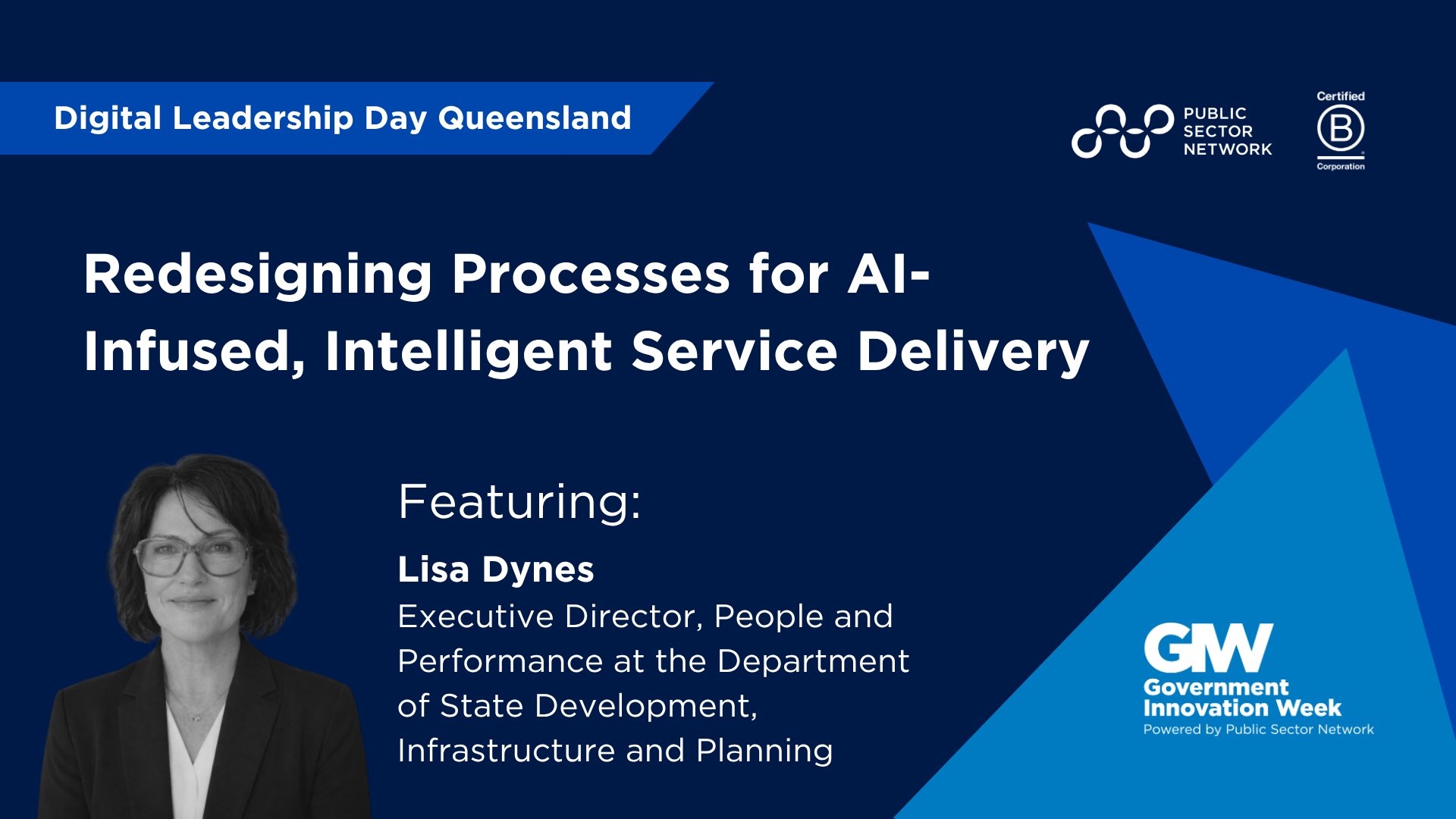
Across the Queensland Public Service, artificial intelligence has moved from abstract possibility to active experimentation. Yet in an interview with Public Sector Network, Lisa Dynes, Executive Director, People and Performance at the Department of State Development, Infrastructure and Planning, said that few agencies have progressed too far beyond the starting line.
“It became quite evident that most of us are at the drawing board stage or the pilot stage,” she says.
Lisa speaks from a vantage point a few others hold. In addition to her departmental role, she chairs the Strategic Workforce Council, a network of HR leaders from across the Queensland Public Service.
The Council recently convened an AI showcase to examine how departments are implementing artificial intelligence in their corporate service delivery models, an initiative born of a shared difficulty in gauging where agencies stood.
“To my mind, we were in rooms talking about AI, and it was really hard to understand where people were at in their journey,” she recalls.
The AI showcase revealed a sector experimenting in earnest, though not yet settled. Queensland’s digital lead agency is reviewing and upgrading QChat, its Copilot-style platform for the public service, while many departments have adopted Microsoft Copilot through their existing software suites, supported by information privacy tools, in her department’s case, Microsoft Purview.
Lisa will bring this perspective to Digital Leadership Day Queensland 2026, part of Government Innovation Week Queensland, on 9 September 2026 at the Royal International Convention Centre. She joins the panel discussion “Redesigning Processes for AI-Infused, Intelligent Service Delivery” and will lead the interactive roundtable “How to Evolve Your Operating Model for Faster, Safer and More Adaptable Government Delivery”, subject matter that closely mirrors her day-to-day remit.
From data collection to decision intelligence
The government has never lacked information. The challenge, Lisa argues, is converting it into insight that genuinely informs sound decision-making.
“Our government’s very good at collecting data. We’ve always been very good at gathering a lot of intel,” she says. The opportunity now lies in “how we streamline our reporting in ways that are meaningful. I think the forecasting piece would be really useful too, but only as an input to decisions moving forward.”
Reporting and forecasting may seem like unremarkable corners of corporate services. Still, they represent the point at which AI can shift government from describing what has happened to anticipating what comes next. For Lisa, realising that shift is fundamentally a leadership task.
“Certainly, I think our leaders’ role is to make sure that people embrace AI as something that will assist. It’s a capability uplift. It is here to stay,” she says.
She returns repeatedly to the importance of foundations. AI adoption done well is “well led, it’s considered, and it’s really aimed at how we can inform decision-making moving forward.” On sequencing, she is unequivocal: “How we establish it and set it up is equally important, if not more important.”
Risk appetite, matched with critical judgement
Asked which capability will matter most to public sector leaders delivering modern, connected services, Lisa points first to decisiveness.
“You have to have that risk appetite and that ability to make decisions very quickly and then to pivot,” she says.
That appetite, however, must be matched with scrutiny. Leaders cannot accept AI outputs at face value; they need the discipline to interrogate how these systems work and where their limitations lie.
“We really do need to sit there and deep dive into what AI is doing. If anything, we’re almost like the guardrails of how AI is rolled out across the sector.”
That framing, leaders as the guardrails, informs her view of the transition from today’s assisted tools toward agentic AI. Lisa advocates a phased and staged rollout, with clear points of human oversight throughout.
“How do we get to a point where we’re confident with the design of the agents and the agentic environment, that we aren’t creating something that is prone to hallucinate or prone to perhaps give us the wrong steer?” she asks. Her answer rests on understanding where the data flows and working closely with the workforce to ensure the guardrails hold.
A human-centred approach to workplace change
For peers leading similar transformations, Lisa offers a clear starting point: recognise that government’s caution is a feature of the environment, not an obstacle to be circumvented.
“In a government environment, we are more on the cautious approach,” she says. Privacy considerations, industrial arrangements and the practical question of how an AI agent will operate within a real workplace all need to be worked through “in ways that are supportive of our workforces.”
Approached deliberately, automation becomes less a threat to jobs than a redistribution of effort. “As we start to augment and, dare I say it, automate processes, we can move and shift our workforces into spaces that are more strategic,” she says, provided leaders “embrace that workplace change in a really human-centred way.”
Lisa is also firm in dispelling a persistent assumption: that AI adoption is the natural domain of younger employees.
“Every generation is embracing AI one way or the other. If you are using the internet or you have an iPhone, it’s got AI within it. The assumption that it’s just the domain of the young is not right.”
The implication for leaders is a dual responsibility. For employees who perceive AI as a threat, they must be “that port in the storm.” For those moving quickly to experiment, they must provide the guardrails that keep the organisation advancing in a uniform way rather than in silos.
“Innovation and the way that AI is progressing is at a rapid rate,” Dynes says. “So I think that measured approach is really important.”
Measured, but moving; a fitting summary of where Queensland’s corporate services now stand, and of the conversation Lisa will lead in Brisbane this September.
Hear more from Lisa. View the executive agenda and request an invitation for the event: https://publicsectornetwork.com/events/government-innovation-week-queensland-brisbane-2026/digital-leadership-day-queensland-queensland-2026/agenda/




Help your peers
Share what you've learned with fellow public servants