

For years, governments and large organisations have invested heavily in T-shaped capability.
The idea was sound:
deep expertise in one area combined with enough breadth to work across functions, disciplines, and strategic contexts.
Modern delivery environments needed people who could operate beyond silos.
That shift helped break down many of the organisational barriers that traditionally slowed collaboration, fragmented information, and limited policy coordination.
But many public sector delivery failures today are no longer caused primarily by poor collaboration between teams.
They are increasingly caused by something else:
the growing disconnect between leadership intent, operational reality, and the systems sitting between the two.
That disconnect is now visible across:
- councils
- infrastructure programs
- ERP transformations
- digital government initiatives
- AI-enabled operating models
- service delivery environments
The issue is no longer simply whether organisations can collaborate horizontally across functions.
The issue is whether they can maintain coherence vertically through increasingly complex delivery systems.
What T-Shaped Capability Solved
T-shaped practitioners combine deep expertise in one discipline with enough breadth to work effectively across adjacent functions and strategic contexts.
Their value is real.
They improve:
- cross-functional communication
- policy coordination
- collaboration between operational teams
- organisational awareness beyond departmental silos
In many government environments, that capability represented a significant improvement over rigid functional structures.
But collaboration capability alone does not always produce delivery coherence.
A council can announce an accelerated housing target and align strategy, communications, and policy teams quickly.
But if infrastructure sequencing, procurement capacity, assessment workflows, and operational staffing remain unchanged, the result is predictable:
- approvals accelerate into delivery bottlenecks
- operational teams absorb the pressure
- citizens experience delays and frustration
- elected members face escalating complaints
- executives receive reporting increasingly disconnected from frontline reality
The issue was never collaboration alone.
It was the absence of vertical coherence and systems consequence awareness.
The Capability Governments Quietly Struggle to Find
Most organisations already have T-shaped practitioners.
Many also have strong technical specialists and capable systems thinkers.
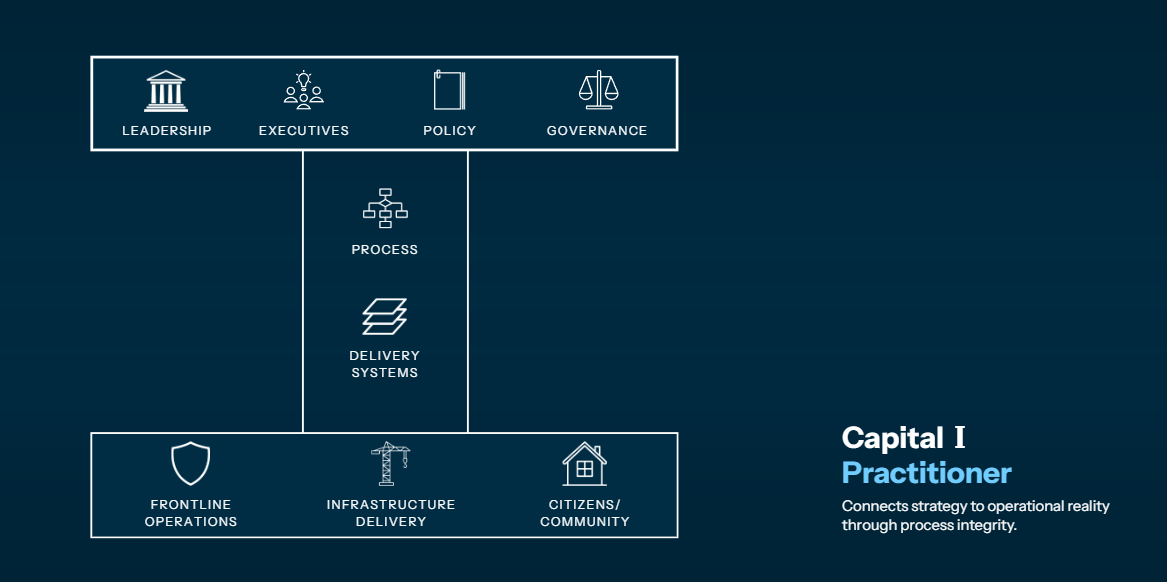
What they often lack is someone who maintains coherence vertically from leadership intent to operational reality as decisions move through the system.
That is the Capital-I practitioner.
Unlike the T-shaped practitioner, whose breadth sits primarily across functions, the Capital-I practitioner has vertical breadth across organisational layers.
They understand:
- leadership and governance at the top
- operational and public reality at the bottom
- and the process connecting the two
They understand both the boardroom and the factory floor.
In government environments, they understand both the policy announcement and the frontline public experience that follows.
These practitioners do not simply collaborate across teams.
They maintain coherence as decisions move through the system.
They understand:
- why executives make certain decisions
- how governance and funding pressures shape behaviour
- how delivery systems actually function
- how operational teams experience policy
- how citizens experience outcomes
Most importantly:
they understand the process integrity required to connect all of those layers.
They connect strategy to operational reality through process integrity.
The Hidden Cost of Coherence Failure
The cost of this gap rarely appears in a single budget line.
It appears instead as:
- delivery delay
- rework
- duplicated systems
- procurement claims
- audit findings
- operational fatigue
- declining public trust
In many organisations, these failures eventually surface not just as operational inefficiency, but as Audit and Risk Committee exposure, repeated findings, procurement disputes, and declining confidence in governance reporting.
The impact is often hidden because the loss appears in fragments across the organisation rather than in one visible failure.
Even one hour per day lost to duplication, rework, manual checking, or process breakdown across a 50-person organisation equates to more than six full-time staff capacity disappearing into system friction.
Most organisations experience far more than that.
The X Practitioner
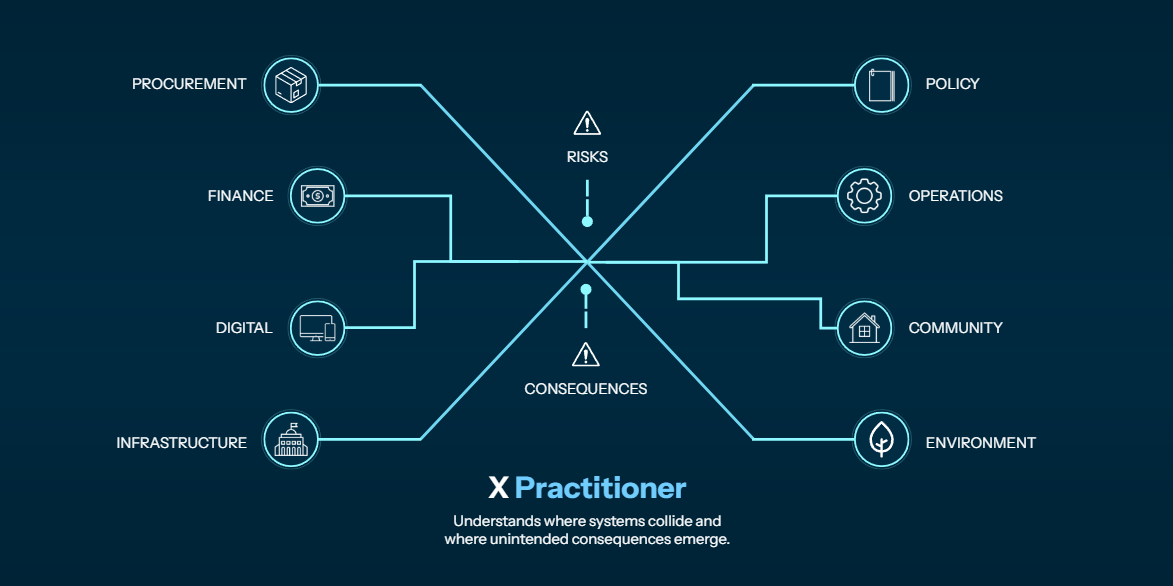
But vertical coherence alone is not enough.
Because government systems do not operate in isolation.
- Housing intersects with transport.
- Transport intersects with energy.
- Procurement intersects with risk.
- Digital systems intersect with workforce capability.
- Infrastructure intersects with long-term operational cost.
The X practitioner understands how decisions propagate consequences across interconnected systems.
Their breadth sits across systems, dependencies, and consequence chains.
They understand that improving one part of the system can unintentionally damage another.
This capability becomes especially important in ERP, software, AI, and operating model transformation.
For example:
- automating intake can overwhelm downstream assessment teams
- accelerating approvals can expose infrastructure constraints
- AI tools can amplify workflow bottlenecks rather than remove them
- back office adminstrative requirements can overwhelm operational staff
- poor data structures can undermine governance reporting
- integration decisions can reshape operational behaviour in unintended ways
The X practitioner sees those consequences before they become failures.
This is not abstract systems thinking.
It is practical consequence awareness inside interconnected operational environments.
What Complex Delivery Environments Actually Require
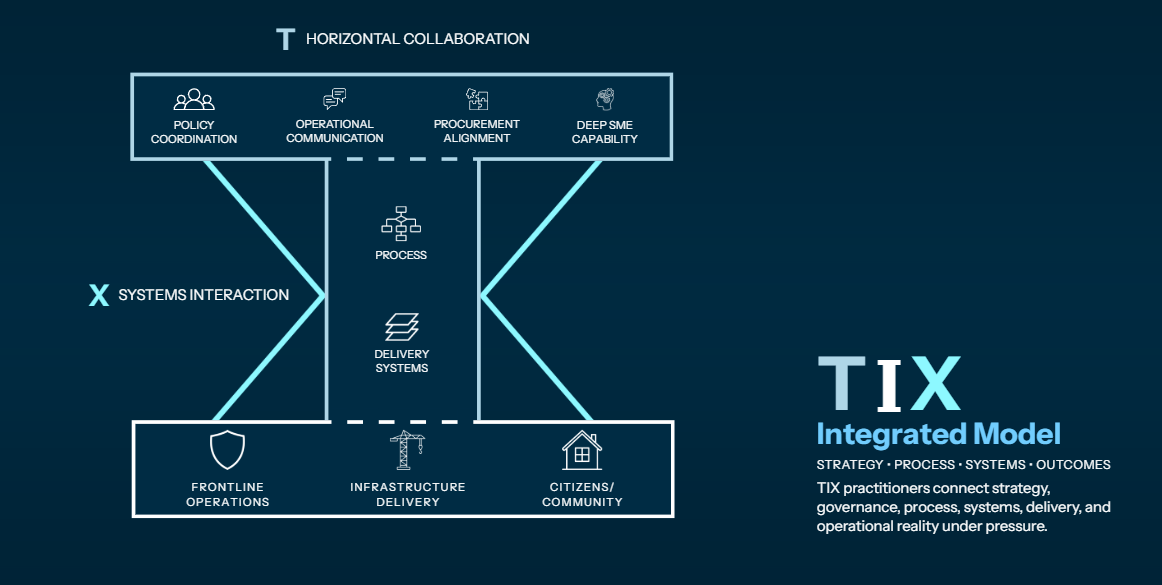
T-shaped practitioners helped governments move beyond silos.
Capital-I practitioners maintain coherence between leadership intent and operational reality.
X practitioners understand how decisions propagate consequences across interconnected systems.
Together, these capabilities become increasingly important in complex delivery environments where strategy, systems, process, governance, and public outcomes continuously interact under pressure.
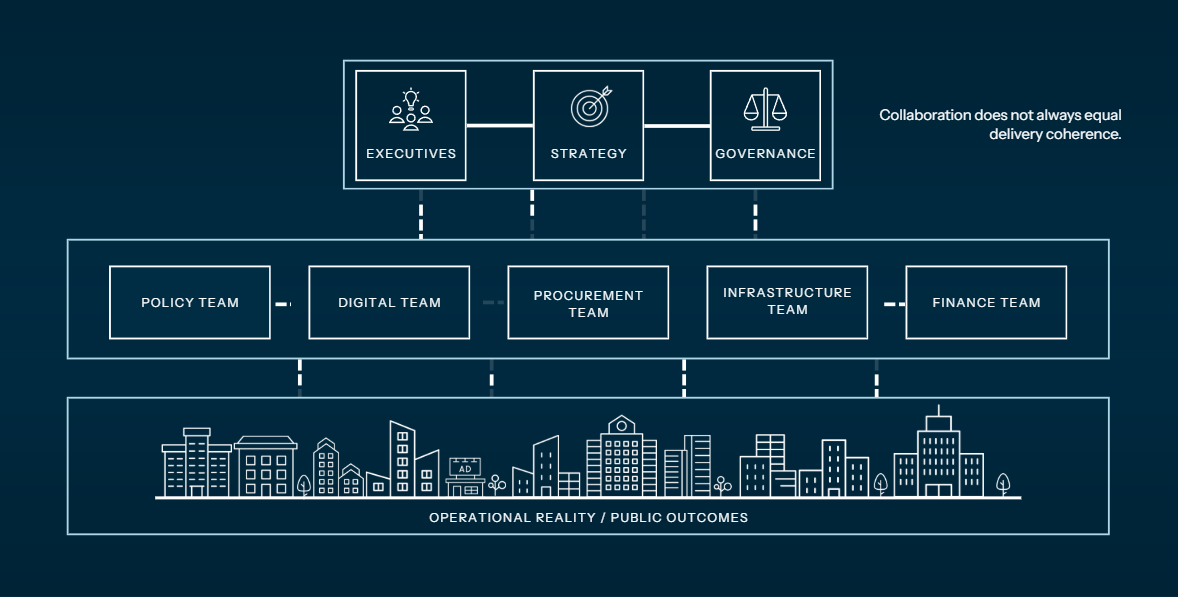
Modern public sector systems are not failing from a lack of intelligence or effort.
They are failing because strategy, systems, process, and operational reality drift apart faster than leadership can see it happening.
The uncomfortable question is not whether an organisation has T-shaped capability.
It is whether anyone inside the system is still capable of maintaining coherence from the boardroom to the frontline before the consequences become visible to the public.
The most interesting discussions generated by this article were not about collaboration capability itself.
They were about whether organisations can identify the people who maintain coherence vertically through the system, and those who understand how consequences propagate across interconnected operational environments.
In many public sector organisations, those capability gaps remain largely invisible until delivery failure, audit exposure, political pressure, or public frustration force the system to confront them.
By then, the project is already viewed as failing, costs have escalated, operational fatigue is entrenched, and trust between leadership, staff, and the public has started to erode.

Published by
About our partner
UrbanTech Plus
UrbanTech Plus helps councils, infrastructure agencies, and delivery partners reduce the governance failures that drive delays, cost escalation, fragmented systems, and poor operational outcomes.We focus on the decisions made before delivery problems become locked in.Our work combines governance reform, digital integration, workflow automation, and lifecycle thinking to improve how infrastructure, planning, housing, and public services are delivered and operated.Core capability areas include:• Governance diagnostics and delivery assuranceAssessing where decision bottlenecks, escalation risks, fragmented accountability, and operational exposure are forming across projects and portfolios.• Planning, approvals, and workflow transformationUsing platforms such as Flowingly and Urban Compass to streamline development assessment, RTI, procurement, compliance, and operational workflows.• Digital engineering and asset intelligenceSupporting BIM, digital twin, and legacy asset digitisation initiatives through platforms including WiseBIM and Nexus Twin.• Lifecycle and operational integrationAligning planning, delivery, facilities management, and asset operations through standards-based approaches linked to ISO 19650, ISO 41001, and ISO 55000 principles.• XD Thinking™A governance-first framework that connects contracts, data, systems, operations, risk, and lifecycle outcomes into a single delivery logic.UrbanTech Plus works across local government, infrastructure, utilities, property, and major programs including growth corridor planning, housing delivery, asset management, and Brisbane 2032-related opportunities.Our approach is practical, evidence-based, and focused on operational outcomes rather than technology hype.Website: www.urbantechplus.comContact: [email protected]
Learn more




Help your peers
Share what you've learned with fellow public servants