
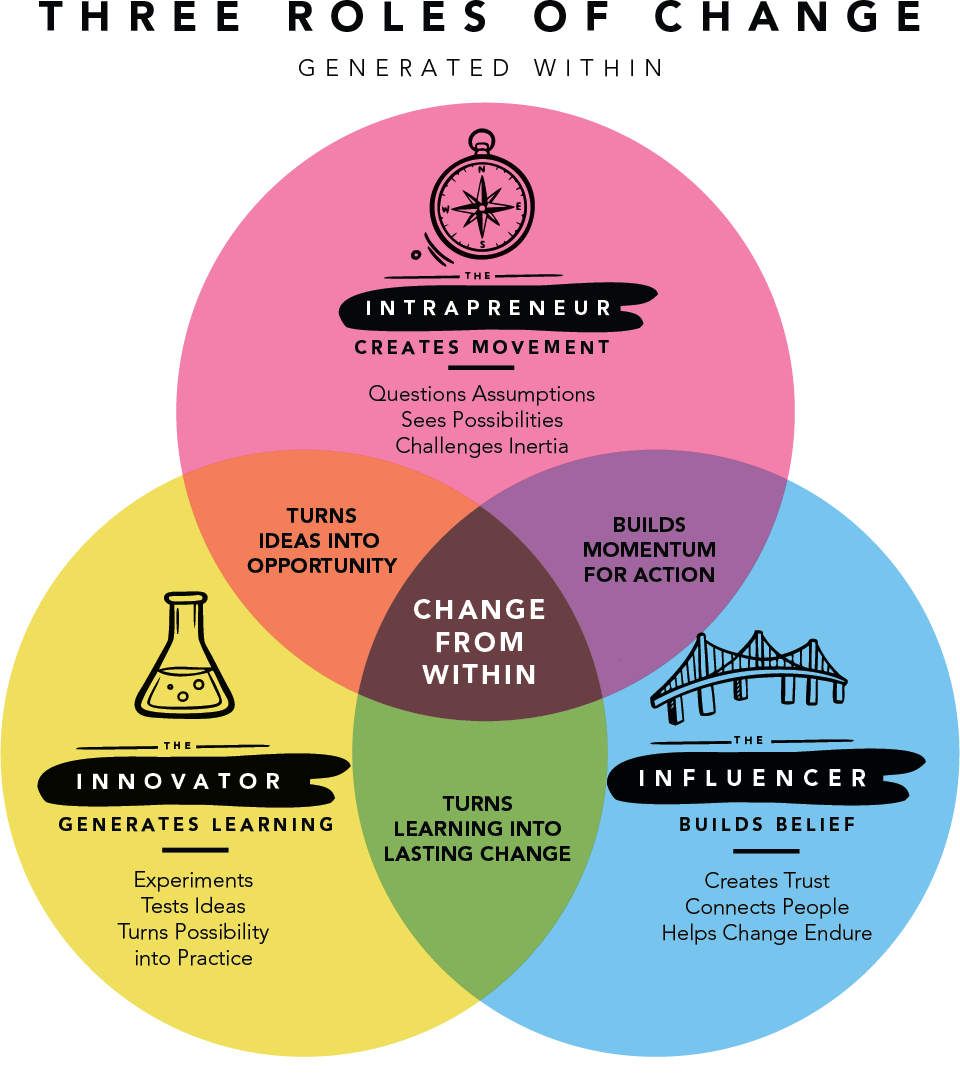
Three Roles of Change (Generated Within)
Public systems are no strangers to change. New strategies are launched, consultants are engaged, innovation initiatives are introduced, and transformation agendas are announced. Yet meaningful and lasting improvement remains remarkably difficult to achieve.
Every day, public servants identify opportunities for improvement, challenge assumptions, and imagine better ways of serving their communities. Some of these ideas gain traction. Many do not. Some become pilot projects that never spread beyond their original context. Others achieve early success only to fade when attention shifts elsewhere.
Understanding why some changes endure while others disappear has become one of the defining questions of my career.
Over the past twenty-five years working in government, I have reflected repeatedly on what separates meaningful progress from mere activity. Looking back across a wide range of initiatives, one observation stands out: successful change efforts rarely depended on a particular methodology, tool, or project plan. To be sure, many factors contribute to change. Leadership matters. Resources matter. Timing matters. Organizational culture, political context, and external events all play important roles. Yet amid this complexity, I noticed three requirements that appeared with remarkable consistency whenever meaningful improvement took hold.
First, there was a need for people willing to challenge assumptions, surface opportunities, and create movement where inertia had taken hold.
Second, there was a need for experimentation, iteration, and learning. Good ideas alone were never enough. Progress depended on people willing to test possibilities, generate evidence, and learn their way forward.
Third, there was a need for trust, support, and belief. Even the most promising innovations struggled to survive unless people were prepared to champion them, connect others to them, and help them become part of how the system worked.
While these were certainly not the only factors influencing success, they were the most persistent and recurring patterns I encountered. They appeared across different organizations, initiatives, and challenges, regardless of the specific context.
Over time, I came to see these not simply as activities, but as distinct contributions to change. Looking back across my career, I could see myself moving between them at different moments. Sometimes I was questioning assumptions, surfacing opportunities, and creating movement where little existed. At other times, I was experimenting with new approaches, testing ideas, and helping teams learn their way forward. Still other situations called for building relationships, earning trust, and helping promising ideas gain the support needed to endure.
As these patterns became increasingly visible, I began to name them. To make them easier to understand and apply, I developed a framework built around three roles: the Intrapreneur, the Innovator, and the Influencer.
While these roles often overlap in practice, each represents a distinct contribution to change. Together, they offer a practical way of understanding how movement, learning, and belief combine to make meaningful improvement possible within public systems. Ultimately, they help explain how meaningful improvement emerges, develops, and endures within public systems.
The Problem with How We Think About Change
When public-sector organizations talk about innovation, the conversation often focuses on methodologies.
Agile. Lean. Project management. Continuous improvement. Change management.
All of these approaches can be valuable. Yet even the most promising methodology cannot create change on its own.
Methods do not move organizations. People do.
Successful change efforts rarely emerge from a single breakthrough idea or a single individual. Instead, they occur when different people make different contributions at different moments. Some challenge assumptions and create movement. Others transform possibilities into learning. Others help improvements endure by building trust and support.
When any one of these contributions is missing, progress often stalls.
Why All Three Matter
Organizations often overinvest in one contribution while neglecting the others.Some are rich in movement but poor in learning. They generate ideas but struggle to make progress. Others excel at learning but fail to build the trust and support necessary to sustain improvement. Still others focus on persuasion without creating enough movement or learning to justify change.
Meaningful improvement requires all three.
The relationship is not strictly linear. People frequently move between roles. One individual may play different roles at different points in a project. Teams may distribute these contributions across multiple people.
What matters is not who performs the role.
What matters is that the contribution exists.
Movement creates possibility.
Learning reduces uncertainty.
Belief sustains improvement.
Together, they create the conditions for change.
The Intrapreneur: Creating Movement
Every meaningful change effort begins with movement.
Someone has to ask:
Why does it have to be this way?
Intrapreneurs create movement by questioning assumptions, identifying opportunities, and helping others see possibilities that may have been overlooked. Unlike entrepreneurs, who often build something outside existing systems, intrapreneurs work within them. They understand the rules, relationships, and realities of the organization while seeking ways to improve it.
Public systems need intrapreneurs because they are designed for stability, continuity, fairness, and accountability. These are important strengths. Yet over time, they can make organizations less likely to question established practices.
Processes become routine.
Assumptions become invisible.
Practices become institutionalized.
The intrapreneur provides an essential counterbalance. They help public systems remain adaptive by challenging the status quo and creating movement where none exists.
Without movement, nothing begins.
The Innovator: Generating Learning
A good idea is not evidence.
An assumption is not knowledge.
And possibility is not practice.
Innovators generate learning. They take ideas and subject them to reality through experimentation, prototyping, testing, and iteration. Their goal is not to prove an idea right but to learn what works, what doesn't, and what needs to change.
This contribution is particularly important in public systems because many of the challenges governments face are characterized by uncertainty. Communities evolve. Technologies emerge. Expectations shift. Under these conditions, answers are rarely available in advance.
Innovators help organizations learn their way forward.
Innovation, in this sense, is not primarily about novelty. It is about reducing uncertainty through disciplined learning.
The most successful innovations I have observed were not necessarily the most creative ideas. They were often the ideas that generated the most useful learning.
Without learning, movement becomes activity without progress.
The Influencer: Building Belief
One of the greatest misconceptions about change is that evidence automatically changes minds.
It does not.
People do.
Even successful pilot projects and compelling evidence can struggle to survive if people do not believe in them.
Influencers build belief. They create trust, connect people across silos, and help others see themselves in the work. They translate ideas and insights into narratives that people can understand, support, and act upon.
Public systems depend on collaboration. No single team, department, or organization has all the expertise, authority, or resources needed to address today's complex challenges.
Meaningful change therefore depends on trust.
It depends on relationships.
It depends on shared belief.
Influencers help create those conditions. They help innovations move beyond isolated pockets of success and become part of how the broader system operates.
Without belief, nothing lasts.
Change Is an Inside Job
One observation sits beneath this entire framework.
Meaningful change in public systems is an inside job.
Over the years, governments have welcomed no shortage of outside expertise. Consultants, advisors, researchers, and facilitators have introduced valuable ideas and perspectives. External support can challenge assumptions and accelerate learning.
Yet lasting change rarely arrives fully formed from the outside.
What ultimately determines whether an innovation survives is not the sophistication of the methodology or the quality of the recommendation. It is whether the people inside the system choose to adopt it, adapt it, and carry it forward.
Public systems persist long after any single project, program, or consulting engagement has ended. New ideas only become part of the system when the people who work within it integrate those ideas into their daily decisions, behaviours, relationships, and practices.
That is why this framework focuses on public servants.
The Intrapreneur, Innovator, and Influencer are not external experts brought in to fix a system. They are the people already working within it. They understand its history, constraints, relationships, and possibilities. They know where flexibility exists, where resistance is likely to emerge, and how change can take root without losing legitimacy.
The role of the consultant may be to provide perspective.
The role of leadership may be to create permission.
But the work of lasting change belongs to the people inside the system.
A More Human View of Change
The Three Roles of Change emerged not from theory, but from observation. They represent patterns I repeatedly encountered while working within public systems.
The framework is not intended to replace existing innovation methodologies or change models. Rather, it complements them by focusing attention on the people who make change possible.
Because beneath every strategy, pilot project, transformation initiative, or organizational improvement effort are individuals creating movement, generating learning, and building belief.
Public systems do not change because a single person has a brilliant idea.
They change when people work together to challenge assumptions, test possibilities, and create the trust required for those possibilities to endure.
That work is rarely dramatic.
It is often incremental.
It is frequently messy.
It almost always takes longer than expected.
Yet it remains some of the most important work in public service.
The future of our public systems will not be shaped solely by new technologies, new policies, or new organizational structures. It will be shaped by people willing to create movement where none exists, generate learning where uncertainty remains, and build belief strong enough to sustain improvement over time.
This is why the framework is built around three roles: the Intrapreneur, the Innovator, and the Influencer.
The naming is intentional.
Each role begins with the prefix "IN."
Not only because they describe distinct contributions to change, but because they reflect a deeper truth about where meaningful change originates.
Change begins inside organizations.
It is created by people working inside systems.
It is sustained by those inside the relationships, processes, and realities of public service.
The Intrapreneur creates movement from within.
The Innovator generates learning from within.
The Influencer builds belief from within.
Together, they remind us that lasting improvement is not something done to public systems. It is something created within them.
Because meaningful change is not ultimately an outside job.
It is an inside job.
And it is through the countless public servants willing to create movement, generate learning, and build belief that public systems continue to adapt, improve, and better serve the communities that depend on them.
In other words, meaningful change happens from within.





Help your peers
Share what you've learned with fellow public servants