

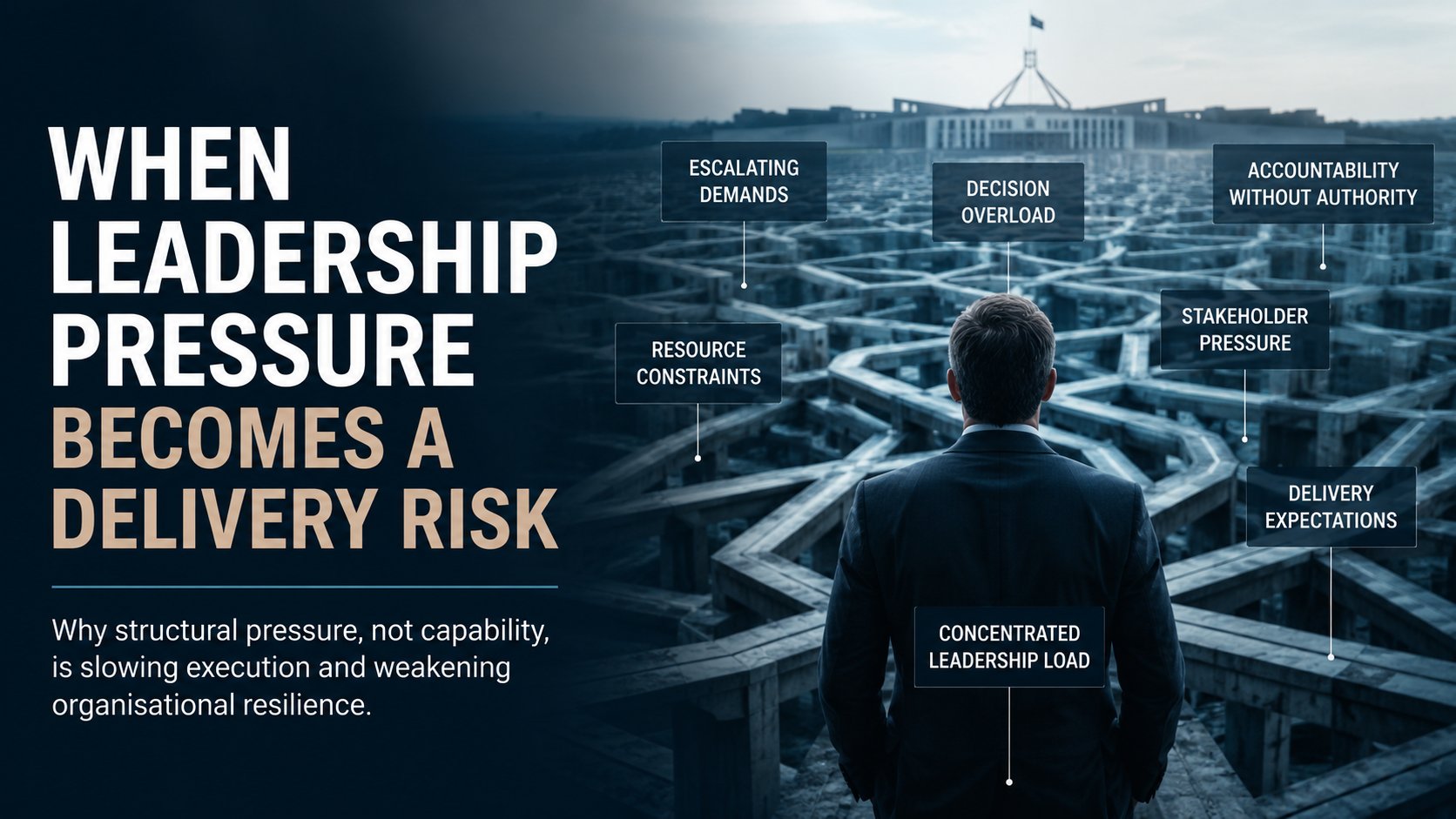
Structural leadership pressure often becomes visible through slowed execution, escalation dependency, and concentrated decision load.
Most organisations do not notice leadership pressure when it first begins concentrating.
They notice it later as slower execution, hesitant managers, increased escalation, delayed decisions, delivery drag, burnout, or trust erosion.
By then, the pressure has often already become structural.
Across public sector environments, one of the patterns I continue to observe is capable leaders becoming operational pressure containers for unresolved organisational strain.
More decisions return upward.
More coordination sits with fewer people.
Managers absorb growing ambiguity.
Teams hesitate because authority and ownership become less clear under pressure.
From the outside, these patterns are frequently interpreted as communication breakdowns, performance decline, capability gaps, or resistance to change.
But structurally, something different may be happening.
Responsibility may be expanding faster than authority, support, decision flow, and organisational capacity are adapting around it.
This matters because concentrated leadership load rarely stays contained.
Over time, execution slows.
Escalation dependency increases.
Decision pathways become heavier.
High-trust performers quietly carry more operational weight than the structure was designed to sustain.
In many environments, burnout is not the starting problem. It is the downstream signal of unresolved structural pressure accumulating over time.
The challenge for organisations is that these patterns can remain partially invisible while delivery still appears functional on the surface.
Projects continue moving.
Meetings continue happening.
Teams continue pushing forward.
But underneath, the system becomes increasingly dependent on a smaller number of people absorbing instability manually.
One of the most important shifts leaders can make is learning to distinguish between behavioural problems and structural pressure patterns.
Not every overloaded manager is failing.
Sometimes the structure itself is producing dependency, escalation drag, and leadership instability faster than the organisation recognises it.
The earlier these patterns are recognised, the easier they are to stabilise before they become workforce fatigue, delivery risk, governance concern, or organisational fragility.
Leadership sustainability is rarely just about resilience at the individual level.
It is also about whether the structure distributes pressure, trust, authority, and execution load in a way the organisation can sustainably carry.

Published by
About our partner
Ultimate Marks
Ultimate Marks helps leaders and organisations identify where leadership pressure, decision-making and responsibility are concentrating in ways that slow execution, increase dependency and create organisational strain.The work focuses on structural leadership pressure: the hidden layer underneath decision drag, repeated escalation, overloaded executives, manager hesitation, accountability-authority misalignment and burnout risk.Rather than treating leadership strain as only an individual capability issue, Ultimate Marks looks at how responsibility, authority, support, trust and decision flow are actually being carried inside the organisation.Services include leadership diagnostics, executive advisory, speaking, workshops and facilitated conversations for organisations seeking clearer visibility of where pressure is accumulating and what needs to shift first.Ultimate Marks is led by Ric Marks, Founder & Leadership Architect, whose background spans operational leadership, technology, business ownership, advisory, government-related environments and organisational systems under pressure.Relevant focus areas include:• leadership load and structural pressure • decision drag and escalation dependency • organisational resilience and execution risk • authority-accountability alignment • executive and manager overload • operational trust and sustainable performance • leadership systems under pressure Ultimate Marks is based in Canberra and works with leaders, teams and organisations seeking practical, grounded insight into how leadership pressure affects execution, trust and organisational performance.
Learn more




Help your peers
Share what you've learned with fellow public servants