

Understanding CMMC 2.0: A Complete Guide to Certification Levels, Compliance Requirements, and Readiness
The cybersecurity landscape supporting the United States Department of Defense (DoD) has evolved significantly over the past decade. As cyber threats continue to target the Defense Industrial Base (DIB), organizations handling sensitive government information are expected to demonstrate stronger cybersecurity practices than ever before.
To address these risks, the Department of Defense introduced the Cybersecurity Maturity Model Certification (CMMC) 2.0, a unified framework that validates whether contractors and subcontractors adequately protect Federal Contract Information (FCI) and Controlled Unclassified Information (CUI). Rather than viewing cybersecurity as a one-time compliance exercise, CMMC encourages organizations to embed security into everyday operations through well-defined policies, technical controls, governance, and continuous monitoring.
Whether you are a defense contractor, software provider, cloud service provider, engineering company, manufacturer, or managed services provider supporting government programs, understanding CMMC is becoming essential for participating in future DoD contracts.
What is CMMC 2.0?
CMMC 2.0 is the Department of Defense's cybersecurity assessment framework for organizations within the Defense Industrial Base. It establishes measurable security requirements that help ensure sensitive government information is protected throughout the supply chain.
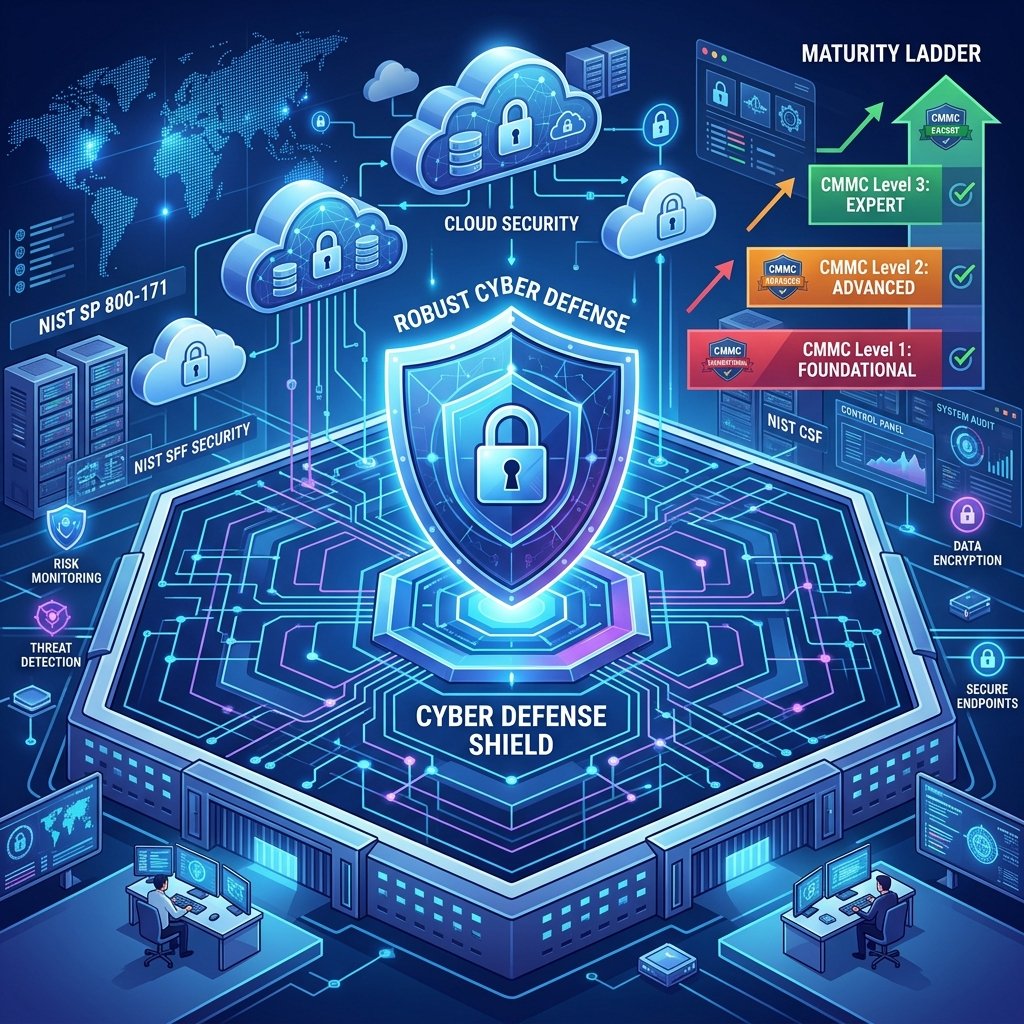
Unlike the original CMMC model, which included five maturity levels, CMMC 2.0 simplifies the framework into three certification levels aligned with established federal cybersecurity standards. This streamlined approach reduces complexity while maintaining rigorous security expectations.
The framework draws heavily from:
- NIST SP 800-171
- NIST SP 800-172
- Federal Acquisition Regulation (FAR)
- Defense Federal Acquisition Regulation Supplement (DFARS)
- Controlled Unclassified Information (CUI) Program
The certification level required depends on the type of information an organization processes and the sensitivity of the defense contracts it supports.
Understanding the Three CMMC Levels
Level 1 – Foundational
Level 1 is intended for organizations that handle Federal Contract Information (FCI) but do not process Controlled Unclassified Information.
Organizations are expected to implement the 17 basic safeguarding requirements identified in FAR 52.204-21. These foundational cybersecurity practices focus on limiting unauthorized access and protecting systems from common threats.
Examples include:
- User authentication
- Basic access controls
- Password management
- Device protection
- Physical security
- Malware protection
- Secure system configuration
Most Level 1 organizations complete an annual self-assessment accompanied by executive affirmation.
Level 2 – Advanced
Level 2 applies to organizations that create, store, transmit, or process Controlled Unclassified Information (CUI).
This level requires implementation of all 110 security requirements from NIST SP 800-171 Revision 2 across fourteen control families, including access control, audit logging, incident response, configuration management, personnel security, risk assessment, and system integrity.
Depending on contract requirements, organizations may either perform an annual self-assessment or undergo an assessment conducted by an authorized Certified Third-Party Assessment Organization (C3PAO).
Because many defense contractors work with CUI, Level 2 is expected to become the most widely adopted certification level.
Level 3 – Expert
Level 3 is reserved for organizations supporting highly sensitive defense programs where protection against advanced persistent threats is critical.
Organizations must satisfy all Level 2 requirements while implementing additional security practices derived from NIST SP 800-172. These enhanced safeguards strengthen resilience against sophisticated cyber adversaries through advanced monitoring, threat detection, incident response, and supply chain risk management.
Level 3 assessments are conducted directly by the Department of Defense.
Why CMMC Matters
Cybersecurity incidents increasingly exploit weaknesses in suppliers rather than targeting large government agencies directly. Attackers often view smaller contractors as easier entry points into critical defense programs.
By establishing a common cybersecurity baseline across the Defense Industrial Base, CMMC helps organizations:
- Protect sensitive government information
- Reduce cyber risk
- Improve operational resilience
- Strengthen governance
- Demonstrate contractual readiness
- Increase customer confidence
- Standardize cybersecurity practices
Many organizations also discover that implementing CMMC improves operational efficiency, risk management, and executive visibility into cybersecurity performance.
Common Readiness Challenges
Organizations beginning their CMMC journey frequently encounter similar obstacles, including:
- Incomplete asset inventories
- Poorly documented policies and procedures
- Lack of evidence demonstrating control implementation
- Limited visibility into third-party risk
- Inconsistent access management
- Insufficient incident response planning
- Gaps in employee cybersecurity awareness
- Weak configuration management processes
Addressing these issues early significantly reduces the effort required during formal assessments.
Building a Successful CMMC Readiness Program
Successful organizations generally follow a structured implementation approach that includes:
- Identifying whether the organization handles FCI or CUI.
- Defining the assessment scope and system boundary.
- Developing or updating the System Security Plan (SSP).
- Conducting a comprehensive gap assessment against applicable requirements.
- Creating Plans of Action and Milestones (POA&Ms) for identified deficiencies.
- Implementing required administrative, technical, and physical safeguards.
- Collecting evidence demonstrating control effectiveness.
- Performing internal readiness assessments before formal certification.
Cybersecurity should be viewed as an ongoing business capability rather than a one-time project. Continuous monitoring, regular reviews, employee training, and executive oversight all contribute to long-term compliance and resilience.
Looking Ahead
As CMMC requirements continue to appear in Department of Defense contracts, cybersecurity readiness will increasingly influence an organization's ability to compete for defense opportunities.
Organizations that begin preparing early are better positioned to reduce implementation costs, improve assessment outcomes, and build greater trust with customers and government stakeholders.
Ultimately, CMMC represents more than a certification requirement. It provides a structured framework for strengthening cybersecurity governance, protecting sensitive information, and enhancing resilience across the defense supply chain.


Published by
About our partner
SecureKnots LLC
SecureKnots LLC is a global cybersecurity, governance, risk, compliance (GRC), privacy, and public sector advisory firm helping commercial enterprises, government agencies, and defense contractors build secure, resilient, and compliant organizations.We specialize in end-to-end consulting, implementation, readiness assessments, internal audits, managed compliance, and certification support across international standards, regulatory frameworks, and government security programs.Our commercial services include ISO 27001, ISO 27701, ISO 22301, ISO 9001, ISO 42001, SOC 1, SOC 2, HIPAA, PCI DSS, GDPR, DPDPA, NIST Cybersecurity Framework (CSF), third-party risk management, business continuity, information security, and privacy governance.Our Public Sector & Defense practice supports organizations delivering services to federal, state, and local governments through specialized advisory for:FedRAMP®StateRAMP / GovRAMPCMMC 2.0NIST SP 800-53NIST SP 800-171FISMACJIS Security PolicyCriminal Justice Information Services (CJIS)Controlled Unclassified Information (CUI)Export Administration Regulations (EAR)International Traffic in Arms Regulations (ITAR)DFARS cybersecurity requirementsSecure System Security Plans (SSPs)Security Assessment Plans (SAPs)Plan of Action & Milestones (POA&M)Authorization package development and audit readinessOur experts help organizations design, implement, and mature governance, cybersecurity, privacy, and compliance programs that meet evolving regulatory expectations while improving operational resilience and customer trust. Whether preparing for certification, achieving regulatory compliance, supporting government procurement, or strengthening enterprise security, SecureKnots delivers practical, risk-based solutions aligned with business objectives.SecureKnots LLC – Securing Trust. Enabling Compliance. Empowering Business.
Learn more








Help your peers
Share what you've learned with fellow public servants