

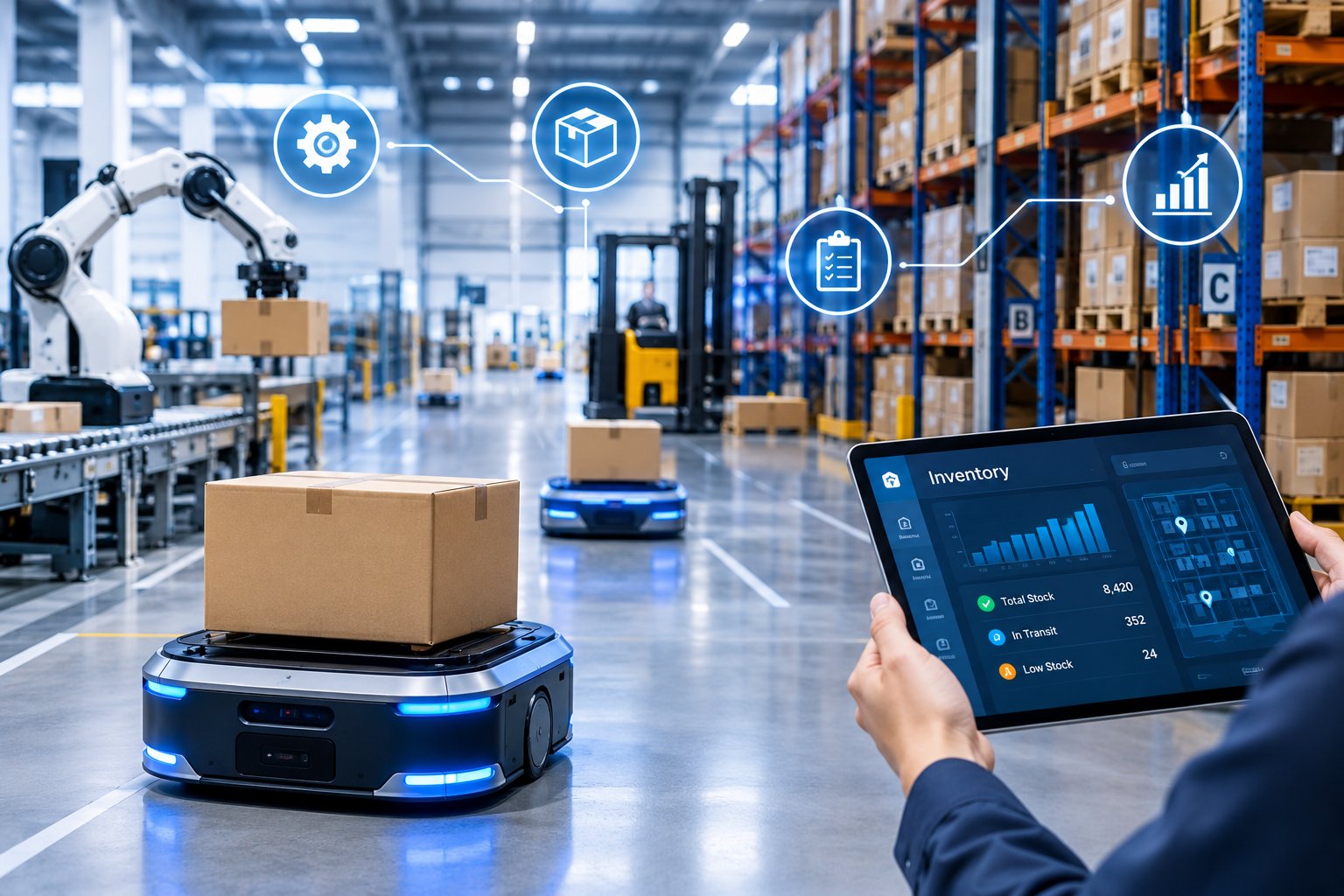
A warehouse can hold every product a customer needs and still fail to dispatch an order on time. A misplaced carton, an outdated stock record or a queue at the packing station can delay the entire process. These problems become harder to manage as order volumes increase and customers expect quicker deliveries. Warehouse automation offers ways to address such everyday difficulties by connecting physical handling, stock records and order processing. The real question for warehouse managers is which tasks need automation and where it will make a meaningful difference.
Key Technologies Changing Warehouse Operations
Automated Storage and Retrieval Systems
In a busy distribution centre, employees can spend considerable time travelling between storage racks and picking stations. Automated storage and retrieval systems (AS/RS) advance inventory management automation by using mechanical equipment to efficiently store and retrieve goods.
These systems can be designed to handle pallets, cartons or smaller containers. They are especially useful where storage space is limited, or where products are moving through the facility often. Installation though needs to be carefully considered in terms of the size of the building, size of the product and expected order volumes. A system designed for standard pallets may not be the right choice for a business that handles thousands of different-sized items.
Warehouse Robotics
Warehouse robotics can assist with moving containers, sorting parcels and transporting products between workstations. Autonomous mobile robots (AMRs), for instance, navigate designated areas using sensors and mapping technology.
Imagine a warehouse worker who has to go up and down multiple aisles to pick items for online orders. A mobile robot can bring picking containers back and forth to cut down on some of that unnecessary travel. This will then allow employees to focus on picking the right items, checking orders and resolving exceptions.
Robots still require adequate working space, maintenance and clear safety guidelines. Their introduction must account for pedestrian routes, emergency stops, and the tasks employees still perform manually.
Warehouse Management Systems (WMS)
Equipment handles physical goods, but software tracks what should happen next. Warehouse management systems coordinate receiving, put-away, picking, packing and dispatch while maintaining records of inventory locations and movements.
For instance, staff can scan an incoming delivery to keep track of its quantity and storage location. Upon receipt of an order, the system can direct picking activity to the required products and update stock records as items are processed.
Integration with purchasing and order management software can improve coordination across departments. Yet even sophisticated systems depend on accurate product codes and consistent working procedures. If staff repeatedly bypass scanning steps, discrepancies can remain hidden in the records.
Automated Inventory Tracking
Barcode scanning and radio frequency identification (RFID) let warehouses record stock movements without relying solely on handwritten notes or manual data entry. You need a scanner to read a label for barcodes, but RFID can identify items that are properly tagged without having to see them.
It all depends on the operation. Barcode scanning may work well in smart warehousing where the cartons are clearly labelled. RFID might be helpful for jobs that require fast scanning of many tagged items, but tag costs, interference, and the environment around the items need to be taken into account.
Implementing automated inventory tracking provides reliable records that help teams investigate missing stock, replenish shelves, and avoid allocating products that are no longer available.
Artificial Intelligence and Connected Data
Demand forecasting tools analyse sales history, seasonal trends, and order data to predict future demand. Sensors can also monitor temperature or other conditions that affect product quality in the storage environment.
These tools are useful if their output results in real decisions. A forecast may show higher demand leading into a seasonal peak, but a supplier delay can change the replenishment plan. But managers still have to consider today's conditions, not treat predictions like orders.
Where Automation Makes a Practical Difference
Fewer Picking and Dispatch Errors
A wrong item sent to a customer creates extra work for the warehouse, customer service team and returns department. Scanning products against order details can catch some mistakes before a parcel leaves the building.
The same principle applies to replenishment. If the system records that a product has moved to a different location, picking instructions can reflect that change. These checks are particularly valuable in facilities handling similar-looking products or large numbers of individual orders.
Better Use of Space and Staff Time
Warehouse automation reduces unnecessary trips, increases access to stored goods and helps teams coordinate repetitive activities. Better use of vertical storage can also ease pressure on floor space.
But faster picking doesn’t mean faster shipping. Extra volume that packing stations can’t process can cause orders to lag elsewhere. When deciding what activity to automate, managers should look at the whole process from delivery receipts to loading outbound vehicles.
More Consistent Operations
Demand can increase rapidly during promotions, holidays or product launches. As part of broader supply chain automation, automated equipment and well-integrated software allow warehouses to handle volume variations without relying entirely on additional manual labour.
There are boundaries. Equipment breakdowns, network outages and unexpected orders can still disrupt work. Employees need to know what to do when things go wrong, and maintenance teams need to be able to quickly find and fix faults.
What to Consider Before Investing
The initial purchase price is only part of the equation. Installation, software, maintenance, staff training, and future updates determine the total cost. Companies should weigh these costs against real savings and service improvements.
Integration is another aspect of importance. New platforms have product information that older systems may not contain, and this can cause problems when data has to move between systems. Testing these links before launch can help avoid errors cascading all through the operation.
Employees should also be involved early. People working in the warehouse know where the bottlenecks are, which products are difficult to handle and which procedures tend to get missed. Feedback from them can help managers to select an appropriate solution and to identify training needs.
Concluding Thoughts
Warehouse automation works best when it responds to the realities of a particular operation. Robotics may reduce unnecessary travel, tracking tools can improve stock records, and connected software can help teams coordinate orders. None of these technologies removes the need for sound planning, trained employees or dependable information.
Businesses do not have to transform an entire warehouse at once. Identifying a persistent problem, testing an appropriate solution and reviewing the outcome provides a more reliable basis for further investment. That approach helps organisations improve day-to-day performance while keeping costs, service quality and future requirements in view.

Published by
About our partner
Seasia Infotech
Seasia Infotech is a CMMI Level 5 certified global technology company specializing in custom software development, AI and machine learning, web and mobile application development, cloud solutions, enterprise software, QA and testing, DevOps, UI/UX design, and digital transformation. With over 25 years of industry experience, we help startups, SMEs, and enterprises build secure, scalable, and innovative technology solutions. Our experienced team has successfully delivered thousands of projects across industries including healthcare, fintech, retail, logistics, real estate, manufacturing, and education. We are committed to delivering high-quality solutions, agile development, and long-term client partnerships.
Learn more









Help your peers
Share what you've learned with fellow public servants