
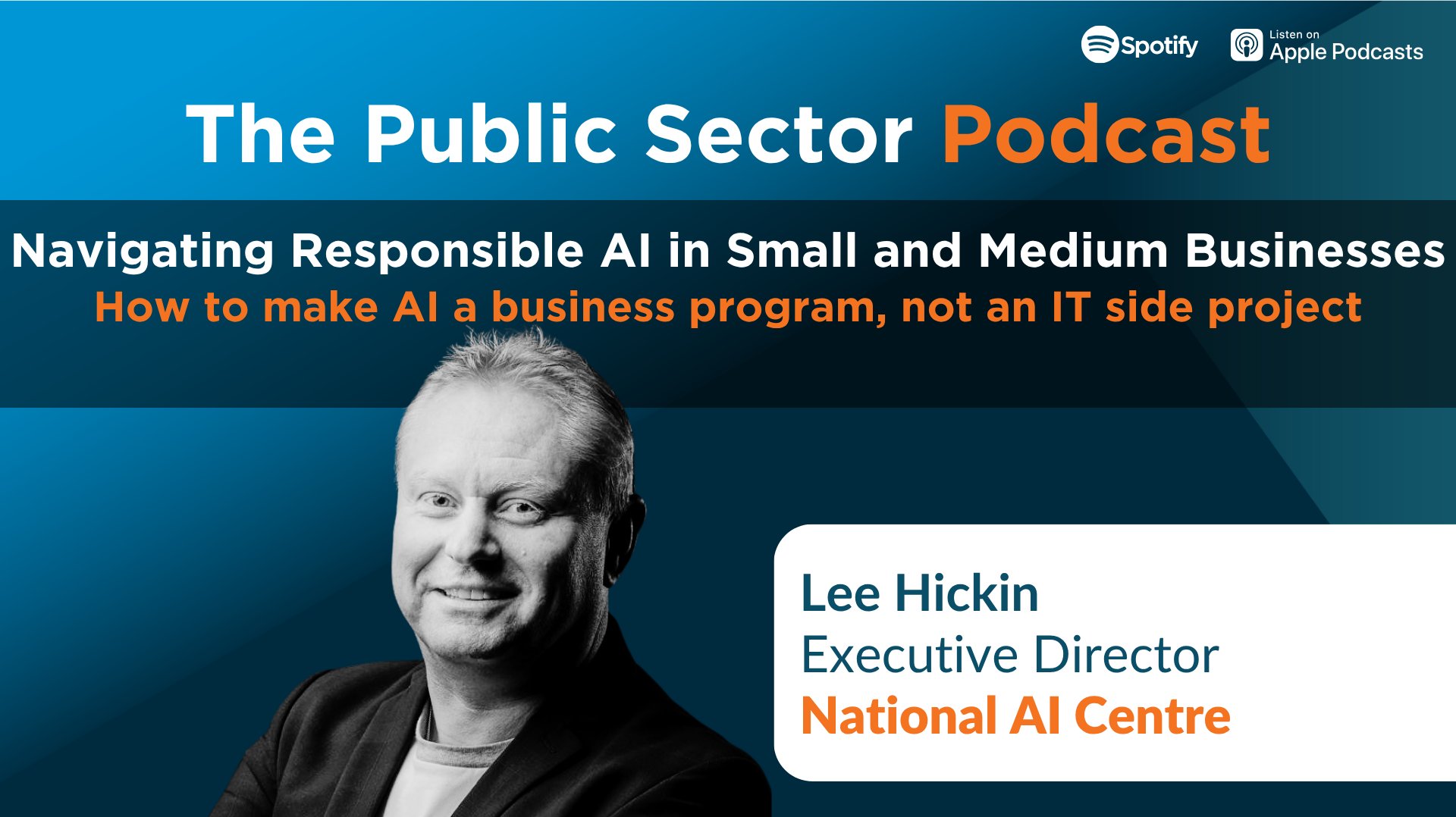
Episode Overview
In this episode, we sit down with Lee Hickin, Executive Director, National AI Centre (new to government after 35 years in the private sector) who delivers a fast, practical talk on what responsible AI adoption really means for small to medium enterprises (SMEs) in Australia. The focus is clear: most SMEs aren’t blocked by access to AI—they’re blocked by uncertainty, confusing language, and a lack of “permission” to move forward confidently.
Through the lens of the National AI Centre, the session reframes responsible AI as two connected challenges: putting in place simple, fit-for-size governance, and building an AI-ready culture where leaders back their people, invest in capability, and treat AI as “you + AI” (not “you vs AI”).
Key Themes
A central theme is demystification: responsible AI isn’t a heavyweight compliance program reserved for large organisations—it’s a set of practical, proportionate habits that help teams adopt safely without freezing in fear. The speaker challenges the doom-and-gloom narrative and argues that over-focusing on worst-case risks can become a self-fulfilling prophecy that slows adoption and leaves smaller organisations behind.
Another theme is leadership and culture. AI is positioned as a business and people change, not just an IT rollout. Confidence is built when leaders clearly state what’s allowed, invest in skills, and introduce governance alongside experimentation—so risk is managed without becoming the excuse to do nothing.
What You’ll Learn
1) What “Responsible AI” Actually Means (for SMEs)
Why “responsible” can’t be a vague catch-all, and how ambiguity becomes the real blocker for small business adoption.
2) The Two Problems: Governance + Culture
How responsible AI requires both practical governance practices and an AI-ready culture that invites teams to engage.
3) The National AI Centre’s Role (and Why SMEs Matter)
How the Centre supports SME adoption with guidance, tools, literacy uplift, and ecosystem building—because SMEs risk being left behind.
4) The “AI Six” Essential Practices
A simplified, SME-friendly set of steps (in the spirit of the Essential Eight) designed to make governance doable without over-engineering.
5) Accountability Without Overkill
Why “assign an owner” beats creating committees and titles—and why AI shouldn’t be dumped solely on CIOs, legal, or risk teams.
6) Supply Chain Basics That Most Teams Skip
Why responsible use includes understanding the tools you’re buying, reading terms, and asking simple but critical questions of vendors.
7) Impact + Risk: Use What You Already Know
How AI can be assessed like other business changes: impacts, stakeholders, “bad day” planning, and documenting what you learn.
8) Transparency at the Right Level
What “transparency” looks like for different organisations—from model builders to small teams using AI for comms, creative, or admin.
9) Testing, Monitoring, and Human Control
Why you need to keep checking AI outputs, and why human accountability matters when things go wrong.
10) The Culture Shift: Clarity, Capability, Confidence
How leaders build confidence by setting boundaries, investing in skills, and encouraging “you + AI” as a practical mindset.
Key Takeaways
- Responsible AI is often blocked by ambiguity, not technology access
- For SMEs, good governance can be simple and proportionate
- Start with clear accountability—AI is a business change, not just an IT task
- Transparency can be lightweight and still effective when AI use is limited
- Test and monitor AI like any other system—assume there will be a “bad day”
- Real adoption depends on culture: clarity + capability + confidence
- The mindset shift that matters: you + AI, not “you or AI”
Why You Should Listen
This episode is for SME leaders, government and ecosystem builders, digital and risk professionals, and anyone supporting AI adoption in Australia who wants a grounded, practical way to move beyond fear and confusion. It offers a clear framework to help teams adopt AI responsibly without turning governance into a barrier.
Memorable Line of Thinking
Responsible AI isn’t about building a bureaucracy. It’s about making expectations clear, investing in people, and building the confidence to adopt AI with practical guardrails.






Help your peers
Share what you've learned with fellow public servants