
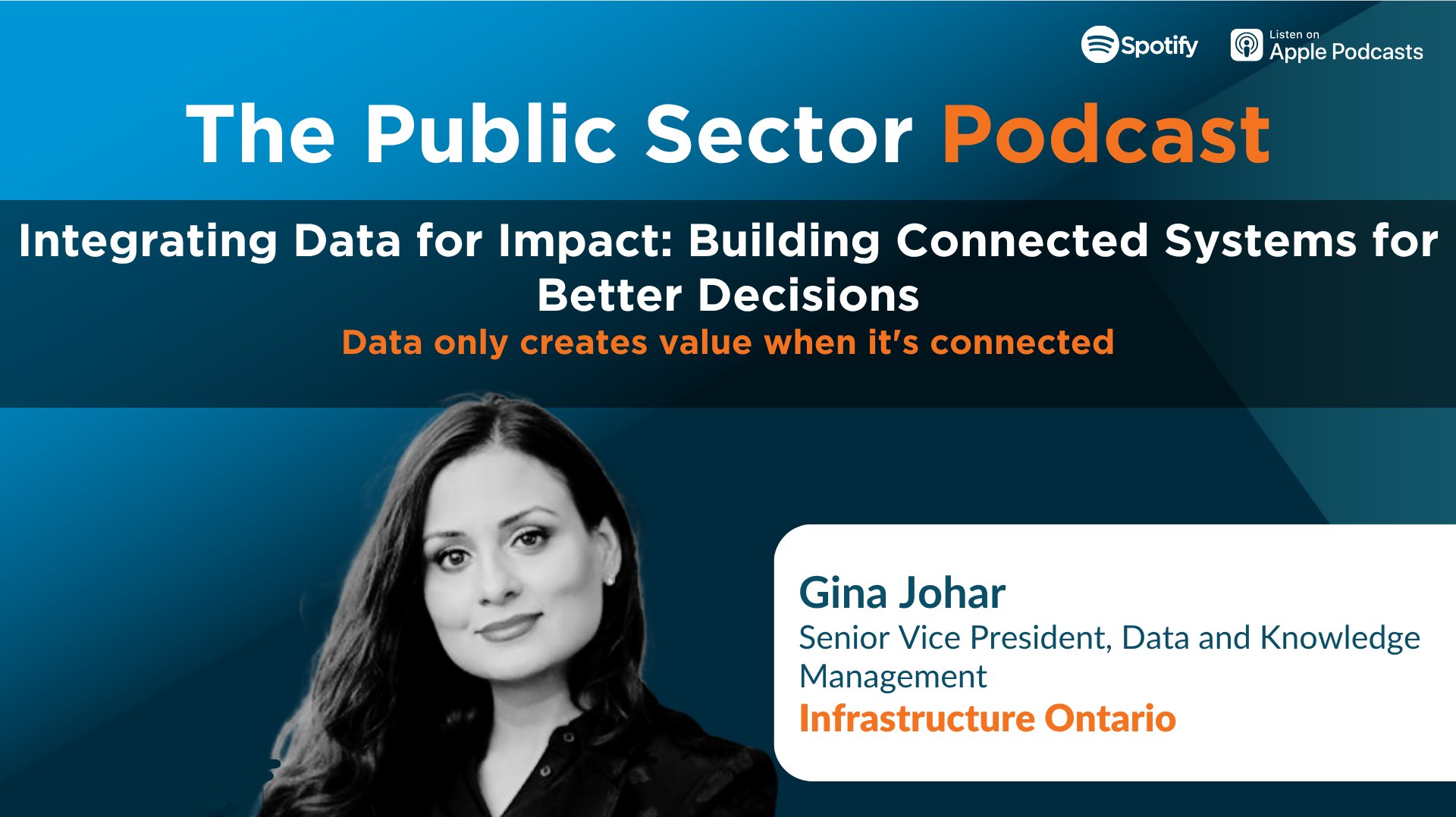
Episode Overview
A deceptively simple question: where should we invest next?
Join Gina Johar , Senior Vice President, Data and Knowledge Management, Infrastructure Ontario who says that her department doesn't put shovels in the ground - it uses information to guide infrastructure planning. So answering that question should be straightforward. It isn't. The data sits across real estate and property, capital planning, capital delivery, asset management, procurement, supply chain, finance, corporate health, people and capability, risk, legal, environment and sustainability, community and stakeholders. Each vertical is doing excellent work, exactly as designed.
And that's the paradox at the centre of this talk: the decisions that matter are horizontal, but our organisations and our data are vertical. Talent is there. Data is there. The answer isn't.
Drawing on 20+ years in the public sector - much of it frontline in service delivery and healthcare - the speaker walks through Infrastructure Ontario's data strategy renewal, and why the whole thing hinges on trust rather than technology.
Key Takeaways
- Data rich, confidence poor. Arriving a year ago to find rich existing work on governance and platform architecture, the diagnosis was simple: nobody had confidence in the data. Multiple versions of the same metric, brilliant logic locked inside bespoke solutions or held by vendors, unclear ownership, and SharePoint-and-spreadsheet reconciliation workflows. An average organisation spends around $1.5 million a year manually tying data together.
- Legacy contracts are a hidden constraint. Service provider relationships struck 20+ years ago - pre-dating the knowledge era - never articulated what data sharing would look like. That data is now effectively under lock and key.
- Decisions don't respect boundaries. Which is precisely why the enterprise view matters, and why most organisations were never designed to deliver it.
- Secondary use is where value is unlocked - and it also requires trust. Many organisations don't yet think in these terms.
- Trust as the operating system, across three pillars. People is where you adopt trust. Process is where you decide it. Technology is where you engineer it.
- People: literacy, clear ownership and stewardship, the right behaviours
- Process: governance as a collective capability; standardisation vs harmonisation; a certification journey covering certified datasets and data products
- Technology: reusable pipelines, collect once use many, automated quality controls, cataloguing, secure access
- Decision rights are the real blocker. The biggest barrier to any integration or transformation agenda is that people don't know who decides what - and not every decision needs a formal governance body. Governance is an implementation.
- Good governance doesn't tell people to stop. It's permission to move responsibly - earned through relationships and an education layer, not mandate.
- Measure the trust. The talk introduces a composite trust index, turning an aspirational value into an observable signal. Dimensions include confidence and use, quality and reliability, governance, and consistency and transparency - weighted across evidence types spanning perception, behaviour and system performance. It's a benchmark to move against, and the foundation under AI, digital twins and other frontier capability.
- Interoperability without trust doesn't produce integration. It just produces more infrastructure nobody uses. Which makes this a leadership challenge as much as a data one - working across boundaries to build organisations that are genuinely good at using data.
Why You Should Listen
For anyone working in data strategy, governance, platform architecture, or change and engagement in government - particularly if you have strong technical foundations but can't get the organisation to act on them. Notably light on technology, heavy on the conditions that make technology useful.
"Citizens don't experience databases, or org charts, or this data strategy. They experience the decisions that come out of the work we do."






Help your peers
Share what you've learned with fellow public servants