
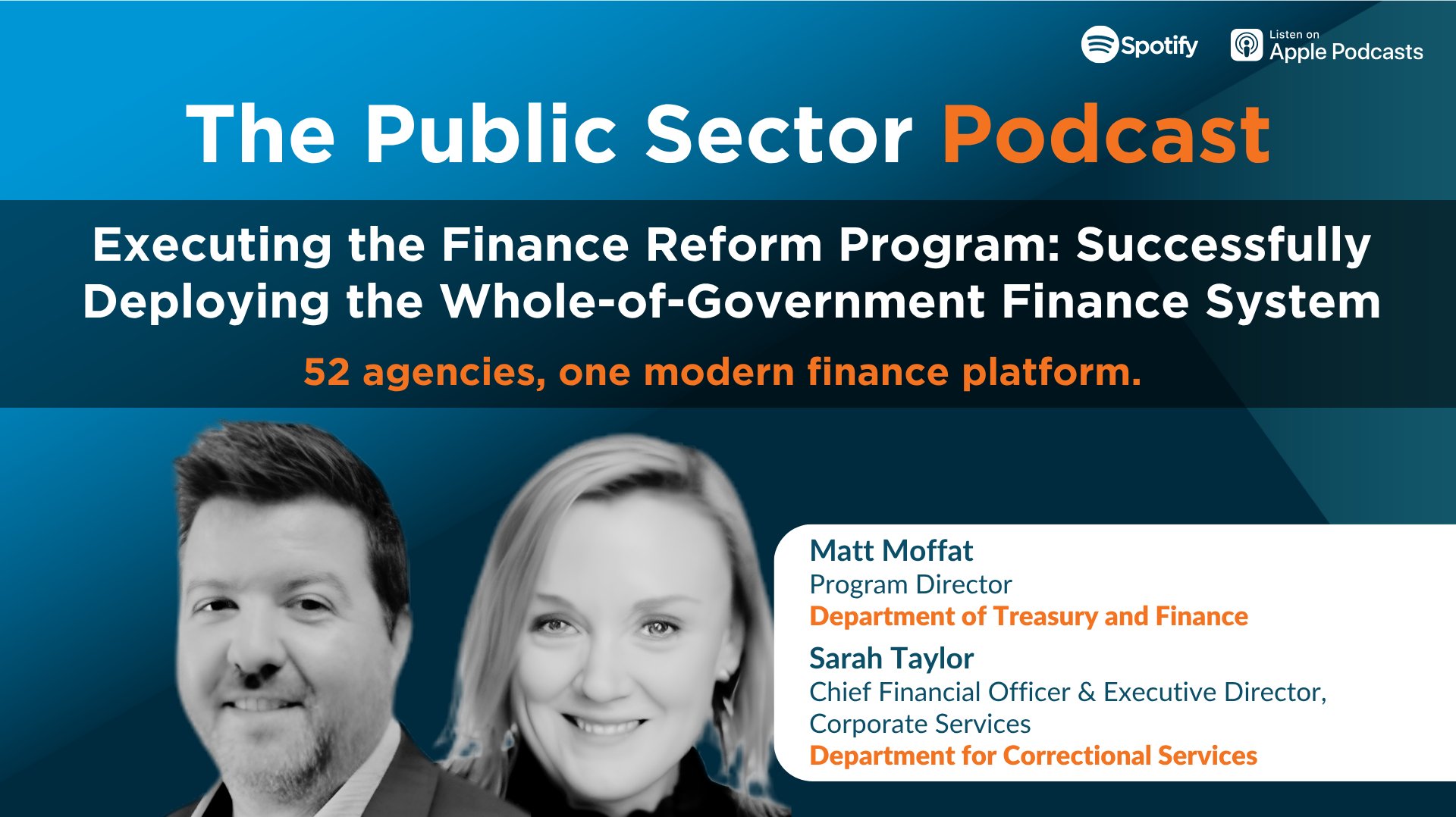
Episode Overview
In this fireside chat, Matt Moffat, Program Director, Department of Treasury and Finance and Sarah Taylor, Chief Financial Officer & Executive Director, Corporate Services, Department for Correctional Services, the team behind South Australia’s Finance Reform Program share what it takes to deploy a whole-of-government financial system across the state. Joined by Sarah Taylor, ED Corporate Services and CFO at the Department for Correctional Services (DCS), the conversation reflects on DCS’s role as the pilot agency and the early lessons from going live first. Together, they discuss why this program is more than a system replacement - it's a once-in-a-career opportunity to reform how finance works across government.
The episode covers the scale and complexity of modernising a 30-year-old legacy platform into Oracle Fusion Cloud, including the rollout approach across 52 agencies, the integration strategy using MuleSoft, and the guiding principle of “adopt, not adapt” to reduce customisation and long-term technical debt. You’ll also hear practical insights on preparing teams for change, building champions, engaging ICT early, strengthening cross-government collaboration, and creating the foundations for better automation, reporting, and executive decision-making.
Key Themes
- Whole-of-government finance reform at scale (52 agencies)
- Moving from legacy “green screen” systems to Oracle Fusion Cloud
- Integration complexity and using MuleSoft to reduce feeder-system change
- “Adopt, not adapt” and reducing customisation/technical debt
- Piloting with Department for Correctional Services: lessons from going live first
- Change management, expectations, champions, and building capability
- Cross-government collaboration and governance (CFOs + CIO engagement)
- Automation, self-service, dashboards, and uplift in reporting/insights
What You’ll Learn
- Why the program shifted from “Masterpiece Replacement” to broader finance reform
- How the rollout is structured across deployment groups and what hypercare looks like
- Why integrations are often the biggest risk - and how to assess criticality and lead times
- How to prepare long-tenured teams for a major platform change
- Why early ICT involvement improves outcomes in cloud implementations
- The benefits (and challenges) of centralised analytics and self-service reporting
- What “standardising the chart of accounts” enables across the state
- Where AI may help address gaps and reduce manual work (e.g., receipting)
Key Takeaways
- Replacing a legacy finance platform is a rare chance to reform processes—not just upgrade technology.
- Integration strategy matters: minimising change to feeder systems can reduce cost and complexity.
- “Adopt, not adapt” supports cleaner upgrades and less technical debt, but increases change effort.
- Pilots surface issues early - build time to absorb learnings before repeated go-lives.
- Executive sponsorship and clear expectation-setting make or break adoption.
- Cross-government collaboration improves outcomes and strengthens future whole-of-government initiatives.
- The long-term value is in automation, better reporting, and more informed decision-making - not just go-live.
Why You Should Listen
If you work in finance, transformation, digital delivery, ICT governance, or public sector reform, this episode provides a grounded view of what it really takes to modernise a finance ecosystem across government. It shares real implementation insights—from integrations and rollout sequencing to people change and collaboration—plus the practical lessons learned from the first agencies to go live.





Help your peers
Share what you've learned with fellow public servants