
Episode Overview
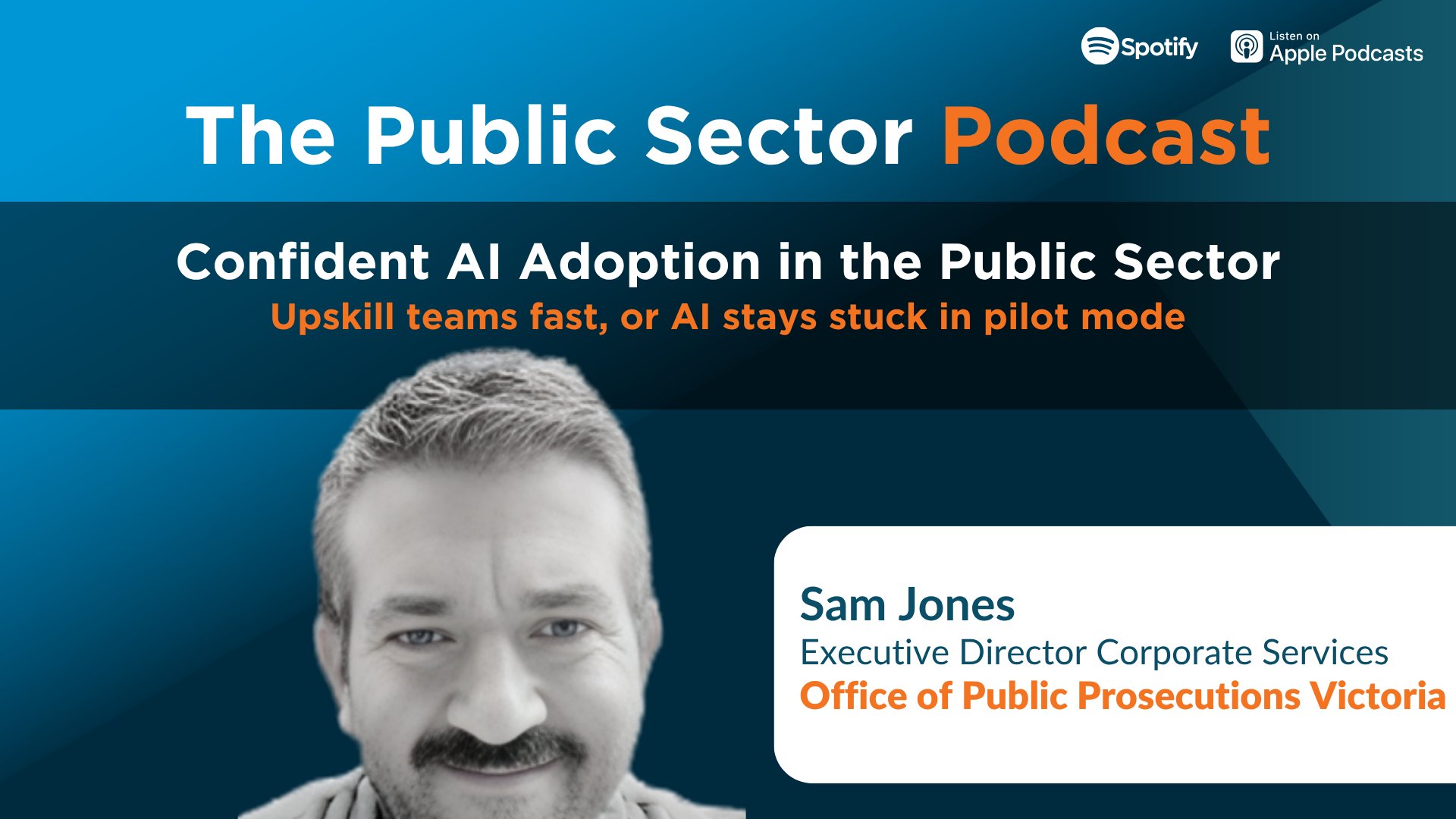
Sam Jones, Executive Director Corporate Services, Office of Public Prosecutions Victoria unpacks what confident AI adoption really looks like in the public sector and why confidence is not the same as speed. It is about clarity: clear use, clear rules, clear accountability, and staff who feel supported to use AI well. Sam emphasises transparency with both internal teams and the communities they serve, including where AI is used, where it could be used, and where it must not be used.
Rather than framing risk as something that comes only from the model, the episode explains how AI risk often comes from ambiguity, weak adoption processes, unclear data flows, and missing guardrails. You will hear a practical approach for building adoption safely: choose the work first, risk-tier it, design guardrails, pilot, learn, iterate, and then scale with evidence.
Key Themes
A central theme is that AI adoption succeeds when it is treated as a change and risk management program, not a technology rollout. The episode addresses why resistance is normal and valuable, and how good leadership interprets resistance as feedback that improves implementation.
Sam also introduces a practical view of governance as enabling guardrails across three layers: policy (people rules), process (workflow controls), and technical (system controls). The aim is to capture efficiency gains while keeping human judgement and accountability firmly in place.
What You’ll Learn
1) What “Confident Adoption” Actually Means
How to define confidence through clarity, boundaries, oversight, and accountability, rather than rushing or relying on enthusiasm alone.
2) Where AI Risk Really Comes From
Why the biggest risks often come from unclear usage, poor data-flow understanding, weak adoption processes, and missing guardrails, not the model itself.
3) The “What’s the Worst That Could Happen?” Test
How to use a worst-case lens to risk-tier AI use cases and decide where review, approvals, logging, and human oversight should sit.
4) Pick the Work, Not the Tech
Why teams should start with a clear use case and workflow pain point before procurement, then design guardrails around the real operational risk.
5) A Repeatable Change Loop That Scales
A practical cycle to follow: pick the use case → assess risk → design guardrails → pilot → learn → iterate → repeat.
6) Handling Resistance Without Dismissing It
How to interpret common concerns (surveillance, de-skilling, replacement, blame, “extra work”) as signals about trust, role identity, and workflow friction.
7) Designing for Adoption: Make It Useful and Normal
How to build buy-in by removing one genuinely annoying task first, co-designing with users, embedding AI into existing workflows, and using champions rather than mandates.
8) Why Explainability Is Not Optional
How poor validation and hard-to-check outputs can make AI a time tax instead of a productivity gain, and why traceability (like accessible citations) is a design essential.
9) Governance Guardrails in Three Layers
How to structure guardrails across:
- Policy guardrails (what’s allowed, accountability, oversight)
- Process guardrails (review points, records, escalation paths)
- Technical guardrails (access control, approved environments, auditability, boundaries)
10) Risk Tiering: Low, Medium, High
A simple way to match guardrails to risk:
- Low risk (summaries/drafting): AI assists, humans check
- Medium risk (research/analysis): AI assists, humans review
- High risk (outcome/decisions): AI assists, humans decide
Key Takeaways
- Confident adoption is built on clarity, guardrails, and accountability
- Most AI risk comes from ambiguity and weak processes, not the model alone
- Start with the workflow pain point: pick the work, not the tech
- Pilot, learn, iterate, then scale with evidence
- Resistance is not failure, it is feedback
- Explainability and traceability are essential for adoption, especially in research-heavy work
- AI can give time back, but leaders must choose how to reinvest it
- AI assists; humans remain accountable
Why You Should Listen
This episode is essential for public sector leaders, transformation teams, and practitioners who want to move beyond AI hype into practical, responsible implementation. It offers a clear, repeatable approach to adoption that balances efficiency with trust, oversight, and real-world accountability.
Memorable Line of Thinking
The real prize is not efficiency for efficiency’s sake. It is what you do with the time AI gives back—and whether people can trust how AI is used.







Help your peers
Share what you've learned with fellow public servants