
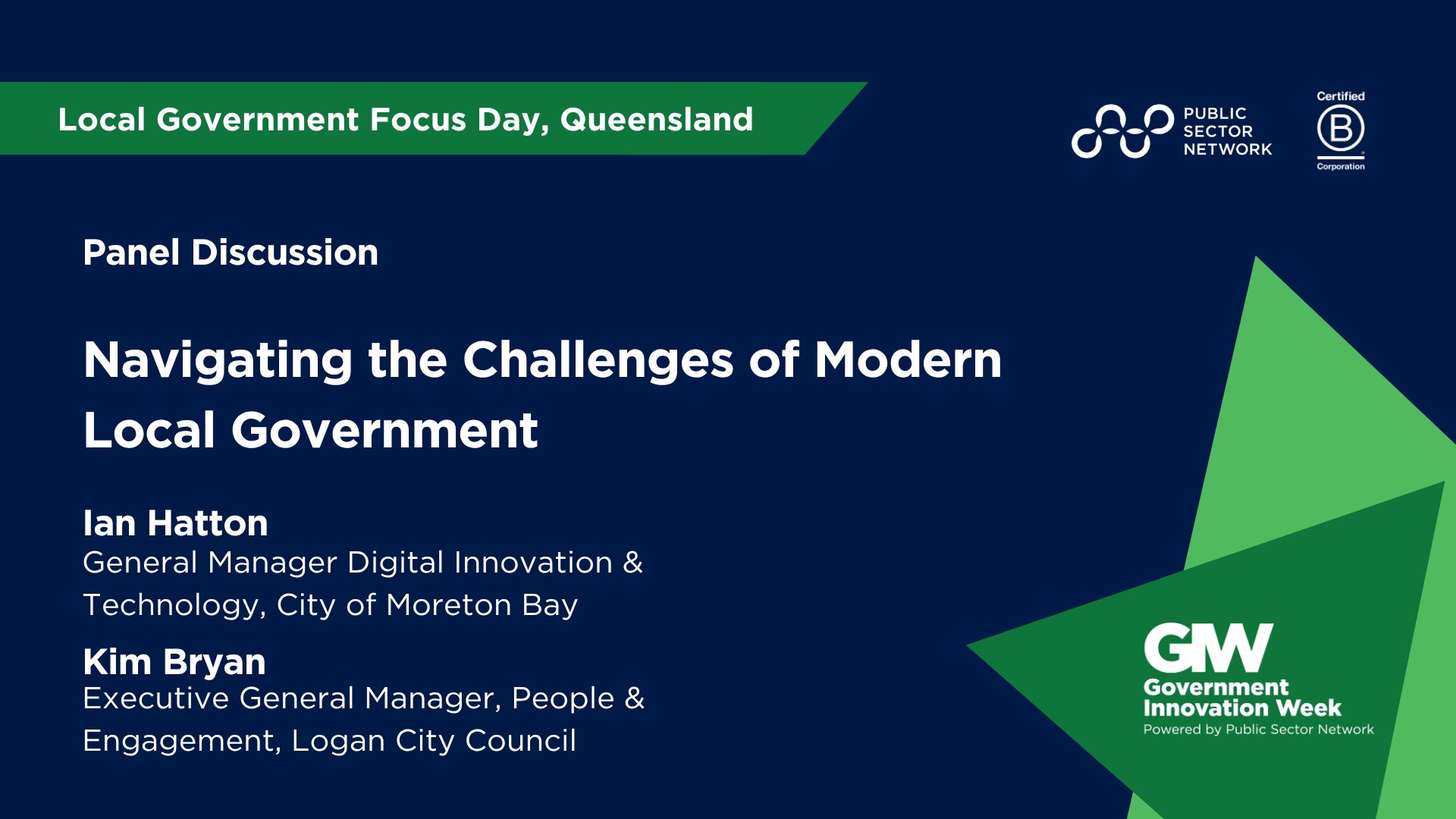
Queensland’s local governments are operating in one of the most complex delivery environments in decades. Councils are expected to do more with less—delivering essential services, enabling rapid population growth, strengthening digital capability, and preparing for transformational opportunities such as the Brisbane 2032 Olympic and Paralympic Games. At the same time, they face persistent workforce shortages, tightening budgets, and rising community expectations for faster, more transparent, and more personalised services.
The Local Government Focus Day Queensland 2026 session led by Ian Hatton and Kim Bryan captures this tension clearly: councils are no longer simply service providers—they are now multi-dimensional system integrators balancing delivery, innovation, governance, and long-term resilience.
View Agenda | Register Now (Free for Public Sector)
The pressure triangle: workforce, funding, and expectations
At the core of modern local government challenges is a persistent “pressure triangle”:
1. Workforce shortages and capability gaps
Councils across Queensland continue to experience competition for skilled talent in digital, engineering, planning, and community services roles. This is compounded by an ageing workforce and the increasing need for hybrid skill sets that combine policy, technology, and service design.
In practice, this means councils must:
- Rebuild workforce pipelines through partnerships with education and industry
- Upskill existing staff in digital literacy, AI, and data-driven decision-making
- Compete with private sector salaries while offering purpose-driven employment
The session framing reflects a growing reality: workforce strategy is now inseparable from service continuity and innovation capacity.
2. Funding constraints and operational efficiency
Local governments are being asked to maintain and expand services while managing constrained revenue bases. This has pushed councils toward:
- Automation of repetitive administrative processes
- Shared services and regional collaboration models
- Increased scrutiny on capital investment decisions
However, efficiency alone is no longer enough. Councils are expected to demonstrate value creation, not just cost reduction—particularly in areas like housing enablement, infrastructure readiness, and climate resilience.
3. Rising community expectations
Modern communities expect:
- Faster digital service delivery
- Transparent decision-making
- 24/7 accessibility
- Tailored, citizen-centric experiences
This shift has fundamentally changed the relationship between councils and residents. Service delivery is now judged against private-sector digital benchmarks, not traditional public-sector timelines.
View Agenda | Register Now (Free for Public Sector)
Balancing innovation with operational reality
A key tension explored in this session is how councils balance innovation ambition with operational delivery obligations.
Innovation in local government is no longer experimental—it is operational necessity. Across Queensland, councils are increasingly applying:
- AI-assisted service delivery and automation
- Integrated data platforms for planning and assets
- Digital engagement tools to improve customer experience
- Cyber resilience frameworks to protect critical infrastructure
However, leaders like Ian Hatton and Kim Bryan must ensure these initiatives do not destabilise core services.
The real challenge is not whether to innovate—but how to industrialise innovation safely at scale.
Governance, trust, and long-term strategic planning
As councils digitise and decentralise decision-making, governance complexity increases.
Modern local government leadership must now integrate:
- Data governance and ethical AI use
- Risk management across digital ecosystems
- Regulatory compliance in fast-moving technology environments
- Community trust-building in an era of misinformation and transparency demands
Strategic planning is also becoming more dynamic. Long-term frameworks must now account for:
- Rapid population growth across South East Queensland
- Infrastructure pressure linked to housing demand
- Climate and disaster readiness
- Intergovernmental priorities tied to Brisbane 2032 readiness
This requires councils to shift from static planning cycles to adaptive, scenario-based governance models.
Building resilient organisations for a volatile future
Resilience is emerging as the defining capability of modern councils.
A resilient local government is one that can:
- Absorb shocks (floods, cyber incidents, economic pressures)
- Adapt services quickly under constraints
- Sustain workforce capability during disruption
- Maintain public trust under pressure
The Brisbane 2032 horizon adds another layer of urgency. As highlighted in broader Queensland planning discussions, major infrastructure and event delivery pipelines are already under strain from workforce shortages and competing capital demands, creating a high-risk environment for delays and cost escalation.
Within this context, councils are increasingly acting as frontline enablers of state and national priorities, not just local administrators.
From transformation to “continuous adaptation”
A key shift underpinning this session is the move away from “transformation projects” toward continuous organisational adaptation.
Rather than one-off digital programs or restructuring exercises, councils are now:
- Embedding innovation into daily operations
- Treating workforce development as an ongoing capability system
- Using data and AI as foundational infrastructure
- Building cross-council collaboration models for scale efficiency
This reflects a broader reality: the pace of change has outgrown traditional transformation cycles.
Conclusion: leading through complexity, not certainty
The discussion led by Ian Hatton and Kim Bryan highlights a defining truth for Queensland local government:
The challenge is no longer managing change—it is managing constant change.
Councils that succeed in the next decade will be those that can:
- Align workforce strategy with digital transformation
- Balance innovation with service reliability
- Strengthen governance without slowing responsiveness
- And build organisational resilience that withstands both growth and disruption
In doing so, they will not only meet rising community expectations—they will help shape the success of Queensland’s broader transformation journey toward 2032 and beyond.
Local Government Focus Day Queensland
Reimagining How Councils Deliver: Citizen-Centric, AI-Enabled and Future-Ready





Help your peers
Share what you've learned with fellow public servants