
New York State is entering one of its most important technology investment cycles in recent years. With agencies balancing modernization pressures, rising cybersecurity demands, AI experimentation, and tighter fiscal conditions, technology leaders are becoming increasingly selective about where they invest and how they evaluate vendor partnerships.
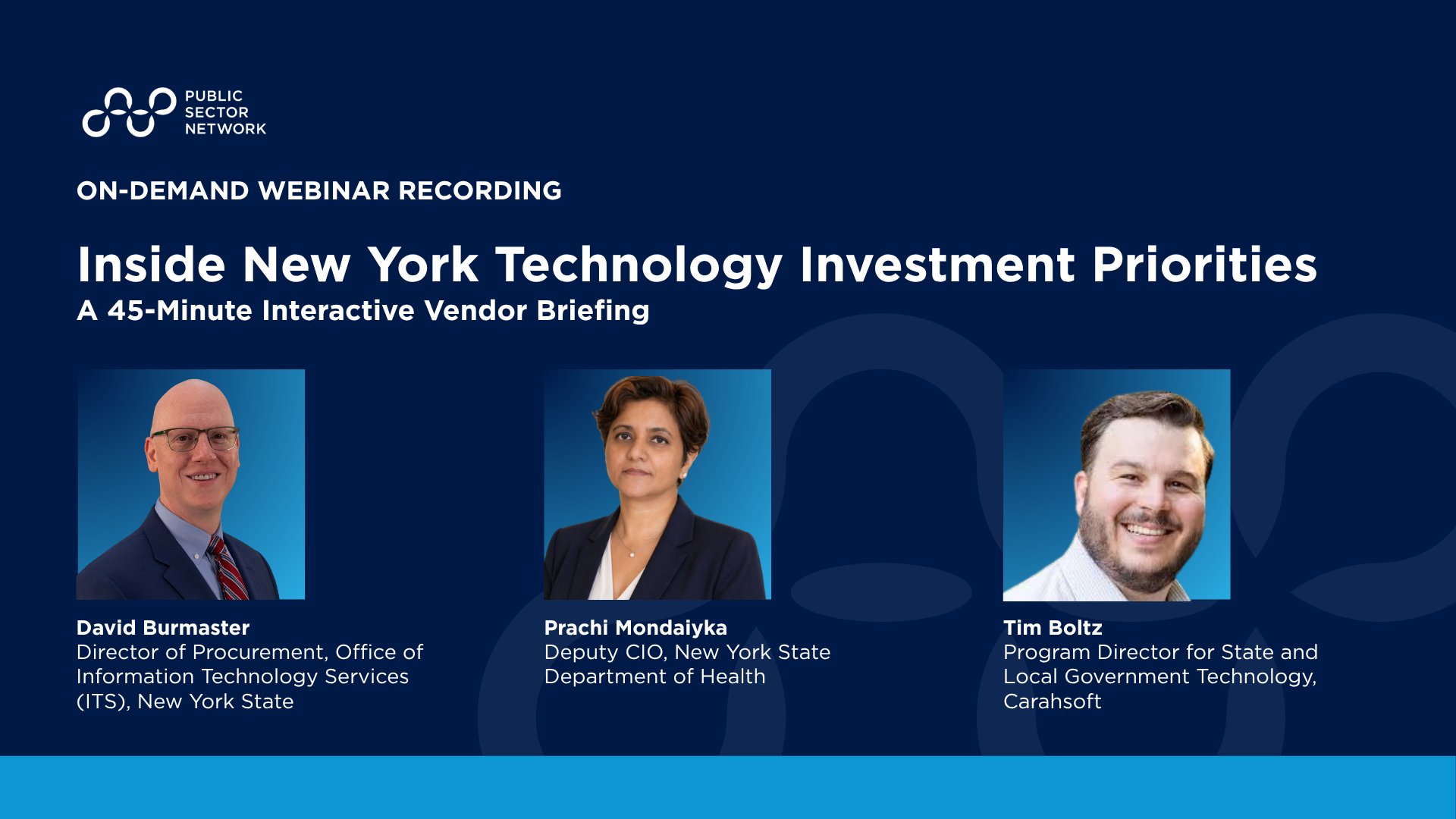
During Public Sector Network's recent Inside New York Technology Investment Priorities vendor webinar, David Burmaster, New York ITS' Director of Procurement and Prachi Mondaiyka, Department of Health's Deputy CIO shared a candid view of the state's evolving priorities and what technology partners need to understand before the next procurement cycle accelerates.
The message was clear: New York is not looking for the newest technology. It is looking for practical solutions that deliver measurable outcomes.
Investment Priorities Are Shifting Toward Efficiency and Enterprise Scale
While technology spending remains significant, agencies are operating in a different environment than they were several years ago.
According to David Burmaster, agencies are increasingly focused on maximizing return on investment, consolidating technology spend, and accelerating time-to-value.
Rather than supporting multiple tools that solve similar problems, New York is moving toward an enterprise product model.
"We're asking why we have three different products that do the same thing when we could centralize spend and deliver a single enterprise capability."
This shift is driving increased interest in:
- Enterprise agreements and strategic partnerships
- Contract consolidation across agencies
- Shared services and centers of excellence
- Long-term cost predictability
- Vendor investments in training and knowledge transfer
At the same time, agencies continue to face significant modernization challenges, particularly around legacy systems and mainframe environments.
AI Is Important, But Government Is Taking a Deliberate Approach
Artificial intelligence dominated much of the discussion, but perhaps not in the way many vendors might expect.
Prachi Mandeka emphasized that New York is not pursuing AI simply because it is the latest trend.
Instead, agencies are focusing on practical use cases where AI can augment human capacity and deliver measurable operational improvements.
Examples include:
- Intelligent document processing
- Contact center augmentation and multilingual support
- AI-assisted routing and knowledge management
- Anomaly detection and predictive analytics
The common thread across these use cases is that humans remain firmly in control.
"AI is augmenting human capacity. It is not replacing human judgment."
New York agencies remain cautious about deploying AI in areas where errors, bias, or hallucinations could directly impact residents and critical public services.
This has significant implications for vendors.
AI capabilities alone are unlikely to differentiate a solution. Agencies increasingly expect vendors to demonstrate:
- Governance frameworks
- Transparency and explainability
- Data protection controls
- Human oversight mechanisms
- Continuous monitoring and risk management practices
As one panelist noted, governance can no longer be treated as a footnote—it must be built into the design of every AI solution.
Cloud Modernization Is Entering Its Second Phase
New York's cloud journey is also evolving.
The first wave of migration focused largely on moving workloads into cloud environments. The next phase is about realizing actual value from those investments.
Agencies are now prioritizing:
- Cloud-native architectures
- API-first design
- Microservices
- Event-driven integration
- Greater interoperability across government systems
The goal is no longer simply to migrate systems but to fundamentally redesign how government technology operates and integrates.
Data Infrastructure May Be the State's Most Strategic Investment Area
Despite the attention given to AI, panelists suggested that data infrastructure may ultimately be the most important long-term investment area.
Agencies possess enormous volumes of information but continue to face challenges using it coherently across organizational boundaries.
New York leaders highlighted growing interest in:
- Federated data governance models
- Enterprise-wide data accessibility
- Real-time data processing capabilities
- Cross-agency information sharing
- Data platforms that support better decision-making
For agencies such as the Department of Health, these capabilities are increasingly essential for emergency response, public health operations, and service delivery improvements.
Without strong data foundations, scalable AI and modernization efforts become significantly more difficult.
Cybersecurity Is No Longer a Separate Project
Cybersecurity was repeatedly described as an operating model rather than a standalone initiative.
Instead of being treated as a compliance exercise or technology purchase, security considerations are now expected to be embedded into every modernization decision.
Key focus areas include:
- Identity and access management
- Zero trust architectures
- Cloud security
- Incident response readiness
- Security-by-design principles
As AI adoption increases, cybersecurity and governance requirements are becoming even more intertwined.
Evaluation Criteria Are Moving From Features to Outcomes
Perhaps the biggest shift for vendors is how agencies are evaluating potential partners.
Historically, technology evaluations often centered on feature comparisons and capability checklists.
Today, agencies are asking fundamentally different questions.
Can the solution demonstrate measurable outcomes?
Has it delivered results in comparable government environments?
Can the vendor prove scalability, resilience, and long-term sustainability?
Technology leaders are increasingly evaluating:
- Operational impact
- Constituent experience improvements
- Risk reduction
- Interoperability
- Talent implications
- Long-term flexibility
"Innovation for its own sake is not valuable. Innovation that solves problems and creates sustainable opportunities is."
This means vendors need to move beyond demonstrations and product marketing and instead provide evidence of successful implementations and measurable outcomes.
What Vendors Need to Do Before an RFP Is Released
One of the strongest messages from the discussion was the importance of early preparation.
New York's procurement environment is highly structured, and vendors that wait until an RFP is issued may already be behind.
According to ITS leaders, well-prepared vendors should:
- Understand New York's procurement requirements and legal frameworks
- Register appropriately to do business in the state
- Review standard contract clauses in advance
- Prepare references and proof of delivery
- Establish reseller and distribution strategies
- Understand MWBE and SDVOB participation expectations
- Demonstrate long-term pricing models and scalability plans
Importantly, panelists cautioned against approaching New York with procurement assumptions based on other states.
"Assuming New York operates like every other state is a very quick way to lose credibility."
The state is increasingly seeking partners who understand its unique environment and are prepared to engage collaboratively rather than simply sell products.
Looking Ahead
New York's next wave of technology investment will be defined by pragmatism.
Agencies are pursuing AI, cloud, data, and cybersecurity initiatives, but every investment is being measured against a simple question:
Will this improve outcomes for New Yorkers?
For vendors, success will depend less on showcasing the newest technology and more on demonstrating long-term value, governance maturity, implementation readiness, and a deep understanding of government realities.
The procurement window may still be opening, but the vendors that build credibility now will likely be the ones best positioned when decisions begin to take shape.
Want to take the next step?
Meet David Burmaster, New York ITS' Director of Procurement, Prachi Mondaiyka, Department of Health's Deputy CIO and more NYS public sector leaders at Government Innovation New York on November 12, 2026 in Albany.






Help your peers
Share what you've learned with fellow public servants