

Introduction
Access to quality healthcare remains a significant challenge for many underserved and Indigenous communities across Canada. Geographic isolation, limited specialist availability, and cultural or linguistic barriers often prevent timely diagnosis and treatment of chronic conditions. Vision Loss Rehabilitation Canada’s (VLRC) Eye Health Screening Initiative (EHSI) in Ontario offers a compelling example of how artificial intelligence (AI) can be leveraged to reduce these barriers and improve health outcomes, particularly for diabetic retinopathy, which is a leading cause of preventable blindness.
The EHSI Model: Bringing Care Closer to Home
The EHSI is an established, scalable program that delivers diabetic retinopathy screening directly to rural, remote, and Indigenous communities. In Ontario, VLRC delivers the initiative in partnership with the Indigenous Diabetes Health Circle (IDHC), whose leadership and community relationships help ensure screening is grounded in culturally safe, trusted, and responsive care. In the 2025–2026 fiscal year, the initiative screened 2,409 individuals, identifying 271 positive cases (11.3% positivity rate). The program’s success is rooted in its community-responsive delivery model, which pairs advanced screening technology with dedicated human resources and culturally safe practices.
How AI Powers the Program
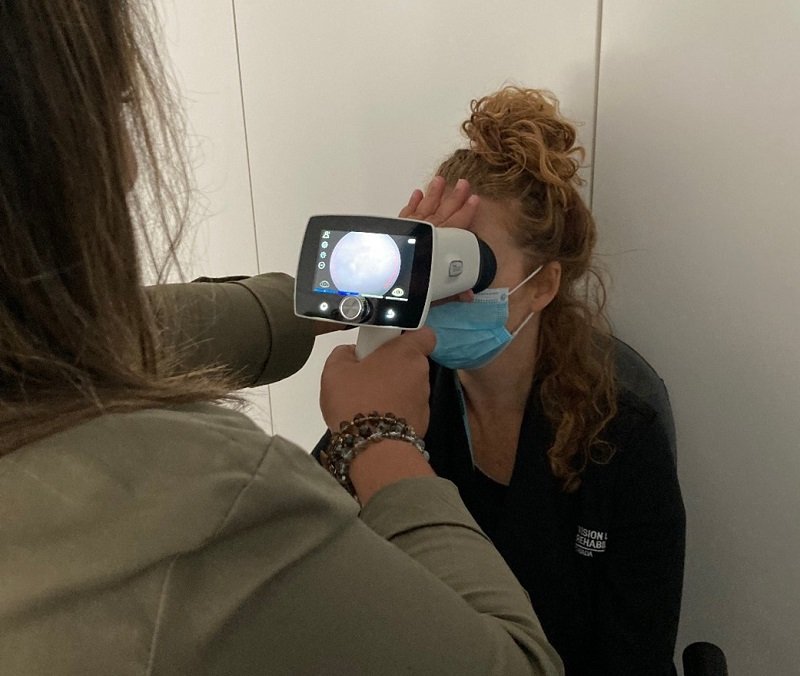
EHSI uses EyeArt, a Health Canada-approved AI screening tool, to support diabetic retinopathy screening at the point of care. The software analyzes retinal images captured by portable fundus cameras and classifies them as positive or negative for diabetic retinopathy. The AI tool’s high sensitivity (over 91% for referral-warranted disease) ensures that individuals at risk are quickly identified and referred for specialist review, while those with negative results receive education and routine follow-up recommendations.
Key Benefits of AI Integration
- Timely Triage: AI enables rapid identification of at-risk individuals, supporting earlier intervention and reducing the risk of severe vision loss.
- Specialist Capacity: By automating initial screening, AI preserves ophthalmologist time for cases that truly require specialist assessment.
- Accessibility: Portable cameras and AI analysis allow screening to be delivered in community settings, reducing the need for travel and overcoming geographic barriers.
Reducing Barriers: Practical Outcomes
Expanding access and equity begins by bringing screening into the places where people already receive care and gather as a community. EHSI delivers services through local health centres, outreach clinics, and community events, reducing the need for patients to travel long distances for screening. The program also invests in local capacity by training dedicated screeners, including Indigenous health workers, to operate equipment and engage with patients in trusted settings. In 2025–2026, 883 of 1,192 screens in Indigenous communities were completed by dedicated screeners, underscoring the importance of community-based expertise and relationships in reaching people who may otherwise go without care.
The model also improves quality and efficiency by pairing technology with standardized practice. Upgrading to newer portable fundus cameras strengthened image quality and workflow, with some sites increasing screening volumes by sixty percent after replacing older equipment. At the same time, an ISO-certified, modular training curriculum helps ensure that screening is delivered consistently across diverse sites, regardless of geography or local staffing context.
Patient and provider experience further reinforces the value of this approach. Ninety-five percent of patients said they would recommend the screening, citing comfort, convenience, and professionalism, while ninety percent of providers reported being satisfied or very satisfied with the program. Their feedback points not only to improved access, but also to the importance of culturally appropriate care and a delivery model that is responsive to community needs.
These improvements translate into measurable health and economic benefits. By supporting earlier detection of diabetic retinopathy, AI-enabled screening helps reduce the risk of severe vision loss and the significant costs associated with preventable blindness. Economic modelling suggests a positive return on investment, with an estimated $7.66 to $27 saved for every $1 invested, consistent with broader tele-retina program estimates.
Lessons for the Public Sector
The EHSI demonstrates that AI is most effective when integrated into a holistic, community-driven model. Key lessons for public sector leaders include:
- Pair Technology with Local Capacity: AI tools amplify impact when combined with dedicated staff and culturally safe practices.
- Invest in Relationships: Long-term success depends on trust, community engagement, and Indigenous and community leadership.
- Support Flexibility: Programs must adapt to local realities, integrating with existing care pathways and responding to community needs.
- Prioritize Sustainability: Ongoing investment in equipment, training, and coordination is essential for lasting impact.
Conclusion
The Eye Health Screening Initiative is a powerful example of how AI can help break down barriers to healthcare in underserved communities. By combining advanced technology with community partnerships and culturally grounded delivery, the public sector can drive meaningful improvements in health equity, early detection, and long-term wellness.
For more information, visit:
This article is based on outcomes and lessons learned from the 2025–2026 EHSI Outcomes Report.




Help your peers
Share what you've learned with fellow public servants