
From Policy to Pipeline: Operationalizing Automated Data and AI Governance
How public-sector organizations can turn governance policy into executable, auditable controls across the data and AI lifecycle.
The Governance Gap Between Policy and Practice
Most public-sector organizations have data-governance policies. Far fewer have governance that operates continuously within the systems producing, transforming, sharing, and using data.
That gap is where trust in artificial intelligence can erode quietly.
Policies may describe appropriate data use, access controls, quality standards, retention rules, human oversight, and accountability. Yet data pipelines run hourly, models are updated frequently, and AI-enabled features can be introduced in short delivery cycles.
When governance runs on a quarterly committee calendar while technology changes every day, policy becomes difficult to enforce consistently.
In an AI-enabled environment, data governance becomes even more important. Trust in an AI system cannot be separated from the quality, lineage, access controls, and permitted use of the data on which it depends.
The practical question for public-sector leaders is straightforward:
How can governance policy become something systems can execute and auditors can verify?
The answer is not to replace governance with automation. It is to operationalize governance through automation.
Why Manual Governance Cannot Scale
Traditional governance practices—policies, review boards, attestations, and periodic audits—still matter. But they cannot alone keep pace with a modern data and AI estate.
Three forces make this clear.
1. Volume and velocity
A midsize public organization may operate hundreds or thousands of pipelines, datasets, dashboards, APIs, and automated workflows. No governance council can manually review every change at the speed those assets evolve.
2. Composability
Modern AI applications often combine retrieval systems, vector stores, embeddings, foundation models, tools, APIs, business rules, and downstream applications.
Risk can emerge in the connection between components: a data-access rule bypassed by a new integration, a model used outside its intended purpose, or a workflow that produces an unreviewed recommendation.
3. Overlapping obligations
Government organizations must reconcile privacy, cybersecurity, records management, accessibility, procurement, ethical-use, and sector-specific obligations.
The NIST Artificial Intelligence Risk Management Framework provides a useful foundation for incorporating trustworthy-AI considerations into the design, development, use, and evaluation of AI systems. Its practical value increases when organizations translate high-level risk principles into repeatable controls.
Automation does not eliminate human judgment. It creates a control environment in which human judgment is applied where it matters most:
Setting policy
Approving exceptions
Resolving disputes
Overseeing high-impact use cases
Improving controls based on evidence
A Practical Definition of Automated Governance
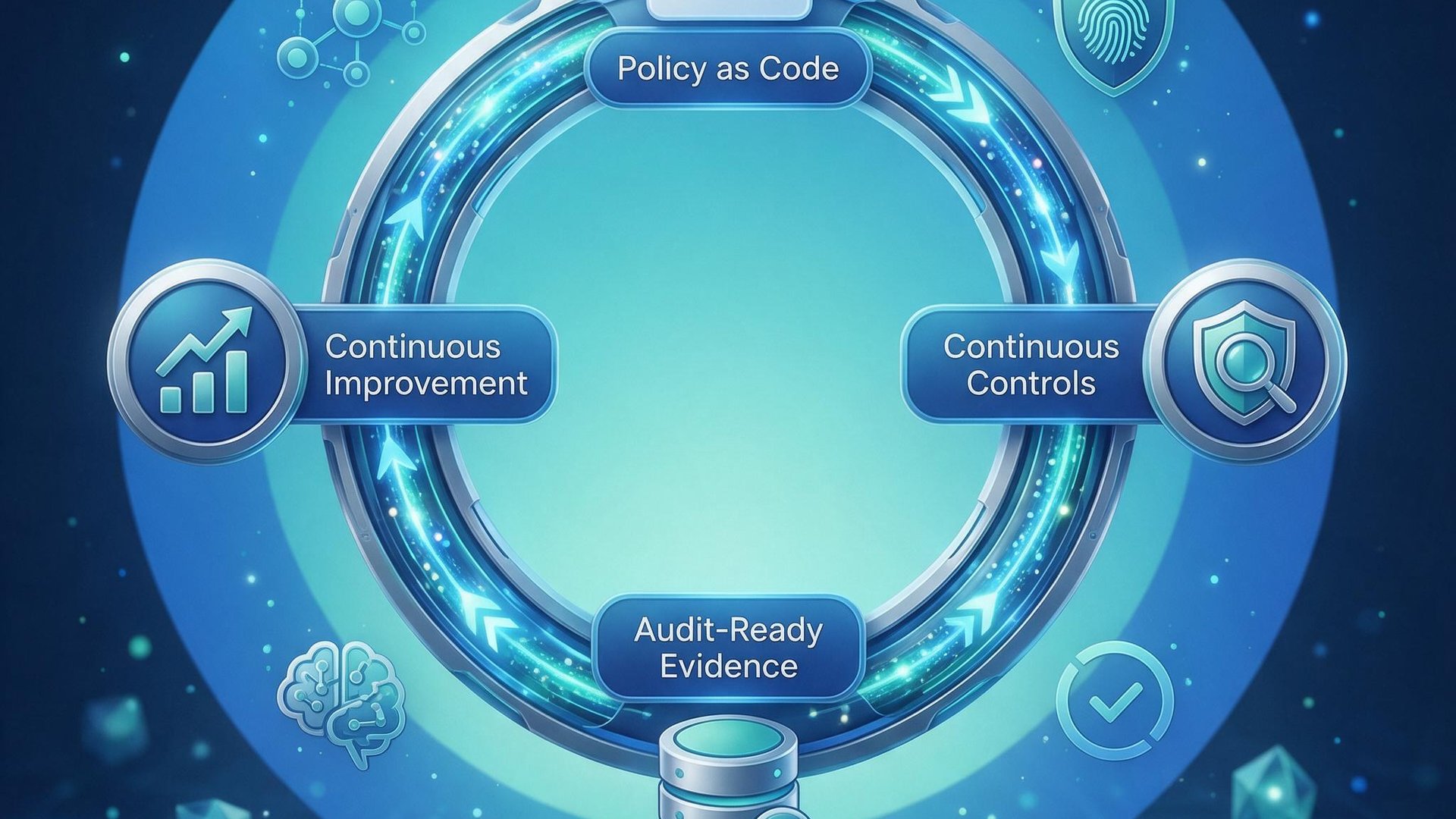
Automated governance is the practice of expressing selected data and AI policies as machine-readable rules, executing those rules against live systems, and producing audit-ready evidence as a byproduct of normal operations.
This definition has three implications:
Policies must be interpretable by systems, not only written for people.
Controls should operate continuously, rather than only at approval gates or audit time.
Evidence should be generated automatically, not assembled retroactively from emails, spreadsheets, and meeting notes.
The technology behind this approach is not necessarily new. Metadata platforms, data-quality tools, policy engines, identity systems, model registries, CI/CD pipelines, and logging platforms already exist in many organizations.
The real change is organizational: governance must be treated as a managed product with named owners, source control, testing, release processes, and measurable performance.
Five Controls to Embed in the Pipeline
Not every governance activity should be automated. Policy interpretation, ethics deliberation, public accountability, and high-impact decision review require people.
But five controls are especially appropriate for operationalization.
1. Metadata capture
Pipelines should automatically publish schema, ownership, sensitivity labels, lineage, and update history when they run.
A data catalog works only when it reflects the current environment. When metadata capture relies on manual updates, the catalog becomes incomplete and quickly loses credibility.
For AI systems, lineage is essential. A public organization cannot explain an AI-assisted decision, investigate a data issue, or evaluate bias concerns without understanding the sources, transformations, and access paths behind data used for training, retrieval, or inference.
2. Policy as code
Many governance requirements involve decisions that can be evaluated systematically.
Examples include:
Whether a role may access a dataset.
Whether data may be used for a particular purpose.
Whether a retention period has expired.
Whether a model has the required approvals for its risk tier.
These are candidates for policy-as-code.
Instead of relying only on documents and memory, an organization can express rules in a policy engine and require applications, data platforms, and AI services to consult those rules at runtime.
The operating-model implication is significant. Governance teams do not merely publish policy. They own policy definitions, tests, versions, and change records in partnership with security, privacy, platform, legal, and program teams.
3. Continuous data quality
Dashboards that report data-quality issues create awareness. Data contracts create accountability.
A data contract specifies what a producer commits to provide:
Expected schema.
Freshness.
Completeness.
Valid ranges.
Classification.
Quality thresholds.
If a contract fails—for example, because a critical field becomes null, the schema changes unexpectedly, or a distribution shifts materially—the platform can pause downstream processing, alert owners, open an incident, or restrict an AI workflow until the issue is reviewed.
This makes quality part of daily operations rather than a monthly reporting exercise.
4. Enforced model registration
A model registry becomes a meaningful governance control only when production infrastructure enforces it.
Before a model is allowed to serve production traffic, the registry should record:
Intended use and prohibited use.
Responsible owner and business sponsor.
Relevant data lineage.
Evaluation results and known limitations.
Required human oversight.
Risk tier.
Approval status.
Review or expiration dates.
A risk-tiering approach allows public organizations to apply proportionate controls.
A low-risk internal drafting assistant should not be governed exactly like a system that supports eligibility, inspections, enforcement, benefits, public safety, or resource-allocation decisions.
5. Evidence generation
The most powerful outcome of automated governance is not simply stronger controls. It is stronger evidence.
Every policy check, approval, exception, override, control failure, and remediation action should produce a timestamped record that can be searched and linked to the relevant framework, internal standard, system, data asset, or model.
When oversight, audit, incident response, or public-records obligations arise, the response should be based on available evidence rather than a retrospective scramble.
A Federated Operating Model
Automated governance works best when it is federated.
Central teams establish common guardrails and reusable platform capabilities, while domain teams apply them to the data, services, and use cases they know best.
Central responsibilities
Central teams should own:
A shared policy catalog and risk-tier taxonomy.
Common identity, metadata, quality, policy-enforcement, model-registration, and evidence capabilities.
Standard evidence schemas and systems of record.
A formal process for exceptions, disputes, and material control failures.
Domain responsibilities
Domain teams should own:
Prioritization of datasets, services, and models.
Domain-specific quality rules and business context.
Local implementation of shared controls.
Timely remediation of control failures.
Documentation of intended use and operational outcomes.
This model prevents two common failures: a central governance office becoming a bottleneck, or every domain inventing different controls with no common evidence standard.
Why Public-Sector Organizations Need This
The public sector has a particularly strong case for operational governance.
Residents need accountable systems
Residents often cannot choose an alternate provider when they interact with government. That raises the importance of fairness, explainability, privacy, due process, reliability, and accountability.
Capacity is limited
Public organizations face real capacity constraints. Governance teams cannot grow at the same pace as data, automation, and AI use cases.
Repeatable controls allow limited expertise to be applied to higher-risk issues rather than routine verification.
Public accountability is broader
Agencies may need to respond to oversight bodies, legislative inquiries, audits, records requests, security incidents, and questions from residents.
Governance evidence must therefore be complete, durable, and understandable.
The goal is not to slow responsible innovation. It is to ensure that innovation is capable of being explained, defended, improved, and trusted.
Where to Start
Automated governance should not be launched as a massive transformation program. Start with a small number of controls that demonstrate value.
1. Instrument one high-value dataset end to end
Capture lineage, ownership, classification, and quality signals from the pipeline that produces it.
Register its key consuming report, application, or AI workflow. Route the resulting records into evidence that can be queried.
2. Convert one policy from prose to code
Begin with a concrete retention, access, classification, or permitted-use rule.
Measure how frequently it is evaluated, where exceptions occur, and what operational problems the control exposes.
3. Publish a simple AI risk-tiering rubric
Apply it across the current AI portfolio.
A straightforward tiering model immediately distinguishes low-risk productivity tools from systems that require more formal assessment, human oversight, and approval.
A working control implemented in one quarter will often teach more than a comprehensive reference architecture. Durable governance programs are usually built from repeatable controls that earned their place through actual operational use.
Closing the Loop
Data and AI governance must move from policies that organizations intend to follow to controls that systems can execute and leaders can verify.
When policy becomes executable, governance becomes part of delivery rather than a checkpoint after delivery.
When every control produces evidence, accountability becomes continuous rather than retrospective.
And when governance is federated with shared platforms and clear ownership, public organizations can increase AI adoption without sacrificing the trust on which public service depends.
Trust is not a document. It is an operating capability






Help your peers
Share what you've learned with fellow public servants