
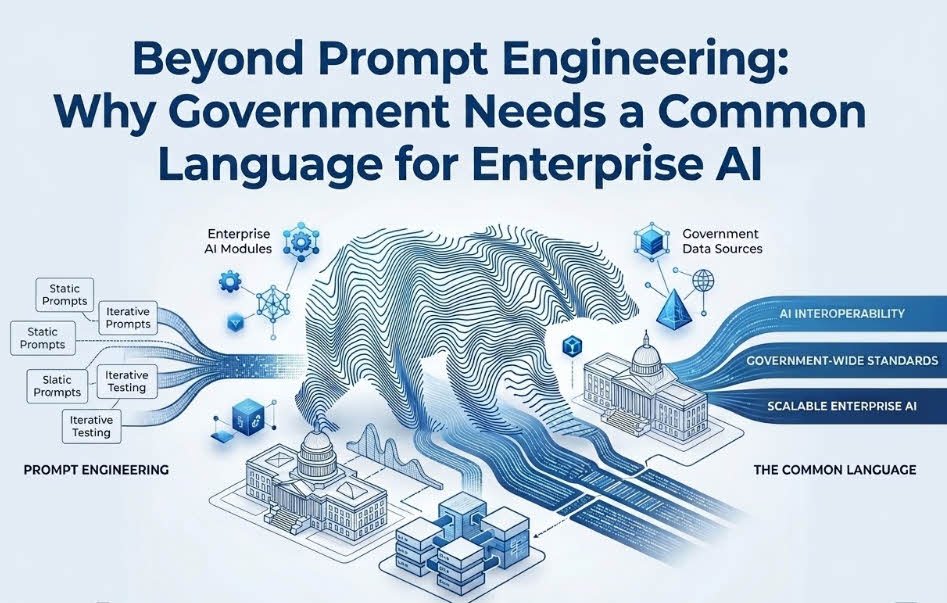
Google Gemini AI Generated Image
Generative AI is entering government faster than most organizations can standardize how it is used.
One employee works in Microsoft 365 Copilot. Another prefers ChatGPT. A technical team experiments with Claude. A data analyst uses Gemini. Each platform has different strengths, different methods of accessing organizational information, and a different user experience.
Yet, beneath those differences, government employees are often prompting AI to perform the same fundamental tasks:
- Analyze this.
- Compare these options.
- Identify the risks.
- Review this architecture.
- Summarize this meeting.
- Build an implementation plan.
- Recommend what we should do next.
The challenge is no longer simply teaching employees how to write better prompts. The larger challenge is establishing a repeatable way for people to communicate intent to AI regardless of which approved platform they are using.
That distinction matters.
If every employee develops their own prompting conventions, agencies eventually accumulate hundreds—or thousands—of undocumented AI workflows. The knowledge of how to obtain a useful result resides with individual users rather than the organization. Prompts become difficult to reproduce, difficult to evaluate, difficult to govern, and difficult to transfer when an agency changes AI platforms.
Government should treat this as an interoperability problem.
We already create standards for APIs, identity, data exchange, cybersecurity controls, architecture, and records management. As generative AI becomes another layer of enterprise technology, the instructions we give these systems deserve similar attention.
A practical answer is to establish a vendor-neutral prompt vocabulary: a small set of reusable commands that describe what we want an AI system to do, while leaving the underlying model or product interchangeable.
For example:
/ANALYZE /SECURITY /MATRIX /EXECUTIVE /DETAILED
The syntax is intentionally simple.
It communicates five things:
- Action — what should the AI do?
- Domain — what professional lens should it apply?
- Output — how should the result be structured?
- Audience — who will consume the result?
- Depth — how detailed should the analysis be?
The slash commands are not intended to replace natural-language prompting, nor are they native commands that every AI platform understands automatically. They are an organizational abstraction—a common vocabulary that can be translated into the prompting and context mechanisms of ChatGPT, Gemini, Claude, or Microsoft 365 Copilot.
Think of it less as a collection of clever prompts and more as an emerging interface between people and enterprise AI.
That idea led to the development of the Enterprise Prompt Command Dictionary, a cross-platform framework designed to make common AI tasks more repeatable, portable and governable.
For public-sector organizations, that portability may prove more important than any individual prompt.

Published by






Help your peers
Share what you've learned with fellow public servants