
For decades, governments have worked to make public services easier to access.
Paper forms gave way to online forms. Websites and mobile apps made services available beyond the counter. More recently, governments have sought to connect services around life events, so people do not have to provide the same information to multiple agencies.
The next shift could go further. Rather than waiting for someone to find a service and complete a form, government could use AI to identify a need, coordinate a response and offer support proactively.
That is the promise of Government 4.0. It could reduce bureaucracy, help people earlier and make services easier to navigate.
But it also creates a new challenge. If government can act without a person initiating a request, how does that person know what is happening? And what happens if the system gets it wrong?
How government’s relationship with people is changing
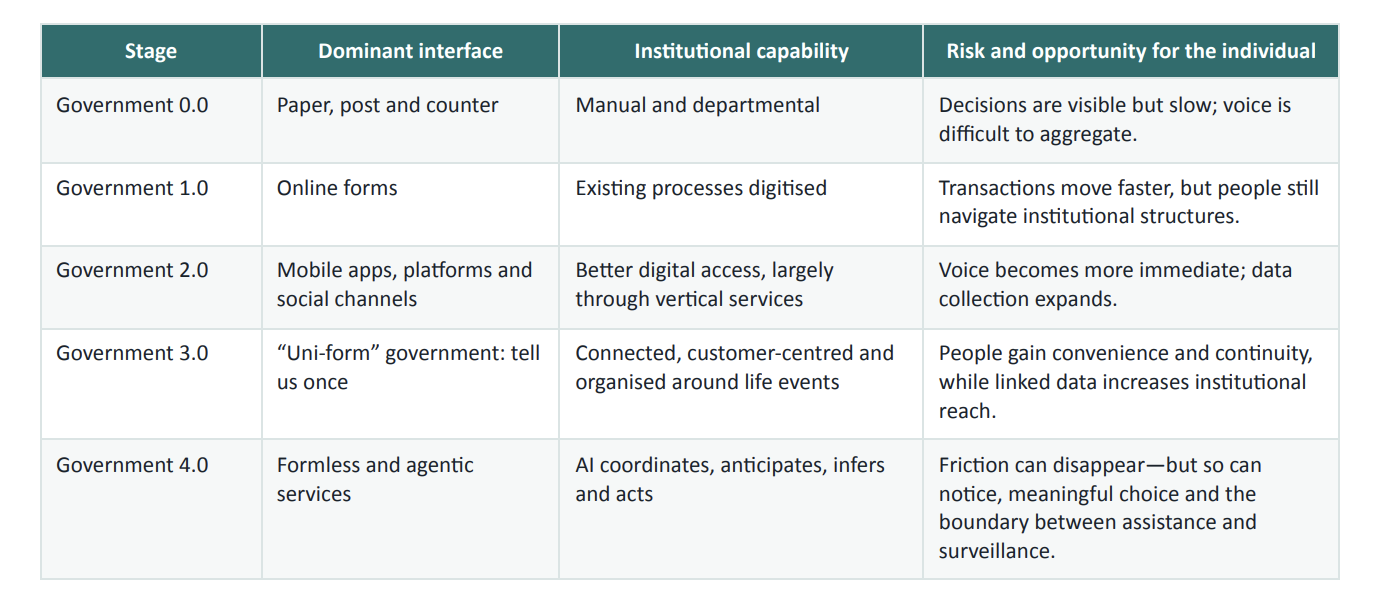
The Future Government Institute’s Citizen Empowerment Compact discussion paper describes five stages of government:
- Government 0.0: Services are delivered through paper, post and counters. Processes are manual and managed by separate departments.
- Government 1.0: Existing processes are digitised, often through online forms. Transactions become faster, but people still have to navigate government structures.
- Government 2.0: Mobile apps, platforms and social channels improve access, while government collects more data.
- Government 3.0: Services become more connected and organised around people’s needs. “Tell us once” approaches reduce repetition, but linked data also expands government’s reach.
- Government 4.0: AI helps coordinate services, anticipate needs, draw inferences and take action. Services can become more proactive and less dependent on forms.
These stages are not a neat timeline. Most governments operate across several of them at once. A person might use a connected digital service for one task and still need to post a paper form for another.
The important point is that each stage changes the relationship between government and the individual. As services become more connected and automated, the potential benefits grow. So does the need for people to understand and influence what happens to them.
The disappearing form
Forms are often seen as a problem to be eliminated. They can be repetitive, confusing and time-consuming.
But a form also creates a visible point of interaction. A person can see that a process has started, what information is being requested and, at least in principle, why.
In an AI-enabled service, that moment may be less visible. Information could move between systems, an AI tool could identify a possible need or risk, and a decision could be influenced before the person knows an assessment has taken place.
Consider a hypothetical example: an agency uses data from several services to identify someone who may need additional support. That could help the person receive assistance earlier. But if the information is outdated, or the system draws the wrong conclusion, the person needs a way to see what happened, correct the record and seek a review.
The same capability that makes a service more helpful can also make government’s actions harder to see. The question is not whether governments should pursue better services. It is how to do so without reducing people’s agency.
Four questions for AI-enabled government
FGI’s proposed Citizen Empowerment Compact offers a way to test whether people have meaningful power when automated systems shape important decisions.
It asks four questions:
- Visibility: Do I know AI is being used and what it is doing?
- Control: Can I control, correct or limit how my information is used?
- Contestability: Can I challenge the outcome and reach a human who can change it?
- Advocacy: Can I get effective help from someone acting in my interests?
These questions shift attention from whether an organisation has completed an internal AI assessment to what an affected person can actually do.
For example, a “human in the loop” may sound reassuring. But that safeguard only matters if the person reviewing a decision has the information, time and authority to change it.
Similarly, control does not mean a person can veto every lawful government action. It means there are practical rights and limits, such as access to information, correction, review and restrictions on how data is used.
Making rights usable
The Compact also raises a harder question: what if someone has the right to challenge a decision but cannot understand it or navigate the process?
This matters particularly for people facing language barriers, disability, financial stress or limited digital access. A formal right can be difficult to exercise without help.
The discussion paper proposes exploring a personal advocacy layer: an independently governed service that could help someone understand a decision, identify incorrect information and prepare a challenge.
This is a proposal for consultation, not a replacement for lawyers, human advocates or existing support. The paper also calls for accessible human and non-digital options to remain available.
What this means for public sector leaders
For teams designing or procuring AI-enabled services, the Compact suggests a practical starting point: look at the service from the affected person’s perspective.
Before a system goes live, ask:
- Will people know when AI has materially influenced a decision?
- Can they see and correct the information used?
- Can they reach someone with authority to reconsider the outcome?
- Is help available for people who cannot navigate the process alone?
The answers will vary depending on the service and the potential impact. A tool helping staff organise routine administration does not carry the same consequences as a system influencing someone’s income, healthcare or access to essential services.
The aim is not to slow useful innovation. It is to build the protections that allow people to benefit from it and trust it.
Help shape the Compact
Government 4.0 offers an opportunity to make public services more responsive and less burdensome. But removing friction should not mean removing the person from the process.
The Future Government Institute is inviting feedback on its proposed Citizen Empowerment Compact. Public consultation closes Friday 6 November 2026 at 5:00 pm AEDT.
Read the discussion paper and contribute to the consultation.



Help your peers
Share what you've learned with fellow public servants