
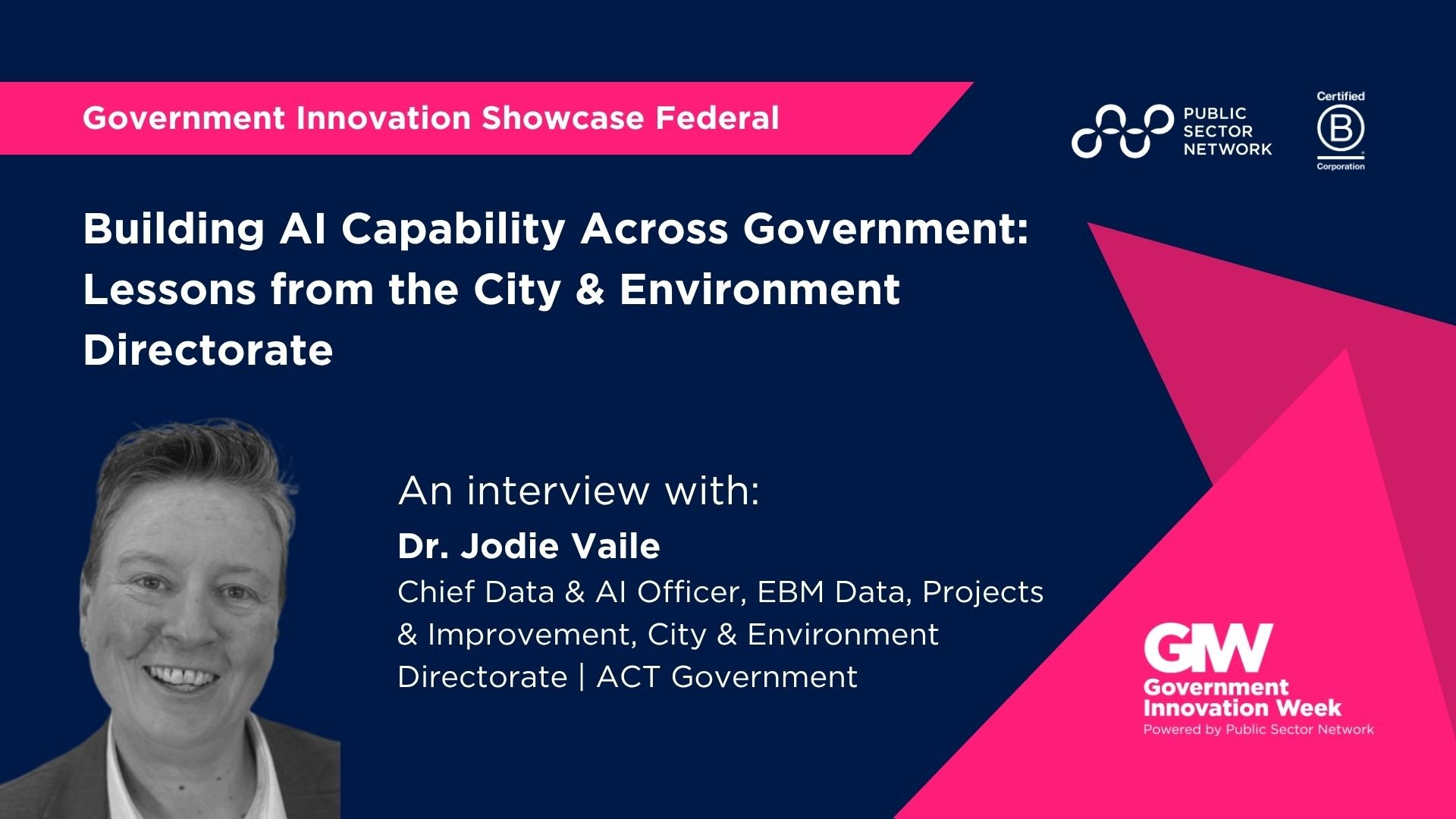
AI adoption across government is moving quickly, but sustainable adoption depends on much more than access to new tools.
For Dr. Jodie Vaile, Chief Data & AI Officer, EBM Data, Projects & Improvement, City & Environment Directorate | ACT Government, the real opportunity lies in helping public servants make better decisions, work more effectively and focus their expertise where it matters most.
Ahead of Government Innovation Showcase Federal 2026, Public Sector Network spoke with Jodie about the foundations needed to build AI capability across government, why data readiness matters, how organisations can move beyond perpetual pilots, and why AI adoption is ultimately as much a people challenge as a technology challenge.
Jodie will continue the conversation at the Showcase as part of the new ACT Digital Futures track. Her fireside chat, “Building AI Capability Across Government: Lessons from the City & Environment Directorate,” will explore how the Directorate is preparing its workforce for AI adoption and embedding AI into everyday operations. The session takes place from 1:10 PM to 1:30 PM on Thursday, 22 October, facilitated by Ash Rutledge, Executive Branch Manager Technology Services Branch, Digital Canberra, ACT Government.
Explore the event: Overview page | Agenda page | Registration page
Q&A with Dr. Jodie Vaile
Public Sector Network: What opportunities are you currently seeing for AI to improve the way government teams work, make decisions and deliver outcomes for the community?
Dr. Jodie Vaile:
One of the biggest misconceptions about AI is that it's primarily a technology discussion. For government, I think it's fundamentally a decision-making discussion.
The opportunities I'm most excited about are where AI helps our people spend less time in internal business processes and more time applying judgement, experience and expertise.
Across government we deal with enormous volumes of policy, operational, regulatory and service information. AI can help synthesise that information far more quickly, identify patterns we may not immediately see, and present insights in ways that support better decisions.
For CED, that means everything from improving approvals, planning and asset management decisions, to identifying risks earlier, strengthening regulatory outcomes, improving service delivery and helping staff navigate increasingly complex information environments.
Importantly, the goal isn't to automate government. The goal is to create better-informed, more capable public servants who are equipped to make better decisions for the community.
In many ways AI should support people who make decisions, not make the decisions for them. As the 1979 IBM training manual immortalised ‘A computer can never be held accountable therefore a computer must never make a management decision’.
Public Sector Network: When the City & Environment Directorate began building its AI capability, what were some of the first priorities you identified?
Dr. Jodie Vaile:
Perhaps the most important decision we made was not starting with technology.
Our early focus was establishing some very basic foundations: understanding what AI was already being used across the organisation, clarifying accountability, and creating a governance approach that would allow adoption to occur safely and consistently.
At the same time, we recognised that AI readiness is heavily dependent on data readiness. There is little value in applying sophisticated AI tools to poor quality, poorly understood or fragmented information.
That is why we've deliberately linked our Data Strategy and AI Strategy. One builds the foundation for the other.
We also recognised the importance of workforce capability. AI will only deliver value if people understand where it adds value, where its limitations are, and how to use it responsibly.
So the initial priorities were governance, visibility, data foundations and capability uplift. Once those foundations are in place, scaling adoption becomes much easier.
Public Sector Network: Introducing AI is as much about people and ways of working as it is about technology. How are you helping employees build the confidence and skills needed to use AI effectively?
Dr. Jodie Vaile:
In many ways, AI adoption is a change management challenge before it's a technology challenge. People don't build confidence through reading policies. They build confidence through hands-on, safe experience.
We're taking a very practical approach by exposing staff to approved tools, providing capability development opportunities, sharing realistic use cases, and encouraging experimentation within appropriate guardrails.
One of the lessons we've learned is that confidence grows when people can see how AI directly helps them solve a problem they're already facing. For some people that's drafting complex documents. For others it might be analysing information, preparing reports, researching issues or improving productivity.
We're also working hard to reinforce an important message: you don't need to become an AI specialist. You simply need enough literacy to understand what the tool is doing, where it can help, and where human judgement remains essential.
The objective isn't to create 3,500 AI experts. It's to create a workforce that understand when the use of an AI tool is appropriate and how it should be applied to the issue at hand.
Public Sector Network: What does responsible AI adoption look like in practice, particularly when government organisations are balancing innovation with privacy, governance, transparency and public trust?
Dr. Jodie Vaile:
For government, responsible AI starts with a very simple principle: just because something is technically possible does not automatically mean it should be done. Responsible adoption means thoroughly understanding what the problem is that needs to be solved. It requires an understanding of the purpose of a particular AI tool, understanding and mitigating the risks, understanding the data involved and ensuring accountability remains clear.
It means considering privacy, security, fairness, explainability and transparency from the beginning, not as an afterthought.
It also means recognising that existing obligations don't disappear when AI arrives. Our privacy obligations remain. Our governance obligations remain. Our legislative responsibilities remain.
The model we're pursuing continues to be both human-centric and risk-proportionate. Lower-risk use cases should have simpler pathways for adoption. Higher-risk use cases require greater scrutiny, assurance and oversight. Both types of case need to enshrine the ‘human-in-the-loop’ philosophy.
Ultimately, public trust is earned when people can see that AI is used transparently, responsibly and in ways that improve outcomes without compromising accountability.
Public Sector Network: How can organisations move beyond isolated experiments and begin embedding AI into everyday operations in a useful and sustainable way?
Dr. Jodie Vaile:
Many organisations become trapped in what I call perpetual pilot mode. They run interesting experiments, generate enthusiasm and then struggle to translate that into ongoing organisational capability. The difference is often centred around governance, operating models and leadership commitment.
To scale successfully, organisations need supported pathways that allow people to move from experimentation to operational use. They need approved tools, clear accountabilities, training, sustainable funding and executive visibility. They also need to focus on use cases that solve real business problems rather than adopting AI for its own sake.
We've deliberately focused on practical, repeatable and low-regret opportunities where AI can improve productivity, service delivery or decision support.
The organisations that succeed won't necessarily be the ones that move fastest. They'll be the ones that move deliberately and sustainably.
Public Sector Network: What role do data quality, evidence and organisational readiness play in determining whether an AI initiative is likely to succeed?
Dr. Jodie Vaile:
They're critical. AI is often described as transformative technology, but in reality AI tends to amplify existing strengths and weaknesses. If your data is fragmented, poorly governed or difficult to trust, AI usually makes those problems more visible rather than solving them. As dictum goes if the data is bad AI is simply a good way to make bad decisions faster.
Similarly, if an organisation lacks capability, clear ownership or executive sponsorship, introducing AI won't automatically address those issues.
That's why we're treating data maturity, governance maturity and workforce capability as prerequisites for sustainable AI adoption. Strong data quality improves confidence in outputs. Good governance improves trust. Organisational readiness improves adoption.
The technology matters, but the foundations matter more.
Public Sector Network: Building AI capability often requires collaboration between operational teams, data specialists, technology teams, policy areas and senior leaders. What have you learned about bringing these different groups together?
Dr. Jodie Vaile:
One of the most valuable lessons is that every group is usually solving a different part of the same problem. Operational teams understand the business challenge. Data teams understand the information. Technology teams understand the platforms. Policy and governance teams understand the obligations. Leaders understand the strategic outcomes.
We are lucky in City & Environment Directorate that we span all of these layers for the ACT. If any one of those groups is missing, the likelihood of success drops significantly.
We've found that the most productive conversations occur when people stop talking about AI as a technology and start talking about outcomes, risks and opportunities. Most disagreements disappear once everyone is focused on the same objective: delivering better outcomes while managing risk appropriately.
AI is ultimately a team sport. Success depends far more on collaboration than technical sophistication.
Public Sector Network: For government organisations that are still at an early stage of their AI journey, what practical steps can they take now to establish strong foundations and prepare their workforce for wider adoption?
Dr. Jodie Vaile:
I'd encourage organisations to keep it simple. Start by understanding where AI is already being used. Build basic AI literacy across your workforce. Establish clear governance and accountability arrangements. Assess whether your data foundations are fit for purpose. Identify a small number of practical, low-risk use cases that deliver meaningful value. Most importantly, create a safe environment for learning.
The biggest risk today is often not that organisations are moving too quickly. It's that AI adoption is occurring informally without visibility, support or governance. The organisations that will be in the strongest position two or three years from now are the ones building capability, governance and confidence today.
The future probably won't belong to organisations that use the most AI. It will belong to organisations that use AI deliberately, responsibly and effectively.
Building AI Capability Across Government
The themes Jodie raises in this Q&A will sit at the centre of her upcoming fireside chat at Government Innovation Showcase Federal 2026.
As part of the ACT Digital Futures track, “Building AI Capability Across Government: Lessons from the City & Environment Directorate” will look at the practical journey from workforce preparation through to embedding AI into everyday operations. The session is designed to give government organisations useful lessons on responsible adoption, capability building, decision-making and public outcomes.
The broader Showcase will bring together government leaders and practitioners on Thursday, 22 October 2026 for a full day focused on responsible AI adoption, digital transformation, data, workforce capability and the changing shape of public service delivery. Registration is free for government attendees.
For ACT Government employees, the dedicated ACT Digital Futures track also creates a chance to hear how local leaders are approaching AI, data, digital services and future-ready government, while still having access to the wider Federal Showcase program.
Government Innovation Showcase Federal 2026
Thursday, 22 October 2026 | Canberra
Complimentary registration for government
Explore the event: Overview page | Agenda page | Registration page



Help your peers
Share what you've learned with fellow public servants