
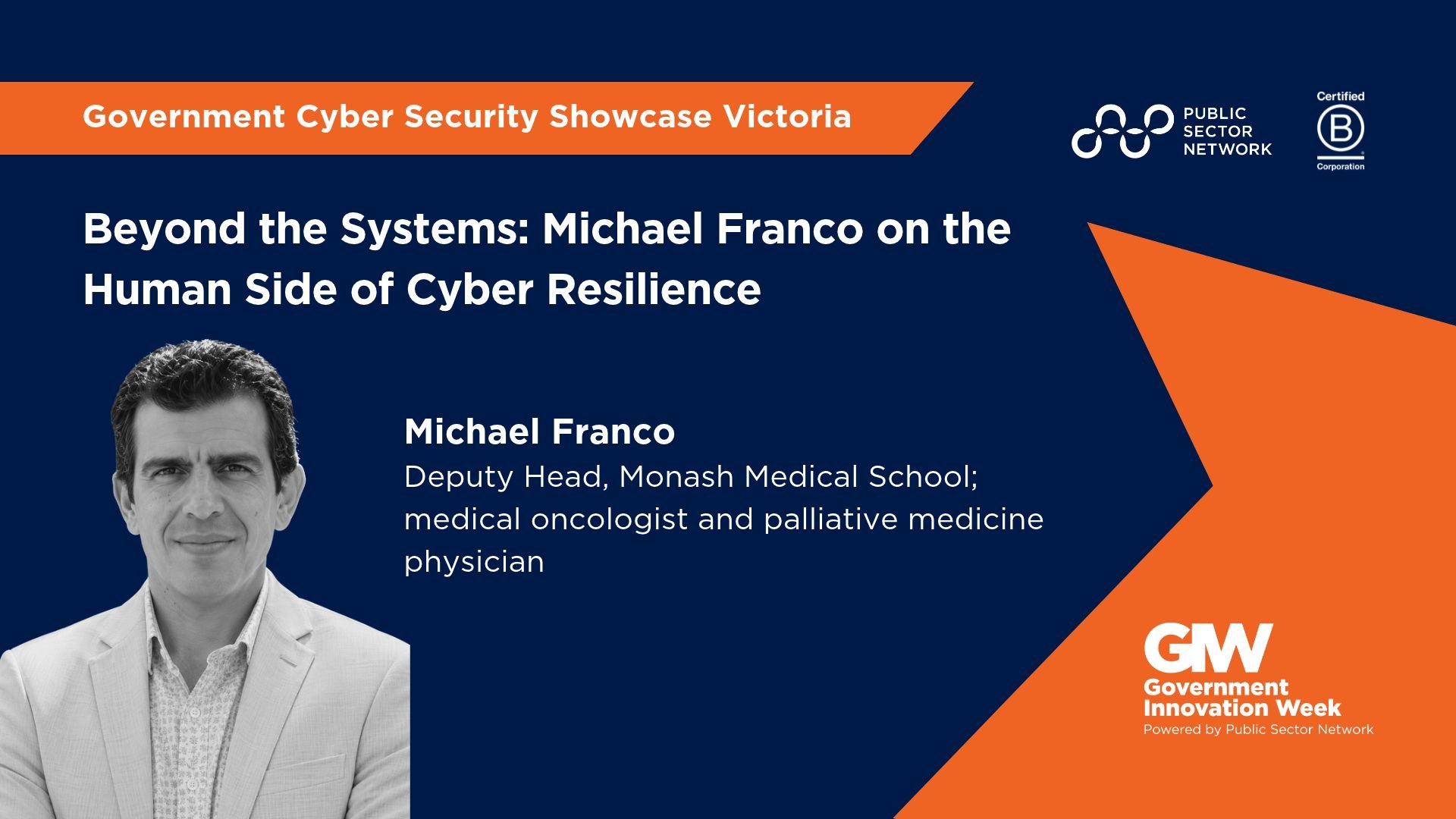
Cyber resilience depends on more than secure systems. It also relies on people knowing how to maintain essential services, raise concerns and make decisions when disruption occurs.
Ahead of his session at Government Cyber & Risk Showcase Victoria 2027, Michael Franco brings a healthcare perspective to these challenges. In this Q&A, the oncologist, palliative care physician and medical educator explores what government can learn from clinical practice about preparedness, trust and responding under pressure.
Explore the agenda | Complimentary registration for government
What changes at the intersection of healthcare, technology and education are shaping how you think about resilience?
Michael Franco: For me, the biggest shift is that digital health is now just health. AI scribes are part of everyday consultations, and virtual hospitals and remote monitoring are business as usual. Leaders must build resilience into how care is delivered, not bolt it on afterwards.
As someone who trains doctors, I also see the flip side. Paper is a resilience technology, and a growing number of junior doctors have never written on a paper medication chart. Downtime skills are quietly fading because the systems usually work.
Government faces the same question: who in your team could still process that payment or permit by hand if the system went down for three days?
What can government leaders learn from healthcare about maintaining trust and essential services when digital systems are disrupted?
Michael: I break bad news for a living. As an oncologist and palliative care physician, I use structured frameworks for those conversations, and they translate remarkably well to a cyber incident.
Three of the steps (I’ll cover the rest in the session):
Find out what people already know. Rumours and social media get there first. Respond to emotion before you give more information. Frightened people can’t absorb data. Finish with a plan and a time for the next update, and then meet that time.
Above all, be honest. Telling people hard news openly builds trust. Patients think, “If the doctor can tell me that, they’re not going to keep things from me.” People think the same way about government.
How can organisations build adaptability into their people and processes, rather than relying only on stronger technology?
Michael: Medicine has a great Australian example. In 1990, Liverpool Hospital in Sydney introduced the Medical Emergency Team (MET), with calling criteria simple enough for anyone to act on, including “if you’re worried about the patient”. A junior nurse with a bad feeling could summon a critical care team within minutes. MET calls are now business as usual in every Australian hospital and save thousands of lives every year.
What made it work wasn’t technology. It was a low threshold to escalate, a flat hierarchy and no blame for false alarms. Organisations could build a “cyber-MET” the same way. And if you never get false alarms, your threshold is too high.
What helps clinical, technology and organisational leaders develop a shared understanding of risk before a crisis occurs?
Michael: In palliative care, the worst time to work out what matters to someone is in the middle of a crisis. As I’ve often said about goals of care: have the conversation before the 2am phone call, not during it. Planning for the worst isn’t giving up, either. When we studied cancer inpatients with not-for-resuscitation orders at Austin Health, most active treatment continued.
Organisations need the same conversation about their critical services, with clinical, technology and organisational leaders in the same room. What matters most? What would we trade off? Who decides, and who steps in if they can’t be reached? When the crisis comes, the decisions will still be hard, but nobody will be facing the problem, or each other, for the first time.
Looking towards 2030, where could closer partnerships between universities, healthcare and government improve preparedness for emerging challenges?
Michael: In cancer care, no new drug reaches patients on promise alone. It’s tested in phases and monitored once it’s in use. AI tools across public services often skip all of that, with every agency testing the same tool separately, on real people.
By 2030, universities should be the “clinical trial sites” for public sector AI, testing tools in a sandbox (including how they fail and how they can be attacked) before supervised pilots and ongoing monitoring. Frontline services bring the real problems, government brings scale, and universities bring rigour and independence. Evaluate once and share widely, so a hospital chatbot tested at a university can inform the one a council is about to buy.
What is one idea or action you hope attendees take back to their organisations after the Government Cyber Security Showcase in Melbourne?
Michael: Every lesson here, from breaking bad news to the cyber-MET, comes back to one idea: resilience is built in conversations, not just systems.
So my one action is this: go back and have the conversation you’ve been putting off. Ask who could run your critical service by hand. Agree who decides when it fails. And invite your biggest sceptic into the room. If you can bring them with you, everyone will notice.
Technology will keep changing faster than any of us can predict. The organisations that come through a crisis well will be the ones whose people already trust each other.
Continue the conversation at Government Cyber & Risk Showcase Victoria 2027
Michael’s responses connect cyber and risk preparedness with practical organisational questions: can essential services continue, do people feel able to escalate concerns, and are decision-making responsibilities clear before an incident?
Hear more from Michael Franco at Government Cyber & Risk Showcase Victoria 2027 in Melbourne on 18 March, part of Government Innovation Week Victoria, 15–18 March. Explore the event program and plan your attendance.



Help your peers
Share what you've learned with fellow public servants